


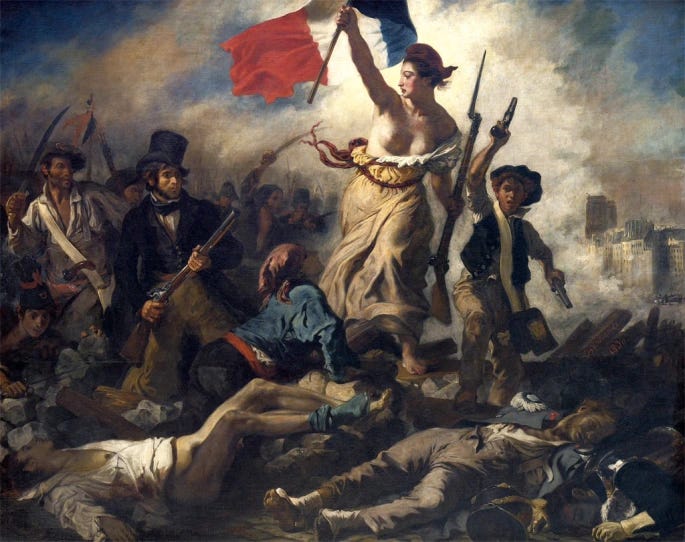
FRANCE. May Day.
As protests continue at home, Macron looks abroad, though not without trouble.
French unions prepared for a thirteenth day of demonstrations on 1 May, a historic day for worker protests. The moves follow Friday’s downgrade of France’s sovereign rating by Fitch, partly on account of ongoing social unrest.
INTELLIGENCE. Emmanuel Macron’s hard-won pension reforms last month appear increasingly pyrrhic as Paris faces more chaos on the street. And while France’s latest GDP growth was better than its EU peers – at 0.2% in the first quarter versus 0.1% for the Eurozone as a whole – its debt is rising and interest repayment is on track to form the budget’s largest item by 2027, the year France returns to the polls. With diminishing prospects of domestic compromise within that timeframe, Macron is increasingly focused on his international agenda, but here too he faces difficulty. After last year’s failed attempts at peace in Ukraine and the ousting of French troops from Mali, Macron’s attempts at leadership in Asia look equally ham-fisted, with comments on Taiwan only irritating allies.
FOR BUSINESS. Macron’s foreign policy is ambitious, but lacks finesse. France will remain a geopolitical price-taker.
TURKEY. SYRIA. Silver bullet.
A timely killing may help Erdogan retain his presidency. Either way, it proves Turkey’s geopolitical potency.
Turkish President Erdogan said on Sunday his country’s spies had assassinated Islamic State’s leader in Syria. Erdogan returned to campaigning after a health scare on Tuesday. Turks head to the polls on 14 May.
INTELLIGENCE. The claimed death of suspected IS boss Abu Hussein al-Qurayshi comes at a good time for Recep Tayyip Erdogan, who otherwise faces an uphill battle to remain Turkey’s president after years of high inflation and a botched response to February’s earthquakes. In a rally on Sunday, Erdogan invoked the spectre of terrorism and lauded Turkey’s rise as a regional power. Against a patchy economic record, bolstering Turkey’s prestige may be Erdogan’s trump card. If not, Erdogan’s key rival, Kemal Kilicdaroglu, is in any case likely to continue Erdogan’s pugnacious “neo-Ottoman” foreign policy. Beyond bolstering national power, balancing Russia and the West has lifted Turkey’s role in regional trade. Boldness in Syria, meanwhile, has given Ankara an outsized role in the Middle East.
FOR BUSINESS. Erdogan trails in the polls, but don’t count him out, nor expect major changes to Turkey’s ambitions.
PHILIPPINES. UNITED STATES. Hedging bets.
A visit to the White House comes amid anti-war demonstrations and a near-miss in the South China Sea.
President Marcos travelled to Washington on Sunday as his opposition protested Manila’s growing US ties. The US State Department on Saturday condemned as “intimidation” a near collision of Philippine and Chinese coastguard ships.
INTELLIGENCE. Since his election a year ago, Bongbong Marcos has reprioritised US ties, which became strained under predecessor Rodrigo Duterte. Marcos’s visit to Washington will celebrate recent wargames and an earlier agreement to host US forces at four additional Philippine bases, but not everyone is happy, including the local governors for three of those bases. Despite a dispute over islands in the South China Sea, Manila’s business community wants to retain close ties to China, the Philippines’ largest trading partner, and which hosted Marcos in January. Marcos has so far ducked questions on support for the US should conflict break out over Taiwan, less than 200km to the north. Until then, military cooperation may not be enough to guarantee Manila’s political allegiance.
FOR BUSINESS. Manila is leaning to Washington, but the alliance isn’t ironclad. Beijing will wield carrots and sticks.
TAIWAN. PARAGUAY. Friends forever?
One of Taipei’s few remaining allies holds for now, with Paraguay’s conservative government re-elected.
Santiago Pena was re-elected as Paraguay’s president on Sunday night with a 16-point lead over his centre-left rival. Pena has committed to continue recognising Taiwan, despite pressure from exporters eyeing the Chinese market.
INTELLIGENCE. The largest of the thirteen countries that continue to recognise Taiwan, events in Paraguay are as keenly watched in Asia as in the Americas. For now, diplomatic recognition will continue, but domestic and foreign pressure to switch to Beijing will only grow as Paraguay’s influential beef and soya farmers eye China’s much larger market. Commodity exports from Latin America to China have surged in recent years, with neighbouring Brazil in particular leaving Paraguay in the dust. Brazil’s president last month led a 200-strong business delegation to Beijing, dominated by the agricultural sector. Once overshadowed by the US, Latin America is increasingly being drawn into China’s economic orbit. Preventing this from becoming a strategic orbit will become a key challenge for Washington.
FOR BUSINESS. Taiwan has won a reprieve, but the trend is still against it as China’s influence continues to rise.
SUDAN. Just getting started.
A ceasefire won’t hold until either of Sudan’s rival militaries – and their foreign backers – gain the advantage.
A senior envoy would head to Sudan, UN Secretary-General Guterres said Sunday, as fighting continued in Khartoum despite the extension of a fragile truce between the Sudanese Army and the paramilitary Rapid Support Forces.
INTELLIGENCE. Since fighting began in April, battles between Sudan’s military and the Rapid Support Forces are escalating into a civil war. Awkward bedfellows run by rival generals, the military and the RSF are roughly matched in manpower and brutality, the latter honed in South Sudan and Darfur respectively. Where the upper hand may lie is the strength of foreign backing, with the military so far enjoying greater leverage through its support from neighbouring Egypt. The RSF, on the other hand, derives backing from the Libyan National Army – itself in charge of only half its country – and Russia’s Wagner Group, bogged down in Ukraine. Ethiopia may prove to be a game changer, seeing an ongoing conflict as a way to distract rival Egypt and confirm a growing regional dominance.
FOR BUSINESS. Neither of Sudan’s competing factions will likely submit unless forced to by their foreign backers.
UKRAINE. RUSSIA. Internal conflict.
Ahead of Ukraine’s planned counteroffensive, Putin must also face off battles inside the Kremlin.
Ukrainian and Russian forces both claimed progress in the battle for Bakhmut on Sunday. Separately, Russia announced the replacement of its military logistics chief, seven months after his appointment.
INTELLIGENCE. As Kyiv prepares for its counteroffensive, an uneasy stalemate along Ukraine’s east continues, with forces ground down in the largely flattened city of Bakhmut. Excepting major strategic surprise, a long war of attrition is likely to continue until a negotiated settlement is reached. The sacking of logistics commander Mikhail Mizintsev was not explained, but can be seen in context of a broader rivalry within Vladimir Putin’s inner circle, where senior leaders have been quickly and inexplicably replaced. As he fails to land a decisive advantage and Ukrainian drones inflict casualties within Russian territory, a risk for Putin is the emergence of rival powerbrokers. Keeping everyone off balance – including the head of the paramilitary Wagner Group, Yevgeny Prigozhin – will remain a preoccupation.
FOR BUSINESS. Putin remains popular and sanctions have had limited impact, but watch for signs of Kremlin discord.