

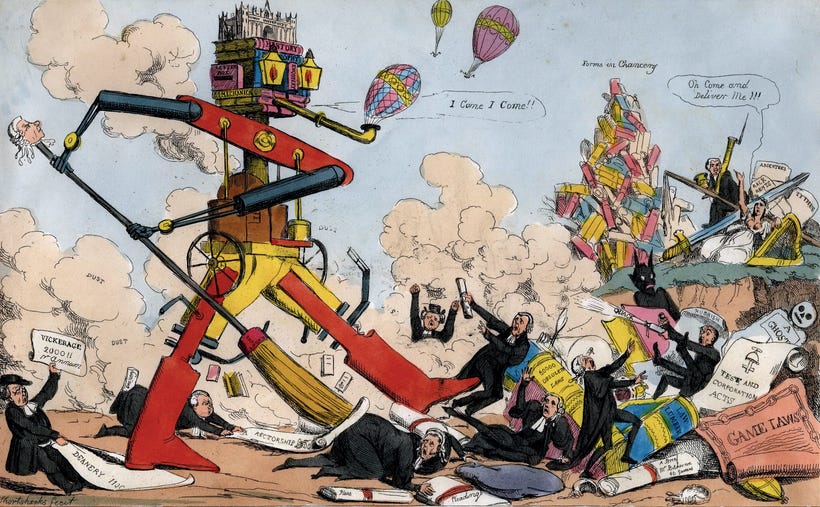

ARTIFICIAL INTELLIGENCE. I, Diplomat.
The UN Security Council examines the threats of AI.
The UK on Tuesday said it would make artificial intelligence the centre of its July presidency of the UN Security Council. The UN announced plans for an AI advisory board and said it would welcome an international regulatory body.
INTELLIGENCE. Artificial intelligence is already transforming society, industry and military power. Countries that lead technologically will lead economically, making AI a strategic resource. The US is currently in front, but China is catching up. Others are hoping a neutral umpire will ensure fair play. Today’s AI could lead to fully autonomous weapons and accelerate nuclear proliferation. Tomorrow’s ‘general’ AI, if achieved, could pose unfathomable risks.
FOR BUSINESS. Debates at the UN could be as wasteful as a day on ChatGPT. Geopolitical divisions – particularly between the US and China – will stymie the drawing of international rules. A fragmented approach is more likely. Europe has already begun regulating. The US will remain laissez-faire. Authoritarian states will want to focus on military applications. And AI algorithms, hardware, data and talent will become the object of great power competition.
ISRAEL. Violence begets violence.
Israeli forces withdraw from the Palestinian city of Jenin.
The Israel Defense Forces withdrew from Jenin on Wednesday, after their largest West Bank operation in years. Hours later, militants in the Gaza Strip fired five rockets toward Israel and seven were injured in a car ramming in Tel Aviv.
INTELLIGENCE. Israel’s operation, aimed at destroying militant infrastructure in the Jenin refugee camp, was over almost as soon as it began. Despite the withdrawal, escalation cannot be ruled out. Palestinian reprisals, already underway, will likely continue. Israel and Palestine may be entering an even more violent phase of their long conflict. Outside powers still insist on a two-state solution, but no real attempts to achieve one have been made since 2014.
FOR BUSINESS. The threat of more frequent terrorist attacks will hurt Israeli businesses already reeling from the mass protests and uncertainty that have marked Netanyahu’s coalition government. But the real risk comes from neighbouring countries getting dragged into the conflict. Iranian proxies in Lebanon and Syria may strike, if they judge the IDF will be sufficiently distracted. China, which wants good relations with all parties, may seek involvement too.
Written by former diplomats and industry specialists, Geopolitical Dispatch gives you the global intelligence for business and investing you won’t find anywhere else.
TURKEY. EGYPT. GREECE. Turkish delight.
Ankara restores ties with Cairo and gets positive signs from Athens.
Turkey and Egypt appointed ambassadors on Tuesday after eight months of talks. Greece’s new foreign minister said on Tuesday that Athens was ready to begin talks with Ankara on ending their long-standing maritime boundary dispute.
INTELLIGENCE. Ankara severed diplomatic relations with Cairo in 2013 when Abdel Fattah el-Sisi launched a coup against the country’s democratically-elected and Turkey-aligned leader, Mohammed Morsi. Over the past decade, Erdogan and Sisi went beyond trading barbs, taking opposing sides over hydrocarbons in the Mediterranean, the conflict in Libya, the war in Syria, the crisis between Armenia and Azerbaijan, and Qatar’s diplomatic spats in the Gulf.
FOR BUSINESS. Turkey’s olive branch to Egypt is part of a broader push to restore strained relations with other regional powers, including the UAE, Israel and Saudi Arabia. Turkey’s ally Qatar has done the same in recent years, signing agreements with Saudi Arabia, the UAE and Bahrain. Resolving the decades-long border dispute with Greece will take more time. As with Iran, greater Chinese involvement in the region could be having a stabilising effect.
LATIN AMERICA. Negotiation and coin.
Lula eyes trade deals and a regional currency.
Brazil assumed the presidency on Tuesday of the Southern Common Market (Mercosur). President Lula da Silva promised to conclude a trade agreement with the EU and promote the creation of a common currency for Latin America.
INTELLIGENCE. The EU-Mercosur trade pact has been on ice since 2019. Officially because Europe objected to Brazil’s felling of the Amazon. Unofficially because French farmers feared competition from Brazilian beef. Lula, with better environmental credentials than his predecessor, could clinch the deal, but a lot depends on how European farmers (and voters) feel amid the pressures of cheap Ukrainian grain and expensive climate adjustments.
FOR BUSINESS. A deal with Europe would be a major win for Latin businesses. But more important is breaking down intra-regional trade barriers. Logistics and cross-border trade are poor, as are efforts at Latin American integration. Lula has ambitions to turn Mercosur’s free-ish trade zone into a currency union. This will be even harder to achieve. The per capita GDP spread between the region’s richest and poorest countries is twice that of the Eurozone.
With the brevity of a media digest, but the depth of an intelligence assessment, Daily Assessment goes beyond the news to outline the implications.
EURASIA. Putin on a show.
Russia parades at the Shanghai Cooperation Organization.
Narendra Modi hosted an online meeting on Tuesday with the leaders of China, Russia and the Central Asian republics. Vladimir Putin used his first international appearance since the Wagner mutiny to thank leaders for their support.
INTELLIGENCE. The China-led grouping, aimed at countering Western influence, is becoming more influential. Originally composed of China, Russia, Kazakhstan, Kyrgyzstan, Tajikistan and Uzbekistan, the group expanded to include India and Pakistan in 2017. Iran joined this week. Afghanistan, Belarus and Mongolia are observers. While often dismissed as neither a security alliance nor a trade bloc, Xi and Putin signalled they want the SCO to do more.
FOR BUSINESS. For China and Russia, the SCO is a convenient way to promote their increasingly aligned interests. But little else unites the group. China and India have had a three-year border standoff. India and Pakistan are barely on speaking terms. Kazakhstan is edging away from Russia. Putin has pitched economic integration. But the ‘stans, watching Ukraine, worried about sanctions, and wary of their larger neighbours, want to keep their options open.
CLIMATE. Sailing for net zero.
The International Maritime Organization debates emission targets.
Member states meeting at the International Maritime Organization this week are hoping to reach agreement on a more ambitious greenhouse gas emissions strategy for international shipping, aiming for net zero emissions by 2050.
INTELLIGENCE. IMO members will likely set a more ambitious target than the present goal of a 50% reduction by 2050. But agreement is not pre-ordained, nor is industry compliance or implementation. China, India and Saudi Arabia have previously resisted mandating ambitious goals. And governments pushing for a global shipping levy to fund climate action are yet convince the US, a middle-ranked merchant navy, but the world’s biggest importer.
FOR BUSINESS. Agreeing to completely decarbonise shipping could be the biggest advance against climate change since the Paris Agreement. The industry carries over 80% of world trade and emits more than 3% of manmade CO2 emissions. Western corporates, like Trafigura and Maersk, have not only welcomed proposals but set their own more ambitious goals. The question is not ambition, but design: standards will sail through, but a tax may run aground.
Emailed each weekday at 5am Eastern (9am GMT), Daily Assessment gives you the strategic framing and situational awareness to stay ahead in a changing world.