

In addition to our daily risk monitoring brief, the team behind Geopolitical Dispatch also provides advice, risk audits, scenario planning, executive masterclasses and board briefings among other services. Click here to get in touch.
CHINA. Intelligence test
Beijing wants to fix its spy problem.
Britain charged two men Monday with spying for China, as Germany arrested three. China announced the formation of the Information Support Force Friday, a new branch of the People's Liberation Army reporting directly to Xi Jinping.
INTELLIGENCE. Judging from the frequent disruptions of alleged Chinese spy networks in the West, Beijing either has an enormous collection apparatus, an amateur one, or both. The creation of a new intelligence service of the PLA seems an attempt to remedy this but as a direct arm of the Central Military Commission, which Xi Jinping chairs, and presumably duplicative of the CMC's Joint Staff Intelligence Bureau, it may only serve to scramble the picture further.
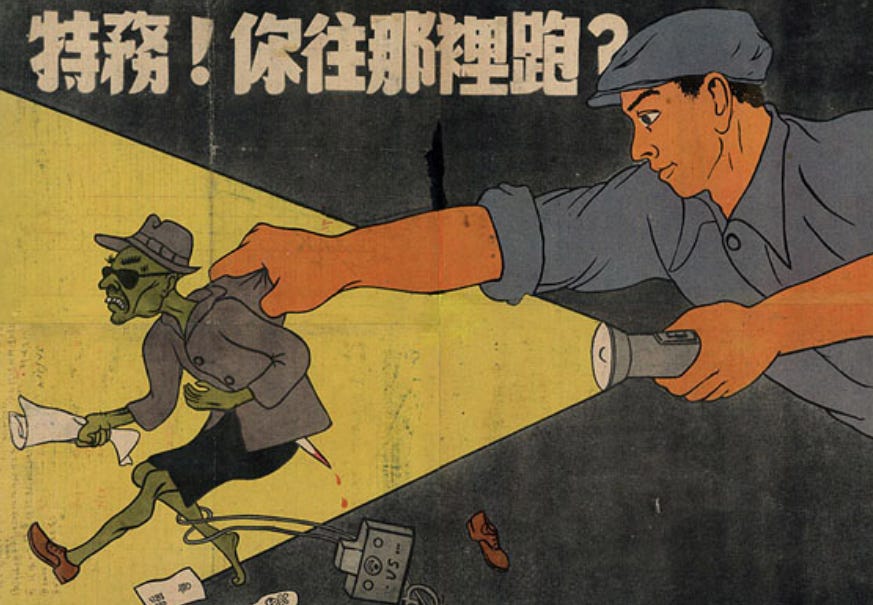
FOR BUSINESS. China's civilian intelligence agency, the Ministry of State Security, reports to the parallel National Security Commission of the Chinese Communist Party, which Xi also chairs. It is not known how the Information Support Force will work with the MSS, but it is clear Beijing is prioritising espionage as a tool of authority. On 15 April, National Security Education Day, the MSS launched a new publicity campaign, saying foreign spies are "everywhere".
Geopolitical Strategy is the advisory firm behind Geopolitical Dispatch. Our partners are former diplomats with vast experience in international affairs, risk management, and public affairs. We help businesses and investors to understand geopolitical developments and their impacts with clarity and concision.
ISRAEL. PALESTINE. Ain’t Passover ‘til it’s over
Holidays highlight the tensions over the war in Gaza.
Protesters burned a symbolic Seder table outside the home of Benjamin Netanyahu Monday, calling for the release of hostages. US synagogues increased security after a week of antisemitic protests, including on Ivy League campuses.
INTELLIGENCE. Marking the escape of the Jews to Israel, Passover is supposed to be a celebration, but with 129 hostages still in Gaza few will be cheerful (Shin Bet Monday denied a report only 40 were alive). The mood is also grim in Palestine with expectations of an assault on Rafah in the coming days. IDF troops have returned to nearby Khan Younis. Violence has risen in the West Bank. In Israel’s north, exchanges have also escalated with Hezbollah.
FOR BUSINESS. After last week’s tit-for-tat with Iran, it’s unlikely Tehran will move beyond its proxies. Theories are circulating the IDF initiated direct attacks in order to foreclose Tehran’s options ahead of Rafah. Less charitable interpretations are that it was to distract the US ahead of Congress’s vote on military aid. Those theories were fuelled Monday with the resignation of IDF intelligence chief Aharon Haliva – the first senior official to quit since 7 October.
SYRIA. IRAQ. Path of least resistance
Iran’s proxies resume the fight.
Shia militia Kataib Hezbollah denied Monday it was behind Saturday’s strike on a US outpost in Syria. Regional media attributed the attack to a lack of progress in Washington's promised withdrawal from Iraq, and its support to Israel.
INTELLIGENCE. Iraq-based Kataib Hezbollah called a truce with the US in January after others in the Iran-backed “Axis of Resistance” attacked a US base in Jordan, killing three. The Israel-Iran strikes have seemingly upended this respite, but things were hardly quiet in the interim for US-backed militias like the Kurdish Syrian Democratic Forces, or pro-Turkish groups such as the Syrian National Coalition, who continue to fight Damascus and, indirectly, Tehran.
FOR BUSINESS. The kaleidoscope got another shake Monday when Recep Tayyip Erdogan made his first trip to Baghdad since 2011. A deal with Iraq’s Kurds (now even less aligned with their kin in Syria, let alone Turkey) has reinvigorated hopes for trade, as well as fears Turkey, not Iran or Saudi Arabia (let alone Israel or the US), may ultimately emerge as the Middle East's hegemon, as it was before 1922. Erdogan met Hamas’s leaders on Saturday.
Emailed each weekday at 5am Eastern (9am GMT), Geopolitical Dispatch goes beyond the news to outline the implications. With the brevity of a media digest, but the depth of an intelligence assessment, Geopolitical Dispatch gives you the strategic framing and situational awareness to stay ahead in a changing world.
BELGIUM. Belang together
The Flemish far-right gains ground.
Flemish nationalist party Vlaams Belang polled first in Flanders according to Monday's “Grand Baromètre” survey, with 27.4% of voting intentions in Belgium's 9 June elections, which will coincide with the ballot for the European Parliament.
INTELLIGENCE. VB is enjoying a sharp rise from 18.65% in 2019, and 11.95% nationally. The mainstream Belgian Socialists and Mouvement Réformateur continue to dominate in French-speaking Wallonia, but VB's francophone equivalent, Chez Nous, accounts for 10% of intentions there and in Brussels, up from 0.3% last year. The growing popularity of these groups has been mirrored recently in Germany, Portugal, and the Netherlands among others.
FOR BUSINESS. The far-right’s ascendance in the heart of Europe was given a free kick last week when local mayors in Brussels attempted to stop a meeting of the National Conservatism Conference involving Hungary's Viktor Orban and Farnborough's Nigel Farage. A sense of Trump-like persecution would be a gift to the European far-right, which otherwise lacks a unifying theme beyond national identity and remains split between two blocs in the EU parliament.
NAMIBIA. Elephant in the room
Estimates of a Guyana-sized oil find.
Shares in Portugal's Galp Energia rose 21% Monday after the company said it had successfully tested a well in the Mopane field offshore Namibia, which is estimated to contain around 10 billion barrels of oil equivalent or higher.
INTELLIGENCE. Guyana is estimated to have 11 billion barrels. Brazil and Algeria are estimated to have 13 billion and 12 billion respectively. Angola, to Namibia's immediate north is thought to have 7.8 billion, though it may be higher. This is all relatively meaningless if commercial extraction cannot occur. Venezuela has the world’s largest reserves at 304 billion but ekes out daily production less than that of Argentina, with 2.5 billion, or Colombia, with 2 billion.
FOR BUSINESS. Namibia should be well-placed to develop an oil sector. Its democracy is stable, its infrastructure relatively good, and its diamond and uranium industries have largely escaped the resource curse. Yet countries once considered well-governed, like nearby Zimbabwe (on its sixth currency since 2008), can decline. Namibia is presently engaged in a reparations spat with Germany and has joined neighbouring Botswana in a dispute over elephant culling.