

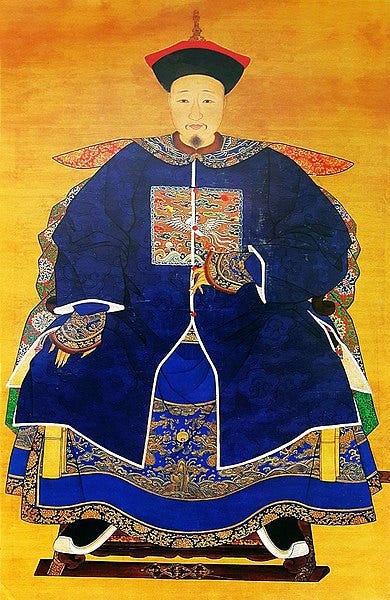
CHINA. Mandarin collared.
Qin Gang's removal is likelier about discipline than diplomacy.
Beijing re-appointed Wang Yi as foreign minister on Tuesday, removing Qin Gang after an unexplained month-long absence. Wang, who was Qin's predecessor before a promotion to the Politburo, is in South Africa for a BRICS meeting..
INTELLIGENCE. Qin, a former ambassador to the US and Xi Jinping protégé, was barely a year into the job. Analysts have suggested his removal was due to a change in policy, but it was more likely due to alleged personal indiscretions. Following rumours of Qin’s affair with a television personality, his removal is likely a message that nobody is immune from Xi’s ‘tigers and flies’ anti-corruption drive, which has so far caught more than 2 million officials.
FOR BUSINESS. Xi has created a disciplined state but at the expense of growth. Personal connections, which long greased China’s economic wheels, have been replaced by bureaucratic process. Officials are more concerned with avoiding risk than hitting targets. Innovation is less tolerated. Also on Tuesday, Beijing named Pan Gongsheng as China’s central bank governor. Reflecting the cautious spirit of the times, he had an 11-year apprenticeship as deputy.
RUSSIA. Boyar unbound.
Sergei Shoigu visits Pyongyang.
Russia’s defence minister arrived in North Korea on Tuesday and will attend Pyongyang's “Victory Day” celebrations, marking the 70th anniversary of the Korean Armistice. Shoigu has kept a low profile since the 23 June Wagner mutiny.
INTELLIGENCE. Shoigu’s appearance in the DPRK is a rebuke to Wagner boss Yevgeny Prigozhin, who blamed Russia’s failures in Ukraine on the minister and his apparatchiks. Yet sadly for Prigozhin and other ultra-nationalists – like the recently arrested war blogger and Donetsk separatist Igor Girkin – Shoigu retains Putin’s trust. An outlier in the Kremlin, Shoigu is an ethnic Tuvan from the Mongolian frontier and was once seen as a successor to Yeltsin.
FOR BUSINESS. Shoigu’s visit to the DPRK is a coming out for a minister who has scored some needed wins in recent weeks. Ukraine’s counter-offensive has stalled. Monthly munition production now exceeds the entire volume for 2022 (in contrast to the West). Cutting-edge US drones have been downed over Ukraine and another damaged over Syria. Shoigu’s visit may also come to symbolise Russia’s revised aims in Ukraine: a frozen conflict and divided country.
Written by former diplomats and industry specialists, Geopolitical Dispatch gives you the global intelligence for business and investing you won’t find anywhere else.
UNITED STATES. National interests.
Debates on what’s ‘woke’ risk leaving a system broke.
An almost unanimous Senate on Tuesday backed an amendment to the National Defense Authorization Act requiring firms to notify of Chinese investment in semiconductors and AI. A final form of the act is expected later this year.
INTELLIGENCE. A hardening stance on China is one of the remaining areas of consensus in Washington, with the usually bipartisan NDAA – expected to appropriate a record $886 billion – delayed by the culture wars. Senate and House versions of the bill are at odds, with the latter containing amendments on abortion, transgender medical costs and diversity programs that won’t survive the Senate. Such issues have also delayed a range of key appointments.
FOR BUSINESS. Brinkmanship is a feature of politics and there is much to dislike about Pentagon budgets, but congressional games risk diminishing the military’s credibility. While it remains Americans’ most trusted institution (Congress is the least), polling by the Reagan Foundation shows high trust in the armed forces has fallen from 70% to 48% since 2018. Firms are used to polarisation on ESG and culture, but the military can ill afford to be dragged in.
UNITED STATES. FRANCE. Desert island risks.
The Pacific is not just for tourists.
Antony Blinken opened a US embassy in Tonga on Wednesday, warning of “predatory” Chinese activities. The same day, Emmanuel Macron met with local leaders in New Caledonia, ahead of a visit to Vanuatu and Papua New Guinea.
INTELLIGENCE. The US and France are shoring up their influence in the region, worried about the potential for Beijing, among other things, to complicate Pacific access in the event of a war. But small island states are not just great power pawns. Fiji last month refused Taiwan diplomatic privileges but also said it would rethink a police deal with China. In the Indian Ocean, the Maldives has exercised its agency by re-exporting $53 million in microchips to Russia.
FOR BUSINESS. Island nations can be tiny, but sovereignty is a big deal. Microstates like Tuvalu are at the forefront of international negotiations on climate change. The Marshall Islands has a ship registry of 81 million gross tonnes. Kiribati, population 121,000, has an exclusive economic zone bigger than India's landmass. Last week, failed crypto entrepreneur Sam Bankman-Fried was accused in court of trying to buy Nauru. They allegedly said it was not for sale
With the brevity of a media digest, but the depth of an intelligence assessment, Daily Assessment goes beyond the news to outline the implications.
GREECE. TURKEY. Forgiven in fire.
Erdogan won’t let a crisis go to waste.
Turkish aircraft helped battle fires in Greece on Tuesday. Recep Tayyip Erdogan said Turkey would do “whatever it takes” to assist. Monday marked the 100th anniversary of the Treaty of Lausanne, which settled Turkey's borders.
INTELLIGENCE. Recent years have seen a deterioration in Turkey’s historically fractious relationship with Greece, but since Erdogan was re-elected in May, the mood has shifted. After Athens sent aid to Turkey following earthquakes in February, Ankara is repaying the favour during a torrid summer, despite several wildfires of its own. Turkey has also been mending ties with Israel and last week, Erdogan expressed openness to a meeting with his Syrian counterpart.
FOR BUSINESS. Erdogan is on a charm offensive, but per his approach to Sweden's NATO accession, he's not doing it out of bonhomie. Turkey wants to reduce security costs and increase trade opportunities by mending ties with its neighbours. For Greece, the dividends of peace could be as lucrative, from fewer refugees at the border to certainty on sea boundaries and gas projects in the Mediterranean. The question now for Turkey is what to do about Russia.
ECUADOR. PERU. Pacific grim.
Violence afflicts more parts of Latin America.
Prison riots in Ecuador killed 31 on Tuesday amid gang violence that saw 120 officers taken hostage across six jails. Demonstrations began in Peru on 19 July. Protesters vowed 10 days of action until Independence Day on 28 July.
INTELLIGENCE. High inflation and persistent income inequality have driven discontent across Latin America. For Peru and Ecuador, however, a series of peace deals between militants and the government of neighbouring Colombia have pushed organised crime across the border, unsettling the informal economy and fuelling violence. Peru also suffers from deep political polarisation, including in its mining belt, where protests have led to a state of emergency.
FOR BUSINESS.There are no easy fixes to South America’s societal woes. Populists from the left are replaced by authoritarians from the right. Firms must price in security and contingencies when considering investments. Cheap labour costs are outweighed by complex regulations and low productivity. The region’s economies, unsurprisingly, have lagged their potential, with a few exceptions. Ecuador faces elections next month. Peru faces a shock recession.
Emailed each weekday at 5am Eastern (9am GMT), Daily Assessment gives you the strategic framing and situational awareness to stay ahead in a changing world.