

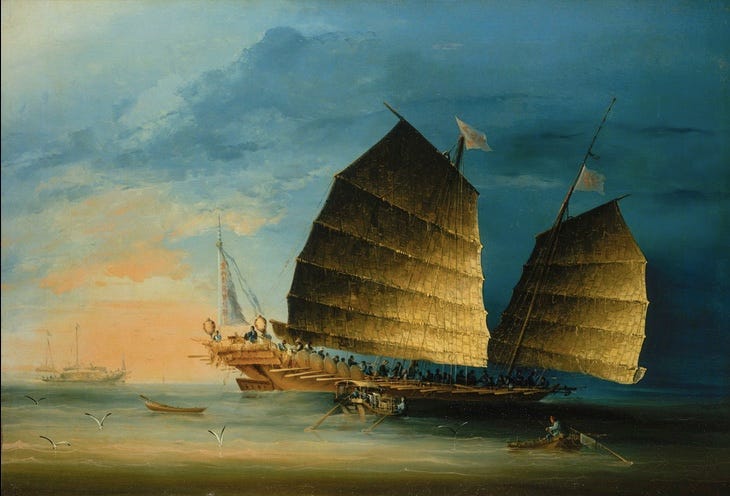

CHINA. MARITIME SECURITY. All at sea.
Maritime tensions are rising across East Asia.
China and the Association of Southeast Asian Nations agreed on Thursday to hasten talks on a code of conduct for the South China Sea. China drove away a Japanese ship that had entered “territorial waters”, state media said on Thursday.
INTELLIGENCE. Beijing continues to militarise features in the South China Sea while keeping rival claimants tied up in endless talks. The US and its allies are disrupting these tactics, but China is hitting back, whether in the Philippines, where the US is currently undertaking war games, the Taiwan Strait, where Beijing on Thursday protested a US Navy reconnaissance flight, or the East China Sea, where the US has major bases and tensions with Japan are focused.
FOR BUSINESS. Disputes around China’s maritime approaches aren’t new, but Western firms have been flummoxed in recent months by GPS jammers impacting airlines and, last week, Vietnam’s banning of Warner’s Barbie movie due to a map depicting Beijing’s South China Sea claim. Expect more drama as these wrangles internationalise. India recently backed the Philippines on its South China Sea claim. France wants to sell Manila cutting-edge submarines.
CHINA. UNITED STATES. We need to talk.
Dialogue gets more important as relations get more difficult.
Secretary of State Antony Blinken met China's top diplomat on Thursday, a day after Microsoft accused Chinese actors of hacking US government emails, including those of Commerce Secretary Gina Raimondo. Beijing denied the claims.
INTELLIGENCE. Congressional calls to cut off communication are misguided. Whether it’s spy balloons or cyber espionage, diplomacy keeps channels open. Washington signalled as much this week, inviting China’s ambassador for a rare briefing at the Pentagon. Beijing, on the other hand, has frozen senior military talks on account of US sanctions. Should an accident occur, picking up the phone can be the difference between crisis and war.
FOR BUSINESS. Poor diplomatic relations are showing up in the economy. Chinese customs data on Thursday showed an 8.4% decline in US-China trade for the year to June. US Census Bureau data showed Mexico and Canada overtaking China in US imports for May. Russia, on the other hand, has seen trade with China soar 40.6% in the first half of 2023. The bifurcating pattern looks set to continue amid attempts on both sides to re-shore supply chains.
Written by former diplomats and industry specialists, Geopolitical Dispatch gives you the global intelligence for business and investing you won’t find anywhere else.
UKRAINE. RUSSIA. Diversion territory.
Distraction proliferates against a military deadlock.
A Russian politician released a recording on Wednesday of an army general criticising the Kremlin for “decapitating” the military. Reporter Seymour Hersh said on Thursday the US offered Turkey $11 billion to ratify Sweden’s NATO bid.
INTELLIGENCE. In the wake of the NATO summit, and amid a stalemate on the frontline, rumours are again filling the void. In an echo of the speculation following the Wagner mutiny, private audio of a sacked officer is being seen as another threat to Putin (it’s not – he’s purging the ranks). Conspiratorial reports of IMF bribes to Ankara are meanwhile confusing events in Europe. Looking for signal in the noise is not easy. And sometimes there’s only noise.
FOR BUSINESS. A military breakthrough on either side will likely be the only material factor to watch in the war’s progression. And as no breakthrough appears probable, the next best thing is to monitor reports of peace negotiations, even if nascent. Economically, there is also little movement. Last-ditch hopes for extending the Black Sea grain deal seem distant but reports of sanctions relief for a handful of Russian banks may coax Moscow to agree.
IRAN. Friend zone.
Alliances shift in and out of Tehran’s orbit.
India's deputy foreign minister met Syria's president on Thursday, the first visit by an Indian minister since 2018. Tehran summoned Russia’s ambassador on Wednesday over Moscow's support for an Emirati claim to three disputed islands.
INTELLIGENCE. Since Iran and Saudi Arabia agreed to restore ties under a Chinese-brokered deal in March, Tehran’s regional influence has risen. Close ally Syria has emerged from isolation. Neighbour Iraq has circumvented US sanctions by trading oil for gas. Peace is closer in Yemen. Proxies in Palestine have grown bolder. But others are rising too. Russia has favoured the UAE in a joint statement. Israel is getting closer to Iranian frenemy Azerbaijan.
FOR BUSINESS. Iran is militarily powerful in a region of smaller countries but economically it is weak. Its loyalty to Russia and China has also been taken for granted. Moscow and Beijing are instead seeking stronger ties to the Gulf states and Israel, traditionally close to Washington. The UAE is important for Russia in particular, both as a haven for oligarch wealth and a hub for sanctioned trade. Washington will be wondering how hard to lean on Abu Dhabi in turn.
With the brevity of a media digest, but the depth of an intelligence assessment, Daily Assessment goes beyond the news to outline the implications.
EGYPT. ETHIOPIA. SUDAN. Thorns of Africa.
Peace could stay elusive in a troubled region.
Egypt hosted a regional summit on Thursday aimed at resolving Sudan's civil war. The same day, Egypt and Ethiopia said they would finalise a water-sharing agreement within four months, a potential breakthrough after years of discord.
INTELLIGENCE. Cairo appears to have achieved a diplomatic feat in bringing together a fractious region’s key players, and in potentially settling a dispute over the Blue Nile’s Grand Ethiopian Renaissance Dam. But both could prove a desert mirage. Multiple attempts to settle Sudan’s conflict have failed. Climate change and population growth only seem to be exacerbating stress on the Nile, which is shared between 100 million in Egypt and 110 million in Ethiopia.
FOR BUSINESS. It would be a miracle if the fundamental drivers of conflict and poverty in northeast Africa could be solved by diplomacy. It would also be a miracle if the external backers of Sudan’s civil war could be induced to leave alone a country where an estimated 3 million have been displaced. Unfortunately, in Sudan’s case, there is too much leverage and wealth to be exploited and the West is too distracted. As for the Nile, it’s not just a river in Egypt.
THE BALKANS. Serbdivided.
Southeast Europe risks a ‘90s flashback.
A brawl erupted in Kosovo's parliament on Thursday after a lawmaker threw water at the prime minister during a speech on diffusing tensions with ethnic Serbs. Washington imposed sanctions on Serbia's intelligence chief on Tuesday.
INTELLIGENCE. Many in the region believe the West is being played by Russia, which wants to entrench divisions in the former Yugoslavia as a distraction to Ukraine and as a foil to European unity. Chicanery in Belgrade and Pristina is dividing Serbs from other ethnic groups. And last week, Bosnia's Serb Republic declared it would no longer abide by the country’s constitutional court. More NATO troops in Bosnia and Kosovo are said to be under consideration.
FOR BUSINESS. Beyond alleged great power schemes – an echo of 1914 – an undeniable contributor to the region’s instability is economic mismanagement. The US Treasury cited corruption as reason for sanctioning intelligence director Aleksandar Vulin, but his links to Russia were mentioned as well. Belgrade has stayed friendly to Moscow on account of its historic ties and cheap energy. Yet Serbia’s inflation was still 13.7% in June. Mismanagement indeed.
Emailed each weekday at 5am Eastern (9am GMT), Daily Assessment gives you the strategic framing and situational awareness to stay ahead in a changing world.