

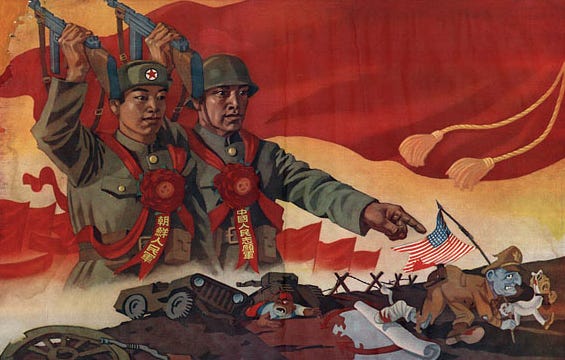
CHINA. NORTH KOREA. Hand to mouth.
Beijing visits a partner it says is ‘closer than teeth and lips.’
Chinese politburo member Li Hongzhong will visit North Korea to mark the 70th anniversary of the Armistice, Pyongyang said on Monday. The visit will be the first of its kind since the DPRK shut its borders during the COVID-19 pandemic.
INTELLIGENCE. The visit would be unremarkable if not for its timing. After three years in isolation, Pyongyang will receive one of China's most senior officials amid a renewed DPRK campaign to intimidate its neighbours. The North fired two more missiles into the sea on Monday after a second US submarine visited the South. The UN confirmed on Monday that it was in talks with Pyongyang about a US soldier who crossed the demilitarised zone on 18 July.
FOR BUSINESS. As its only true ally, the DPRK’s provocations are mostly tolerated by Beijing, but there have been occasions – such as in 2017 – when China has sided with the West on sanctions. As then, Beijing has an incentive to squeeze Pyongyang – which is economically dependent on China – in exchange for concessions from Washington. But equally, an errant North serves as a useful buffer and way to keep the US, Japan and South Korea off-balance.
CHINA. RUSSIA. High seas, high stakes.
Beijing and Moscow up the ante.
China and Russia began joint naval and air patrols in the Pacific, Chinese media said on Monday, a first for the two countries. Russian drones attacked Ukrainian ports on the Danube on Monday, across from NATO-member Romania.
INTELLIGENCE. Having finished exercises in the Sea of Japan, Russian and Chinese ships are likely to return to waters around Taiwan, but with the added involvement of joint air assets, the sabre is being rattled a bit louder. Sabre rattling was likewise the reason behind Moscow's strikes on Ukrainian port infrastructure along the Romanian border. Russia wants to deter Black Sea trade without having to attack foreign ships and risk NATO’s direct involvement.
FOR BUSINESS. Russia’s intimidation seems to be working. After the strikes, 30 ships dropped anchor outside the Danube port of Izmail. Insurers are reviewing whether to cover Ukrainian river ports. Alongside strikes on Kyiv and Odesa, the attacks also show Russia’s reach. China, for its part, has stayed mute. Beijing wants to retain good relations with Eastern Europe, including for a mooted Belt and Road project to link Greece and the Danube via canal.
Written by former diplomats and industry specialists, Geopolitical Dispatch gives you the global intelligence for business and investing you won’t find anywhere else.
CHINA. TAIWAN. Exercises and futility.
Neither side wants war, but neither can back down.
Taiwan cancelled part of its annual military drills on Tuesday due to a category-four typhoon, expected to be the worst in years. China sent 37 aircraft and seven ships to waters around the island on Saturday in anticipation of the exercises.
INTELLIGENCE. Beijing would like to claim credit for stalling the exercises, but Taipei cannot afford to look weak ahead of elections next year and amid a campaign in Washington to obtain more military supplies. The Pentagon on Thursday said it was doing what it could to speed up $19 billion worth of delayed deliveries. Senate Democrats are meanwhile fighting House Republicans over how much to give Taiwan in next year’s foreign military grants program.
FOR BUSINESS. Like Ukraine, Taiwan is beholden to Western military aid while lacking Western guarantees. Unlike Ukraine, its chip industry and strategic location mean it is vitally important to world trade. Beijing is flexing muscles, but like Taipei, it doesn’t want a war it might not win, and which would harm its economy regardless of the outcome. China has meanwhile flagged more support to consumers and property investors. With sticks come carrots.
EUROPE. Slowing, smouldering.
As recession deepens, populism looms.
A manufacturing survey released on Monday suggested a deepening slowdown across the Eurozone. The leader of the Christian Democratic Union said on Sunday he would be open to cooperating with the far-right Alternative for Germany.
INTELLIGENCE. The CDU retracted the comments, but with the AfD now polling second, the pressure to cooperate will grow. Despite a setback for the far-right in Spain this weekend, the movement’s march across Europe continues. The Vlaams Belang party – which threatens Flemish secession – leads in Belgian polls. In Austria, the ultra-nationalist Freedom Party tops support. Danes have followed Swedes with a Koran burning in Copenhagen. The gyre widens.
FOR BUSINESS. The HBOC flash Composite Purchasing Managers' Index hit 48.9 in July, down from 49.9 in June, bearing out fears of deindustrialisation amid higher wage and energy costs. Monetary policy will make matters worse, at least in the short term, with the European Central Bank expected to raise rates another 25 basis points on Thursday. Euro rates are at their highest level in two decades. The pain of a hot summer could be exacerbated by a cold winter.
With the brevity of a media digest, but the depth of an intelligence assessment, Daily Assessment goes beyond the news to outline the implications.
UNITED ARAB EMIRATES. The camel’s back.
Middle East Respiratory Syndrome re-emerges in the Gulf.
A 28-year-old man from Abu Dhabi tested positive for MERS, the World Health Organization confirmed on Monday. Believed to come from camels, it is this year’s first instance of the virus, which has a 35% fatality rate and no cure.
INTELLIGENCE. MERS had outbreaks in 2014, 2015 and 2019, primarily in the Gulf, but also in South Korea via a man who had visited Saudi Arabia, the UAE and Bahrain. Public health measures taken since SARS-CoV2, a distant cousin, have lessened the spread, but the case suggests MERS-CoV remains endemic in livestock, including camels. So far, the infection appears to be isolated. The man was hospitalised on 8 June and 108 contacts have been monitored.
FOR BUSINESS. While no vaccine for MERS is yet available, several inoculations and treatments are in development. It is nonetheless a reminder of the potential for ‘black swan’ diseases to jolt economies. It is also a reminder that studies into the origin of zoonotic coronaviruses ought to be prioritised and depoliticised to avoid the next one. As for COVID-19, the pandemic isn’t over, with hospitalisations in Japan having risen for more than nine weeks.
PAKISTAN. Striking out.
The government seeks new ways to retain power.
Former prime minister Imran Khan was given bail by Pakistan’s Supreme Court on Monday on charges of a lawyer’s murder. The same day, Pakistan’s election commission demanded Khan’s arrest on a separate contempt of court case.
INTELLIGENCE. Pakistan’s military establishment has made 150 separate charges against Khan to prevent him from running in elections scheduled for October. Yet the populist ex-cricketer claims he can win even without his now-dissolved Pakistan Tehreek-e-Insaf party. Low-level insurgencies across the country are also giving the military headaches. Earlier this month, 12 soldiers were killed in separate attacks, including the storming of an army base.
FOR BUSINESS. In the wake of an IMF bailout, forestalling a balance of payments crisis, Islamabad is under slightly less pressure, but the government remains unpopular and beholden to creditors in Beijing and the Gulf. The economy is also stuck in the doldrums. Despite a $20 billion investment aim for the IT sector and multiple ribbon-cuttings for China-backed projects, investors are staying away just as a long-awaited privatisation program gets going.
Emailed each weekday at 5am Eastern (9am GMT), Daily Assessment gives you the strategic framing and situational awareness to stay ahead in a changing world.