

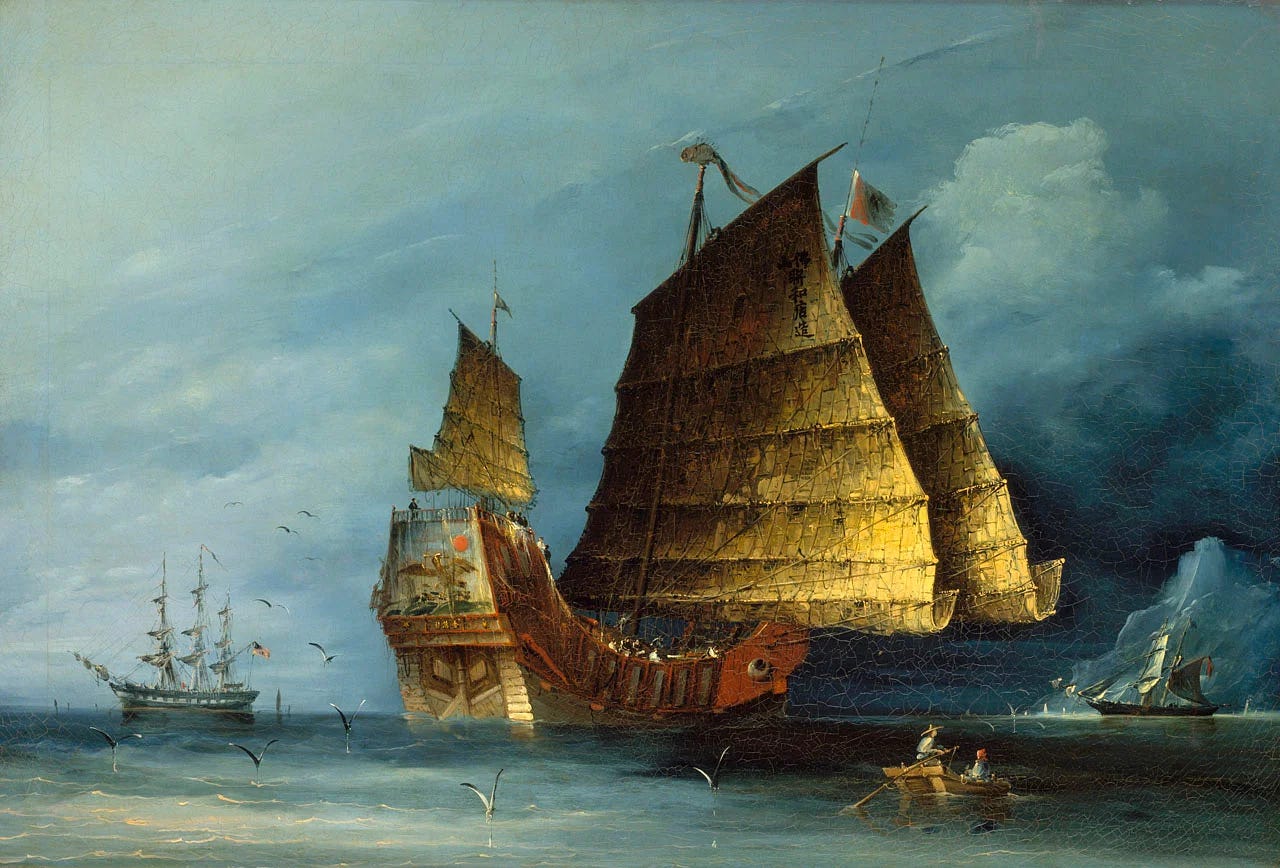
CHINA. UNITED STATES. Naval gazing.
Beijing and Washington are sizing up.
Two US sailors have been arrested on suspicion of selling secrets to China, the Department of Justice said on Thursday. On Wednesday, the Pentagon said its top Asia official had a rare conversation with China's foreign ministry.
INTELLIGENCE. It’s no secret that China and the US want to understand each other’s capabilities, particularly in sea power, where they are almost matched in the Pacific. It thus makes a lack of direct dialogue between their militaries more unfortunate. Washington is trying to break the ice by having Pentagon officials meet with Chinese diplomats instead. The problem is the foreign ministry, reeling from the removal of its head, has less influence than the generals.
FOR BUSINESS. China may be stealing a march in naval power, but the US economy, for a change, looks stronger than China’s, which is facing the threat of deflation. After weeks of scattergun policies, however, Beijing is now rolling out a bigger arsenal. On Thursday, it announced a relaxing of urban residency rules. On Tuesday, 28 measures were revealed to support entrepreneurs. Beijing wants to see if these work before using the infrastructure bazooka.
IRAN. Hello sailor.
Hardliners benefit from internal and external pressure.
The US may place Marines on commercial ships transiting the Strait of Hormuz, US officials told Associated Press on Thursday. A third senior official was shown in a sex tape on Sunday, in a string of scandals to rock Iranian social media.
INTELLIGENCE. As rumour surrounds the health of Ayatollah Ali Khamenei, 84, factions within the Islamic Republic are jockeying for position. A series of sex tapes has been released in recent weeks, suggesting an orchestrated campaign as morality police resume dress code patrols 10 months on from riots that killed at least 500 and saw almost 20,000 arrests. Belligerence in the Persian Gulf, leading to a US response, may also be a coordinated move.
FOR BUSINESS. The Islamic Revolutionary Guard Corps has seen its power grow since sanctions were reimposed in 2017, after the US withdrew from the Joint Comprehensive Plan of Action nuclear deal. Now rivalling the clerics, the IRGC is using its smuggling profits and internal controls to tighten its grip. This is bad news for Western firms seeking re-entry. China and Russia, on the other hand, are enjoying a boom, with Moscow currently eyeing a free trade deal.
Written by former diplomats and industry specialists, Geopolitical Dispatch gives you the global intelligence for business and investing you won’t find anywhere else.
INDIA. Open and closed.
Delhi wants foreign investment but isn’t sure how.
Delhi on Thursday imposed new licencing requirements for the import of computers, laptops and tablets in a bid to boost manufacturing. Sources told Reuters on Thursday that Tesla was in advanced talks to build low-cost EVs in India.
INTELLIGENCE. Before its deindustrialisation in the 19th century, India was allegedly the world’s biggest manufacturer. It has long sought to regain the title, but bad infrastructure, red tape and internal customs barriers have made Delhi's ‘Make in India’ aspirations difficult to achieve. And despite a huge potential market, knee-jerk policies and protectionist instincts have made India a harder sell to foreign investors than other regional markets.
FOR BUSINESS. India has long coveted East Asia’s industrial might, but adopting 1970s-style import substitution in an era of global value chains is not going to do it. Delhi’s problem is balancing the needs of multinationals with the wants of voters, particularly when well-paid jobs are scarce. It is also competing with other countries offering a similar value proposition, like Indonesia, whose investment minister reportedly met Elon Musk in California on Thursday.
SAUDI ARABIA. Cut both ways.
Riyadh wants to balance markets and relationships.
Riyadh on Thursday extended a 1 million barrel per day oil production cut by another month to the end of September, stating it could “deepen” reductions further to stabilise prices that have plateaued against weak Chinese demand.
INTELLIGENCE. Riyadh knows the move will annoy Washington, which remains worried about inflation, as well as a recent fall in job openings and contracting factory indices. Nonetheless, Riyadh wants to keep fellow oil-producing Arab states happy amid a possible deal with Israel that the White House has been eager to finalise. It can also afford to draw down on political capital with the West, having agreed to host a peace conference for Ukraine this weekend.
FOR BUSINESS. Lowering supply hasn’t sent markets higher yet, but against lower inventories and a capital expenditure slump among Western oil majors, Saudi Arabia may be laying the ground for a sustained rise in crude prices. This would help fund an ambitious series of mega-projects the Kingdom is due to kickstart and add to the diplomatic influence Riyadh has accrued since Russia’s invasion of Ukraine and its subsequent energy sanctions.
With the brevity of a media digest, but the depth of an intelligence assessment, Daily Assessment goes beyond the news to outline the implications.
TURKEY. RUSSIA. Putin a price on it.
Stubborn inflation leaves Erdogan vulnerable.
Turkish consumer prices rose 47.8% year-on-year in July, compared to 38.2% in June, according to statistics released on Thursday. Turkish officials on Thursday said a visit by Vladimir Putin was being planned for late August.
INTELLIGENCE. Higher energy prices and a weaker lira will mean Recep Tayyip Erdogan will be under pressure to ease some of the pain, putting exporters like Russia in a strong bargaining position for bilateral deals. Erdogan will also be minded to adjust Turkey’s position on Ukraine, following its recent agreements to support Sweden’s NATO bid and return Ukrainian prisoners to Kyiv. Additionally, Erdogan wants Putin to reallow Black Sea grain exports.
FOR BUSINESS. After a series of rate hikes since the May election, July's inflation was stronger than expected, but it likely reflects the impact of pre-election stimulus, such as a hike to the minimum wage and government salaries. Without wanting to undo these measures, or put further costs on borrowers, Erdogan will want other ways to tame prices. Moscow’s return to the Black Sea Grain Initiative would be ideal, but a deal for cheap Russian oil could do.
COLOMBIA. Dealing with the devil.
Gustavo Petro faces questions over peace deals and campaign finance.
A 180-day ceasefire began on Thursday between Colombia and its biggest remaining rebel group. Nicholas Petro, the president’s son, said on Thursday that people with ties to drug traffickers helped fund his father's election campaign.
INTELLIGENCE. Petro, a former guerrilla in his youth, has made a series of controversial peace deals with Colombia’s remaining militias. This has brought relative peace to the country but has sent arms and criminal activities over the border, notably to Ecuador and Peru, which are now dealing with renewed violence. Allegations that Petro may have benefited from narco money could now harm his agenda. Petro’s son was arrested on Saturday on similar charges.
FOR BUSINESS. Since the 1970s, cocaine has been one of Colombia's largest industries, funding a web of cartels and guerrilla groups. And despite a recent coca price crash and US appetites moving towards methamphetamine and fentanyl, it’s still big business. Petro’s plans to decriminalise parts of the trade, however, may put him under greater scrutiny, as may the State Department’s criticised decision last month to suspend satellite monitoring.
Emailed each weekday at 5am Eastern (9am GMT), Daily Assessment gives you the strategic framing and situational awareness to stay ahead in a changing world.