

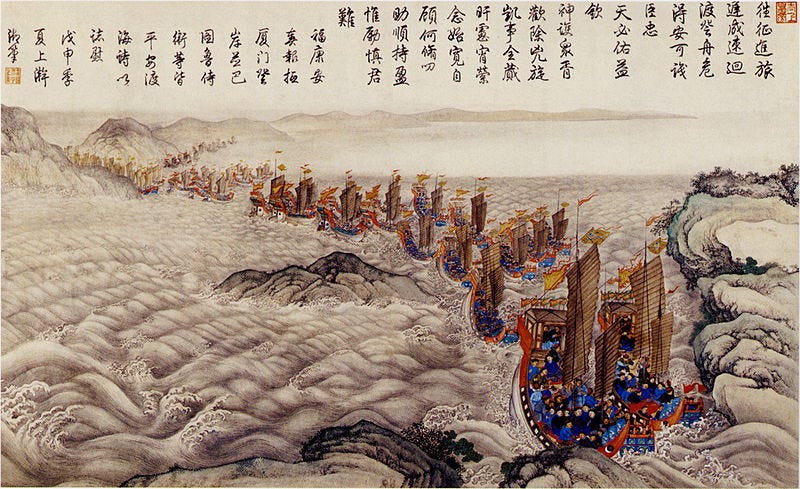
CHINA. UNITED STATES. Stormy waters.
Naval tensions rise as Washington strikes a deal with Taipei.
Joe Biden on Monday signed legislation to implement the first stage of the US-Taiwan Initiative on 21st-Century Trade. The Pentagon confirmed it dispatched four destroyers when Chinese and Russian ships were sighted off the Aleutians.
INTELLIGENCE. The US-Taiwan Initiative falls short of a free trade agreement and is largely symbolic, but that will not matter to China, which sees any marker of Taiwanese sovereignty as a red line. Patrols off the sparsely populated Aleutians are likewise symbolic, but to the US they show China has the capability and intent to traverse the so-called Third Island Chain, from the Bering Sea to Fiji, to which US forces would retreat should Taiwan, Guam or Okinawa fall.
FOR BUSINESS. Beijing and Washington both want stabler trade ties, but the sabre-rattling continues. On Saturday, China used a water cannon to block a Philippine boat in the South China Sea. Last week, the White House allegedly asked that arms for Taiwan be included in Congress's budget request for Ukraine. Tensions are taking their toll. US imports from China fell 24% for the first five months of 2023. Foreign direct investment inflows to China have crashed.
CHINA. INDIA. Climbing down the mountain.
Signs of peace in the Himalayas.
India’s foreign minister on Monday said progress had been made on several points of contention along the border with China. Delhi on Thursday said Narendra Modi would soon travel to South Africa, where he is expected to meet Xi Jinping.
INTELLIGENCE. Clashes in 2020 and 2021 along the Line of Actual Control, India’s de facto border with China, appear to be in the rear-view mirror. Tensions will persist – India is spooked by Chinese infrastructure along the border, including dams on the Brahmaputra River – but repeating the 1962 border war would be in neither side’s interests (India especially). A meeting between Modi and Xi at the BRICS Summit should be a further sign of de-escalation.
FOR BUSINESS. As in military affairs, India is not yet a match for China economically, and can ill afford a trade war. Chinese retailer Shein, banned by Delhi in 2020 after the first border clash, is returning. Imports of Chinese batteries and pharmaceutical ingredients are booming. The two sides are finding common ground, from avoiding tariffs on Russian oil to opposing restrictions on coal. They are also resolving disputes before Xi visits next month for the G20.
Written by former diplomats and industry specialists, Geopolitical Dispatch gives you the global intelligence for business and investing you won’t find anywhere else.
POLAND. BELARUS. Oblast from the past.
Warsaw accuses Minsk of repeating tricks from 2021.
Poland accused Belarus and Russia on Monday of planning to send a wave of Middle Eastern migrants to the border, as happened two years ago. Almost 20,000 migrants have so far sought to cross from Belarus to Poland this year.
INTELLIGENCE. The only thing that scares Polish politicians more than Russia is another Middle Eastern migrant crisis. Should Belarus reprise its policies, whereby Syrian and Iraqi “tourists” were given visas for “hunting” along the Polish border (an activity exempt from Covid-19 restrictions), the EU will find its still uncertain asylum laws put to the test. It would certainly be a step up in border intimidation from Wagner mercenaries and helicopter brush pasts .
FOR BUSINESS. Combining political fears of asylum seekers with Russia’s hybrid war against the West would be almost too good for Belarus to pass up. Yet bringing in more “tourists” from the Middle East or elsewhere could backfire. The push factors beyond Europe are greater, with wars in the Sahel already sending thousands across the Mediterranean. And they are greater for Belarus too, where young men could spy an opportunity to flee conscription.
THE BALTICS. RUSSIA. North wind.
Pressure builds for NATO’s Baltic members.
Britain's Royal Air Force on Monday said it had intercepted a record number of Russian aircraft in recent Baltic patrols. On Wednesday, Lithuania said it would join Latvia and Estonia in decoupling from Russia's energy grid by early 2025.
INTELLIGENCE. In the wake of Finland’s accession to NATO, Moscow wants to prove the Baltic Sea is not a Western lake. Last week, it launched exercises involving 50 vessels and 6,000 personnel to coincide with Belarusian drills nearby. This week, Kremlin-linked media is reprising 2014-era tropes of Russophobia – once fielded against Ukraine – following recent moves by Latvia and Lithuania to strip several thousand ethnic Russians of permanent residency.
FOR BUSINESS. The former Soviet republics of Estonia, Latvia and Lithuania were quick to join NATO and the EU, but Russian influence continues, notably through common infrastructure and large Russian-speaking populations. The Baltic states are trying to decouple from the former, but it will take time and money. They are trying to manage the latter, but curbing citizenship rights risks breaking European law. Russia will be keen to point out perceived hypocrisy.
With the brevity of a media digest, but the depth of an intelligence assessment, Daily Assessment goes beyond the news to outline the implications.
CAMBODIA. THAILAND. Old wine, new bottles.
A new generation emerges within the same old clique.
King Norodom Sihamoni formally appointed Prime Minister Hun Sen's son, Hun Manet, as Cambodia's leader on Monday. The same day, Pheu Thai, runner-up in Thailand's elections, announced an alliance with a conservative bloc.
INTELLIGENCE. Cambodia’s transition was no surprise, but for voters in Thailand, the coalition between Pheu Thai and the Bhumjaithai Party spells an end to three months of political horse-trading and any hopes for reform under Move Forward, which won the most votes. By joining Bhumjaithai, Pheu Thai, the party of sibling former prime ministers Thaksin and Yingluk Shinawatra (deposed by coups in 2006 and 2011), is now firmly of the establishment.
FOR BUSINESS. Thailand's next prime minister will now presumably be Thaksin's daughter Paetongtarn Shinawatra. Though a successful businesswoman and member of the Millennial generation, she is nonetheless expected to entrench the status quo. Hun Manet, on the other hand, could be a sheep in wolf's clothing. Though a military general and dynast, he is understood to want reforms and better ties with the West, unlike his father, who has relied on Beijing.
LEBANON. Danger zone.
Gulf states tell their citizens to leave Beirut.
The UAE joined Saudi Arabia, Kuwait, Qatar and others on Sunday, in warning its citizens not to travel to Lebanon. Clashes between rival Palestinian factions at the Ain al-Hilweh refugee camp broke out last week, killing 13.
INTELLIGENCE. Lebanon’s relations with the Gulf have never been easy. In 2017, Lebanon's prime minister was detained in Saudi Arabia and forced to resign on state television (he later recanted and served three more years). In 2021, relations were frozen over disagreements on Yemen, religion and drugs. This time, the problem may simply be that Lebanon, which has technically been without a government for a year, has become too unsettled, and too unsafe.
FOR BUSINESS. Sending the army into Ain al-Hilweh, which traditionally runs itself, was seen by many as a crisis point in a country where crisis has no meaning. It is hard to predict where things will settle – Lebanon’s descent into religious fiefdoms has left it largely ungoverned – but we may be witnessing a strategic Saudi exit, which could vacate the space for Iran (as was the case pre-2005), and would follow a pattern recently established in Syria and Yemen.
Emailed each weekday at 5am Eastern (9am GMT), Daily Assessment gives you the strategic framing and situational awareness to stay ahead in a changing world.