


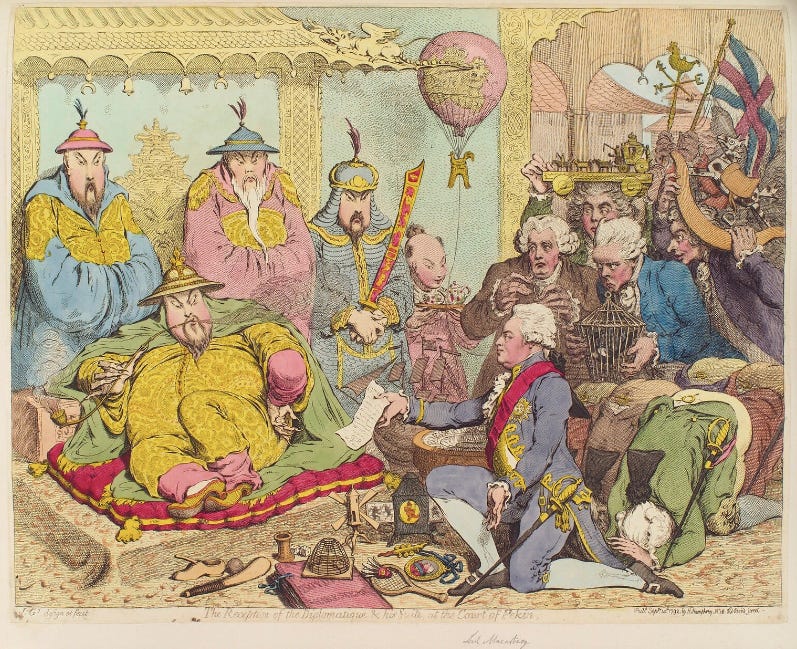
CHINA. UNITED STATES. BRITAIN. EUROPE. Trade-off.
Economics will keep the superpowers talking, for now.
China's foreign minister urged the US to "return to rationality" after a meeting with Washington's envoy to Beijing on Monday, the most senior interaction between the powers since the US shot down a Chinese spy balloon in February.
INTELLIGENCE. China’s message was icy but may also signal a thawing of ties. The same day, Britain’s investment minister visited Hong Kong – the first by a senior UK official in five years – saying London would engage with Beijing where interests converge. Western and Chinese strategic goals remain largely irreconcilable, but there remain shared interests on trade. Where security and economics collide, however, will be the biggest near-term challenge. Consultants Capvision had their Chinese offices raided on Monday, a month after officials tapped Bain & Company on espionage concerns. The EU has meanwhile proposed sanctioning several Chinese firms over Russia ties.
FOR BUSINESS. Investors in China are used to balancing security concerns with commercial potential, but the tightrope is getting narrower. Diversification strategies should be considered if they haven’t already.
CHINA. SOUTHEAST ASIA. Drilling down.
China takes incremental steps to project and normalise its power.
Joint military exercises began on Tuesday between China and Laos. Beijing recently concluded exercises with Singapore and Cambodia. The US staged its largest-ever drill with the Philippines in April.
INTELLIGENCE. Whether via Taiwan or the South China Sea, one of Beijing’s imperatives is to break out of the so-called “first island chain”, between China and the Pacific. A US imperative is to prevent this, through alliances from Japan south to Australia. China’s war games with its neighbours will remain limited for as long as counterparts wish to hedge their bets. Pyongyang is Beijing’s only true ally. Yet China will gradually “salami slice” towards a new normal in security. Both the Laos and Cambodia manoeuvres broke new ground. China will similarly increase dual-use activities to disguise military undertakings, such as using space research for missile development.
FOR BUSINESS. Just as China is taking a dual-track approach to science and research, Western companies will need to take increasing care that their goods and services are sequestered from potential military supply chains.
CENTRAL ASIA. In the middle.
The ‘stans seek to balance China, Russia and the West.
The presidents of Kazakhstan, Kyrgyzstan, Tajikistan and Uzbekistan will visit Beijing this month, China's foreign ministry announced on Monday. The same leaders visited Moscow on Tuesday for Russia's Victory Day parade.
INTELLIGENCE. The appearance of four Central Asian heads of state at Putin’s 9 May celebrations, joining the leaders of Armenia and Belarus, will upset many. Yet the outward fealty of these former Soviet republics is more to do with hedging China than taking sides on Ukraine. Beijing’s economic pull is complicating dynamics in Moscow’s traditional sphere of influence. The West is also making its presence felt. Kazakhstan, which hosted the US’s secretary of state in February, is working to avoid secondary sanctions. Uzbekistan, which announced fresh elections on Monday, is attempting to show Washington a democratic face (though its president is also using civic reforms to cement power).
FOR BUSINESS. Russia remains the region’s key security partner, but Beijing’s economic rise could change this in time. Reputations in the West still count, offering investors comfort, but in a multipolar future this will matter less.
UKRAINE. RUSSIA. TURKEY. Not rocket science.
Ankara’s obstinance on air defences comes down to simple self-interest.
Ukraine issued air raid alerts across two-thirds of the country early Tuesday as Russia stepped up drone and missile attacks. On Sunday, Turkey said it had refused a US request to send a Russian-built missile defence system to Ukraine.
INTELLIGENCE. Notwithstanding the recent arrival of US Patriot anti-missile systems in Kyiv (and dubious claims of downing a Russian hypersonic missile), Ukraine is still suffering a barrage of air attacks as its leaders promise a mooted spring counter-offensive. Turkey’s acknowledgement that it had refused to send its controversial S-400 missile defence system to Ukraine, purchased from Russia in 2017, will thus come as a dismay. A week out from elections, Turkey’s foreign minister said the S-400s posed no threat to the NATO alliance and Turkey would not seek to re-join the US’s F-35 fighter jet program, from which it was dropped by the Trump administration in retaliation.
FOR BUSINESS. Irrespective of its NATO membership or impending elections, Turkey will continue its fence-sitting foreign policy for as long as that allows it to economically benefit from the region’s growing geopolitical cleavages.
JORDAN, SYRIA, ISRAEL, IRAN. A mouse roars.
Tiny Jordan shows its displeasure, almost certainly with US backing.
A Jordanian air strike on Monday killed an Iran-linked drugs kingpin in Syria, a day after Damascus was readmitted to the Arab League. The same day, Iran’s state media promised to equip Syria with its military's most advanced equipment.
INTELLIGENCE. Promising to clamp down on amphetamine production was a key request made by Jordan in agreeing to Syria’s readmittance to the Arab club. Yesterday’s rare attack was both a warning shot that Amman is serious and a signal to Iran that its sway over Damascus could now be contested. Even under severe sanctions, Iran – with an economy the size of Australia’s in parity terms – dwarfs most of its neighbours and will not go away. But as Saudi Arabia and the UAE attempt to mend ties, US allies like Jordan and Israel will continue to try. Early Tuesday, Israeli jets killed 12 in Gaza, including three leaders of Palestinian Islamic Jihad, a militia backed by Syria and Iran.
FOR BUSINESS.Proxy battles will increasingly define politics in the Middle East, meaning investors will need to take greater note of foreign as well as domestic policies. The region is tricky, but with oil wealth it remains fast-growing.
CHILE. Step to the right.
A socialist leader receives a major blow.
The ultra-conservative Republican Party emerged in first place early Monday after weekend elections to select a committee to redraft Chile's Pinochet-era constitution. The party was runner-up in Chile’s 2021 presidential polls.
INTELLIGENCE. After voters rejected efforts to rewrite the constitution in 2022, which would have enshrined the right to neurodiversity and culturally appropriate food among others, President Gabriel Boric, a former communist, has failed again. Beyond the constitution, the defeat could complicate plans for the nationalisation of Chile’s lithium reserves and similar policies. A week after the re-election of Paraguay’s conservative government, the result could also signal the receding of South America’s “pink tide”, which has swept left-wing governments to power since 2018. Neighbouring inflation-racked Argentina goes to the polls in October, where right-wing parties are rising in support.
FOR BUSINESS.Fears of a “lithium OPEC” among Chile, Argentina and Bolivia – all with socialist governments – may fade, but Latin American populism won’t go away. Stabler mining jurisdictions like Australia will still stand to benefit.