

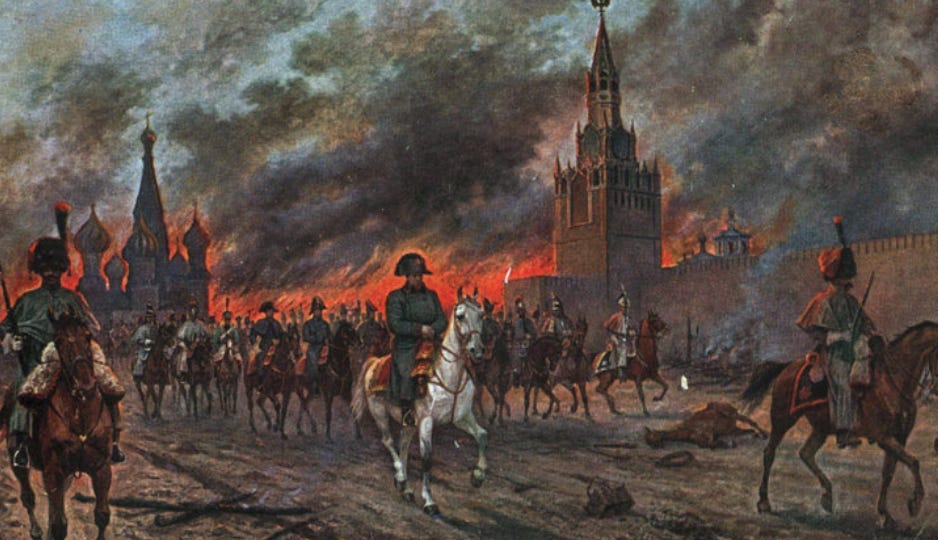
FRANCE. RUSSIA. Acting the Bonaparte.
Napoleon is returning to cinemas but only in fiction.
France aimed to finalise a bilateral "security guarantee" with Ukraine by the end of 2023, the French foreign ministry said on Wednesday. The same day, NATO ministers promised "interoperability" with Ukraine, though not membership.
INTELLIGENCE. It is unlikely Paris will agree to full mutual defence with Kyiv, but admitting this will be delicate as either outcome will be a gift for Moscow’s propaganda efforts. Though conciliatory at the start of the war, Emmanuel Macron is now among the most hawkish Western leaders on Russia. He visited former-Soviet Central Asia earlier this month and has injected himself into disputes in the Caucasus, offering arms to Russia’s erstwhile ally Armenia.
FOR BUSINESS. Macron has cause to stand up to Putin. Russia is disrupting French interests in Africa. The Kremlin funds the French far-right (Charles de Gaulle's grandson has sought Russian citizenship). Russian firms are cutting out French nuclear contracts. But while France sometimes strays beyond NATO’s comfort zone (it has even rattled sabres at allies like Turkey), it won’t agree a deal that could drag the rest of Europe, let alone the US, down with it.
Written by former diplomats and industry specialists, Geopolitical Dispatch gives you the global intelligence for business and investing you won’t find anywhere else.
THE SAHEL. Crumbling foundations.
More cracks along Africa’s road to Europe.
Al Qaeda-linked militants had killed at least 40 in Burkina Faso, the UN said Wednesday, amid a worsening struggle between the region's military juntas and Islamist rebels. Niger said Monday it had revoked a human trafficking law.
INTELLIGENCE. Ethnic Tuareg rebels in the north of the Sahel have for years sided with terrorists and criminal groups to pursue aims of self-governance. And with the region’s recent coups leading to the exit of Western and UN security forces, the rebels have grown stronger. The juntas are using carrots and sticks to regain control, but both approaches entail greater flows of migrants, guns, gold, and drugs to and from Europe, as well as a greater role for Russia.
FOR BUSINESS. Russian mercenaries have filled the vacuum, but they aren’t there to secure Europe’s southern fringe. The remnants of Wagner Group are estimated to be making $10 million per month in Mali. A Russian gold refinery there was announced last week. Burkina is eyeing a Russian nuclear power plant. Even Chad, the region’s remaining Western ally, is allegedly collaborating with Russia in Sudan, and this month opened a Russian arts and culture centre.
With the brevity of a media digest, but the depth of an intelligence assessment, Daily Assessment goes beyond the news to outline the implications.
UNITED STATES. Joe blow.
The Democratic primary may be the one to watch.
Billionaire donor Bill Ackman said Wednesday Joe Biden should "step aside", joining other Democrat grandees who have suggested the President retire. California Governor Gavin Newsom will debate Florida’s Ron DeSantis on Thursday.
INTELLIGENCE. Newsom has not announced his candidacy, but like several other high-profile Democrats – from Michigan Governor Gretchen Whitmer to former wrestler Dwayne Johnson – he’s acting as if he’s in the race. Despite a strong economy and a ham-fisted opposition, Biden is increasingly unpopular. Current polls would see him lose to Donald Trump, despite the ex-president’s legal woes and Republican underperformance in recent state elections.
FOR BUSINESS. Republican donors are meanwhile rallying to third-placed contender Nikki Haley, though Trump’s 50-point lead and recent courtroom wins suggest she’d face a near impossible task. The most likely defeater of Trump, at this stage, would be a non-Biden Democrat, but Biden, 81, insists he will run. And besides, the life of the formidable Henry Kissinger, who died aged 100 on Wednesday, proves that getting older is often no barrier to getting wiser.
NEW ZEALAND. New zeal.
A Pacific ally wants to prove its worth.
New Zealand's foreign minister on Thursday said Wellington would boost its partnership with Washington in his first policy speech since returning to the job after three years. His party last week helped form a new right-leaning coalition.
INTELLIGENCE. New Zealand’s three-party coalition government made headlines this week by scrapping the previous administration’s youth tobacco laws and banning mobile phones from schools. Yet unlike its time zone, New Zealand is not as far ahead of the world as it tends to think. Malaysia this week made a similar backflip on smoking. France and Italy got there first on phones. The real shift could be in geopolitics, ending years of relative closeness to China.
FOR BUSINESS. As foreign minister under Jacinda Ardern’s first government, Winston Peters moderated his prime minister’s nonchalance on Beijing. But when replaced by Nanaia Mahuta in 2020, New Zealand swung back towards equivalence (symbolically if not in substance) between China and the US. China remains New Zealand’s biggest trade partner, but a surplus in Wellington’s favour insulates it from any blowback should it now more closely follow the US.
Emailed each weekday at 5am Eastern (9am GMT), Daily Assessment gives you the strategic framing and situational awareness to stay ahead in a changing world.
THE SUN. Stormy weather.
Geomagnetic storms and an early solar maximum may come down to earth.
The US National Weather Service warned Wednesday that multiple coronal mass ejections were determined to reach the earth on 1 December. Scientists in India this week predicted the next solar maximum could start as early as January.
INTELLIGENCE. Much is still unknown about solar cycles, but the 11-year pattern in the sun's activity can lead to solar storms that impact the earth's atmosphere and the current solar cycle is estimated to be one of the strongest since records began. The 1859 'Carrington Event' caused telegraphs to short-circuit and auroras as far south as Cuba. A storm of similar magnitude today would cause widespread power blackouts and global communications disruption.
FOR BUSINESS. A 2013 study estimated the cost of another Carrington would be between $600 billion and $2.6 trillion. With low-orbit satellites, a tech-centric economy, and a global reliance on mobile telephony it is unclear what the cost would be in 2023. Solar flares bathed Siberia in scarlet light earlier this month but had minimal impact on civilian or military technology. Just as well. In 1967, a radio burst from the sun triggered US nuclear defence systems.
The headline editor deserves a bottle of champagne.