


Hello,
In this week’s Irregular column, we look at the influence of film on foreign affairs, and of foreign affairs on film.
Historically, there has been little connection between Barbie and geopolitics. But the blockbuster ignited international controversy after a fictional map of Barbie Land was said to wrongly chart China’s so-called ‘nine-dash-line’, marking the boundaries of a disputed claim to a string of islands in the South China Sea.
Barbie, busy enough dealing with Ken’s discovery of the patriarchy, had to also contend with censorship from the Vietnamese and Philippine governments, irked by the film’s seeming endorsement of China’s territorial ambitions. Warner Bros, the film’s producer, likely benefitted from the scandal – all publicity is good publicity – while losing access to some secondary markets.
Bizarrely, Barbie’s rival for audience attention, Oppenheimer, attracted less geopolitical controversy – except for from certain nuclear non-proliferation advocates, like former Australian Foreign Minister Gareth Evans, who lamented a missed opportunity to push the case for stricter arms control.
Christopher Nolan did, however, explore the development of the 20th century’s most important foreign affairs technology. Nuclear weapons shortened World War II, gave leaders the ability to destroy large swathes of humanity with a button, redefined military power, and established the international institutions that shape the world today.
The ‘Barbenheimer’ phenomenon reminds us that film, the great 20th-century art form, still matters in foreign affairs – even in an era when soft power is taking a backseat to the use of military force, great power competition has resumed, and economic coercion proliferates.
Written by former diplomats and industry specialists, Geopolitical Dispatch gives you the global intelligence for business and investing you won’t find anywhere else.
Aspiration, exported
Since its invention, cinema has had a powerful impact on foreign affairs. For decades, Hollywood exported a vision of American lifestyles and values for voracious worldwide consumption. America’s 20th-century primacy rested not just on its military and economic power but also on its soft power, with film its dominant cultural contribution.
Notwithstanding that Barbie and Oppenheimer will likely be the world’s highest-grossing films of 2023, there are questions about Hollywood’s hegemony. Nourished by the dominance of both the English language and the American economy since 1945, Hollywood now faces increasingly stiff competition.
India’s ‘Bollywood’, and to a lesser extent Nigeria’s ‘Nollywood’, now compete for influence in a multipolar world. Curiously, or perhaps predictably, Chinese movies barely rate, and a once-prolific Hong Kong industry has declined in correlation to mainland intervention.
And, of course, new technologies, business models and consumption habits are undermining film as a form of cultural projection. Local streaming services are gaining traction in major markets, for example with JioTV in India, or Tencent Video across China and Asia. Squid Game, a Korean production, has been Netflix’s most successful show.
Whether Hollywood will be swallowed up by the “prehistoric tar pits of Wilshire Boulevard”, as Charlie Chaplin hoped, after his exclusion from the United States in 1952, remains to be seen.
Film as a domestic political tool
The power of cinema has not been lost on politicians, who have long used film to promote their domestic interests. Lenin said that for the Bolsheviks “film is the most important art” and Stalin welcomed it as “the greatest medium of mass agitation”. During Soviet times, movies promoted socialist ideology, but not all were as dreary as that sounds.
Early Russian films like Eisenstein’s Battleship Potemkin were not only cinematic but propaganda masterpieces. And since Putin’s return to the Presidency in 2012, the government has funded scores of high-budget films (many about World War II or, for Russians, the Great Patriotic War) to inspire national pride and warn against the dangers of revolt. Equally, it has censored, defunded, and discouraged independent filmmaking that undermines official narratives.
And it’s not just the Russians who are using film as mass agitation. One of Hollywood’s most successful films from 2022, Top Gun, was supported by the US Department of Defense in the form of jets, aircraft, and personnel. This followed the remarkable success of the 1986 original in boosting Navy application numbers. There was reportedly a 500% in naval recruiting the year the film was released. Indeed, that the US Department of Defense maintains an entire office – the Entertainment Media Office – to support movie and TV production demonstrates it understands the power of film.
Governments also use film to prosecute their international agendas – showcasing their values, cultures, and lifestyles. The Institut Français, Goethe Institute, and British Council have long led the charge. More recently, as their geopolitical ambitions have grown, the Chinese Confucius Institute and the Russian Russkiy Mir have expanded their presence and sought to influence foreign publics through film. Through these bodies, diplomats the world over fund film festivals – not only promoting their own nation’s cinema but often to promote certain values. For example, an annual LGBT film festival in Russia – ‘Side by Side’ – was only possible with Western funding.
With the brevity of a media digest, but the depth of an intelligence assessment, Daily Dispatch goes beyond the news to outline the implications.
Influence and scandals abroad
Film can subtly influence political dynamics between countries. Former Indian minister Shashi Tharoor once remarked that India’s greatest asset in Afghanistan – long a major security concern – was not its military but the soap opera Saas, which no Afghan would dare miss. During the Cold War, Russians missed out on Hollywood but got French, Italian, and Mexican shows instead. Each of those cultures still holds high appeal in Russia today.
Films can cause geopolitical scandals too. Barbie is hardly the first. Zoolander was banned in Malaysia and Singapore, despite the obvious satire of Ben Stiller’s mission to assassinate the Malaysian prime minister. Borat questioned whether Kazakhstan really was “the greatest country in the world”, initially causing a diplomatic storm in Astana but later bringing an influx of tourists. And Winnie the Pooh was banned in China after referring to the teddy bear became a light-hearted way to mock Xi Jinping.
No biz like showbiz
Some politicians, however, owe their careers to cinema – jumping from showbusiness to “showbusiness for ugly people”. Ronald Reagan rose to prominence as an actor. Arnold Schwarzenegger became governor of the world’s fifth-largest economy. And in an incredible case of life imitating art, the world’s biggest political celebrity today – Volodymyr Zelensky – played the lead role in Servant of the People, a 2015 comedy about a high-school teacher elected President of Ukraine after a video of him ranting about corruption went viral. Zelensky, of course, was not the first Apprentice to rise to President.
Where does the camera point next?
Cinema remains an influential medium with the power to shape perceptions in subtle ways – and therefore an important instrument of statecraft. But its power is diminishing in a world of lower cinema attendance, decentralised ‘content creation’, and atomised consumption habits.
Once a monolithic potential propaganda device, cinema has lost its monopoly on the moving image. YouTube and TikTok are the new frontiers in propaganda and censorship.
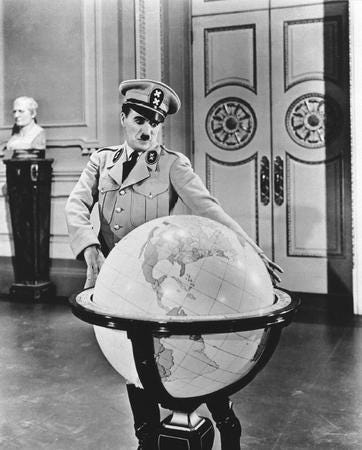
And for all cinema’s influence on geopolitics, we must remember that even at its peak, film has only ever been a form of soft power: Charlie Chaplin’s The Great Dictator mocked Hitler but did not disarm him. Oppenheimer will not reduce the risks of nuclear Armageddon. Barbie will not exacerbate tensions in the South China Sea. No film has ever sparked a revolution.
But they are fun to watch.
We likewise hope you are enjoying Geopolitical Dispatch. We will continue to cover these issues and more in our regular Daily Dispatches.
Thank you again for reading. As always, please consider passing our analysis on to a friend or colleague.
Best wishes,,
Damien Bruckard
Emailed each weekday at 5am Eastern (9am GMT), Daily Assessment gives you the strategic framing and situational awareness to stay ahead in a changing world.
