



Hello from Melbourne,
In today’s Irregular, something slightly unusual – an interview with our chief strategist Michael Feller about what goes into Geopolitical Dispatch, how to read the world, and the lessons he has learned from years writing, analysing and pun-tificating about it.
I hope you enjoy,
Damien
Brief encounters
Damien: Michael, I thought we could do an interview with you as the lead author of Geopolitical Dispatch. A lot of people reading Geopolitical Dispatch probably know your name. They see it down the top of each edition, but they may not necessarily know an enormous amount about you. So I’d like to focus this interview on Geopolitical Dispatch itself, starting with a little bit about yourself. Could you just give us a potted biography—how you came to be writing Geopolitical Dispatch and what you were doing prior to this?
Michael: Like you, Damien, I was a diplomat. In addition, I also worked for several years for the Australian prime minister’s department. Although I had been a journalist in a previous life, it was in the PM’s department that I really learned to write, because you have to write for the nation’s busiest person and be able to express extremely complex ideas in a very small amount of space—not only describe what’s happening, but where it’s going, what to do about it, and provide more than a media summary, but policy advice and analysis. Having suffered through the years of learning to do that, I needed to use that skill to justify the cost of acquiring it. So when I did end up leaving government, with yourself, we created Geopolitical Dispatch to essentially provide readers and businesspeople with the quality of geopolitical analysis that the prime minister would get.
Damien: I want to hone in a little bit on that, because you had previously worked as a journalist before we met during our time at the Australian foreign ministry and before you ended up in the prime minister’s department. Obviously, you write a lot as a journalist and even as a diplomat—writing cables back from, in my case, Moscow, in your case, Singapore. Both of those roles involved this mix of political and economic analysis, with a particular audience in mind. I was wondering if you could talk a little bit about whether, and if so how, that experience as a diplomat also shaped not just how you write, but how you view the world.
Michael: In terms of how you view the world, I have a master’s in international relations, as most people in the foreign service have, or they have something similar, and you’re taught all sorts of theoretical frameworks, only one of which is the realist theory of international relations. But once you’re in the system, you immediately become a realist because you realise essentially that’s how the world works. It doesn’t work the way that we want it to work. It just works the way that power and money dictate, essentially, for better or worse. It just is like that.
So you end up focusing on quite material things. You also learn, writing for a professional audience, to strip out a lot of your normative biases, because not only does it come across as a little trite and unnecessary, but it often will obscure your analysis.
The other thing that my time in government taught me was not so much how to write—although I did learn how to write very succinctly—but how to analyse, and specifically training in structured analytic techniques, which are methodologies of intelligence analysis essentially developed by the CIA in the Cold War to understand adversaries on which there was limited information and the information that was available was often disinformation. How do you understand rationally things which are otherwise designed to be inexplicable? That’s where you have structured methodologies for attacking a qualitative problem.
That’s also something that we try to bring to bear in what we write for Geopolitical Dispatch and, indeed, what we also do for clients with Geopolitical Strategy. We’re not just using the toolkit of economists or journalists or academic analysts. We’re using the toolkit of intelligence analysts to really find the dots that others can’t see and then connect those dots.
That’s, I hope, what people find valuable in Dispatch: that we go a layer beneath what the media is reporting. Otherwise, what’s the point of just adding yet another analysis to the thousands of publications which cover global affairs every day? We wanted to create something that was unique and something that presented value to justify the paywall, really.
Short form syndrome
Damien: Absolutely. Maybe we can come back a little bit later to some of the structured analytic techniques, because I think they’re really valuable. My own reflection from reading the news, and especially working with a lot of clients now on the advisory side, is that people are not short of information. They are short of structure in thinking through where the world is going, what could happen and what they should do about it. There’s a lot that can be valuable, whether that’s for a business client or just an individual, in providing those frameworks and guiding through a more structured way of understanding the world.
As a reader of Geopolitical Dispatch, you get something very compact. You get five stories, five analyses. They’re highly structured: an unbelievably good pun in the heading, a bit about what’s happened, two tight paragraphs—five of them each day. But that’s obviously just the tip of the iceberg. That doesn’t come out of nowhere.
Many people comment to me about Geopolitical Dispatch that they’re so impressed with the variety of topics and the global coverage. Everyone asks me, “How does he do it?” So I guess the question is: how do you do it? More specifically, what does your day look like? Where do you start? What are you reading? How much material do you have to get through? How do you decide what’s worth writing about? How much time are you spending on the research versus the writing side? What’s the day in the life of Michael Feller?
Michael: Without giving away too many trade secrets, the product you see is the tip of the iceberg. Probably about 70 per cent of my time is research: collecting information, speaking to contacts around the world to verify what I’m hearing and get a sense check. It’s not so much from the point of view of, “Is this true?”, because that can be a difficult and subjective question. It’s more, “Does this make sense?”
There’s no shortage of information out there on the internet, and now, with the explosion of artificial intelligence, we are all drinking from a firehose of information. It’s not hard to uncover stories. I’ve got a list that I work off when developing each day’s edition of literally hundreds of stories that are happening in the world, and I don’t cover 90 per cent of them. But I’m constantly referring back to that list, back to that dataset, to triangulate. I’ve got various methods that I use to do that efficiently that people who have worked with us understand.
The product that you see, again going back to the Prime Minister’s briefing, and those briefings that, say, the US President would get—assuming he reads briefings anymore—it really is just the tip of the iceberg underneath. No one’s got time to read the iceberg. But in the process of making it really succinct, you actually end up sharpening your thinking anyway.
I found that when I was a journalist and a diplomat, whether it’s an article for a newspaper or a cable for a foreign ministry, say you have 800 words to describe something. Your thinking about it is nowhere near as sharp as if you’re forced to put it into 50 words. By forcing you to distil it into a haiku, so to speak, you actually end up embedding more information through those 50 words than you did through the 800 words.
Damien: It’s probably also harder to do that. It reminds me of that quote—I don’t know whether it was actually Mark Twain or whether it’s misattributed to him—“I would have written a shorter letter, but I didn’t have the time.”
Michael: I’ve heard Blaise Pascal, Mark Twain, Winston Churchill. But it’s true. It’s very true, and it’s hard. It’s something that I’ve now probably spent at least 10,000 hours on, which supposedly is the point at which you become an expert. I’m not saying I’m an expert in this, but it does take time.
I was also very privileged to spend so many years in the cauldron of Australian foreign policy, working with very smart people who were also very good at distilling things into policy haikus, because you were dealing with incredibly time-poor individuals who need to make incredibly high-stakes decisions. There’s just no way to get around it. You just have to learn to impart information succinctly, accurately, and go beyond the sort of news summarisation that AI or media monitoring can easily do.
Busy bodies
Damien: That strikes me as quite important. The thing the reader sees is five minutes of reading. But what they’re actually getting is the result of all the hours that precede those five minutes—the selection, research, checking, analysis and then compression. The brevity is a very deliberate feature. And that matters because it’s not only prime ministers who are very busy.
When I talk to readers of Geopolitical Dispatch, they tend to be very knowledgeable people themselves. When I read each edition, while short, it goes well beyond an “explainer” or the bare minimum to get up to speed on a certain issue. Instead, it assumes a decent amount of knowledge and interest in geopolitics. Do you have a kind of reader in mind when you’re pulling it together?
Michael: Reflecting our audience, the reader I have in mind is a busy executive or investor who, as you say, does have a base level of knowledge, but doesn’t have time to really think about geopolitics in depth or do their own reading to get up to speed. They may have five minutes a day, which is about the amount of time you need to read all five Geopolitical Dispatches each morning. There’s a presumed knowledge—not to the level of the expert—but the target audience is someone who already has an interest in the world and has a stake in the outcomes of what’s happening. Not necessarily a political stake, but they have something riding on what happens.
In terms of our article selection—what we cover and how we cover it—there is always an implicit business link, even if we don’t always make it explicit. The way we filter the news is: will this impact markets? Will this impact business? Will this impact the distribution of global power? There are a lot more stories out there, including humanitarian stories, which are very important to cover, but we can only cover so much. So we do limit ourselves to things which will have an impact on either the bottom line or the general operating system that the world is in. High politics, markets, the economy. That’s the targeting.
News peak
Michael: Absolutely. You’re obviously reading and consuming news. I imagine it’s watching news, listening to news, reading analyses, digesting think tank reports, talking to people, contacts, et cetera. Dispatch itself is very different to all those sources for all of the reasons that we’ve spoken about. What have you learned about the news as a source for informing oneself and staying up to date on geopolitics, especially if you’re, say, a business leader or maybe working in markets in some fashion? It is the default means of staying on top of geopolitics. Any reflections on the benefits and pitfalls of the current media environment?
Michael: I’m a former journalist, of course, so I think the media is extraordinarily valuable as a fourth estate, as part of democracy. But essentially, as a source of information, you’ve just got to remember that its current model is still designed to get people to look. I’m not saying that quality media is hype or clickbait, but it’s designed to revolve around human interest or to make something interesting in and of itself to make you read it, so that you see the ad or buy the paper. In an article of 500 words, there may only be 25 words which are actually useful.
I’ve become really good at skimming, and also at choosing my sources really carefully because I can’t afford to be drowned in news. Otherwise, I’ll never write anything. So I tend to discipline myself in what I read. News-wise, I spend a lot of time reading Reuters, Bloomberg, Associated Press, and not much time reading the big newspapers like The New York Times or The Washington Post. Not that they’re bad—they’re great publications—but I’ve only got so many hours, and I’m looking to pick the eyes out of things.
Damien: I imagine trying to go as close as possible to the source of facts.
Michael: And with structured analytic techniques, you have to be quite careful not to take on the opinions of other writers. It’s quite easy to do that when reading some of these elite mastheads, because they’re very good writers and they’re very convincing. But they have a standpoint which a lot of the time can be very wrong, because not only do they have a normative view that they impart—I’m not saying I disagree with the normative view, by the way. I’m a centrist dad—but I don’t want to just be regurgitating mainstream positions on the world. I want to be providing something more nuanced and more useful to busy people who have a stake in the game.
Analysis and paralysis
Damien: Speaking of structured analytic techniques, one thing that we do a lot on the advisory side of the house as part of Geopolitical Strategy is, with clients, really trying to help them distinguish between facts, trends and uncertainties. By that I mean: what has actually happened? What are some things that you can say with a fair degree of confidence are heading in a particular direction? And then what are matters where there is a much greater degree of uncertainty about where things could head?
That sounds really basic, but often they’re conflated and it is often a really useful starting point for breaking down any geopolitical question, and then starting to think about how it relates to you as an organisation. Applying that sort of lens, when you look back over the last couple of years, what do you see as the important facts that have actually changed in the world of geopolitics over the past few years that are unequivocally true and that matter? What are some of the top trends where you’re pretty confident the world is heading in a certain direction? And what are a couple of the big open questions where it’s really up for debate and there’s less certainty?
Michael: The things I’ll say can apply to all three of those categories. They are the relative rise of China and the relative decline of the US in global power; the rise of artificial intelligence in the white-collar economy; and the rise of populist politics in the West. They’re all facts, they’re all trends, and they’re also all unknowns in terms of where exactly they will lead. They’re sort of the big themes of our time, if you will, and everything kind of relates to those three things.
The interregnum, if we’re in one, is the result of all three. Artificial intelligence maybe a little less so. It’s certainly very important, but I think people over-index on how important it is, frankly, because we’ve been living in a world of rapid technological change, at least in the West, for the last two or three hundred years. But in terms of politics, politics 300 years ago is still, if you squint hard enough, more or less recognisable.
As revolutionary as AI is supposed to be, I still think in 100 years, if you squint hard enough, politics will still be recognisable. Human nature is a constant through that. Power, the desire to build wealth for yourself, your family, your nation, your community, potentially at the expense of others—that’s sort of an iron law in history, and I suspect it will always be with us.
If I could add a fourth thing, obviously climate change. Although I think we may only be beginning to see the impacts of that. Certainly the last 12 months have been a bit scary, and I think a lot of people who were sceptical about climate change have come around to being quite worried about climate change. Whether that will actually lead to anybody doing anything about it at the global level is still an open question.
Damien: If they were in my apartment in Paris in June, they would have been convinced of the dangers of climate change.
Michael: It’s just been extraordinary when you’re seeing the effects in many parts of the world right now. When you look at it, I think we’re at the beginning of the megatrend of climate change. Climate change is not new, and in many ways the world has always had changes in climate, of course, but the difference of a couple of degrees is enormous.
Hurrican Putina
Damien: It’s funny. In political terms, I often think about geopolitics as similar to climate change, in the sense that one big trend in the last few years—probably the last decade—has been the increasing degree to which politics and international politics plays a role in economic policy and the economy generally becoming a bit more politicised, slowly over time and to varying degrees. But that’s causing systemic change to what the nature of the economy actually is and the environment for participants in the economy, businesses, investors and consumers alike.
One Geopolitical Dispatch reader who I met by happenstance last week in Sydney—we were debating whether China would invade Taiwan—described an analogy used by, I think, a former very senior national security person in the United States: Xi Jinping being like climate change and Vladimir Putin being like a hurricane.
That’s a bit of a pivot to one thing that we have written a little bit about separately, which is that history obviously moves in different ways. Two of the big theories of what moves history are the “Great Man” theory—that it’s all about people and personalities and Napoleons and Hitlers and maybe Donald Trumps—and then there are those that believe much more in structural forces: economic, demographic, etc. Probably it’s a bit of column A, a bit of column B.
When I read your work, I get a sense of your attention being focused on both of those things. Another observation from one reader of Geopolitical Dispatch is that it is, in some ways, chronicling history in real time. So, as a “historian of the present”, which you could potentially be described as, how do you see that balance between the structural and the personal after having done this for some time now?
Donkey business
Michael: If you’ve ever read Asimov’s Foundation series, it’s essentially about these historians who have worked out a way to completely map the past and the future, and everything is completely predictable based on structural trends—until someone called the Mule comes along, like Napoleon on his horse in Hegel, and disrupts everything.
I think most of the time it’s the structural things. A bit like a company: under a normal chief executive, under normal operating conditions, you can kind of predict how things will go. But then every now and then you get a CEO who is either a genius or a disaster, and that can overtake all those structural factors of your supply chain, the economy, your consumer market, yada yada.
I think we have someone like the Mule in Donald Trump today. Certainly, other periods of geopolitical interregna have all had a defining Mule-like figure. You mentioned Napoleon and Hitler, and obviously you had the defining figures of the previous interregna. Not the only ones. The previous interregnum probably really started at the beginning of the First World War, and you had several of these characters: Lenin, Stalin, even the guy that murdered the Archduke in 1914. These figures really do change history and overtake the structural forces, and have those structural forces then bend to their will.
But most of the time it is structural. There’s this really interesting historian who I’ve followed over the last few years, Peter Turchin. He began his career studying pine beetles. He was a biologist, and he then had this epiphany that us humans were all just like pine beetles and our societies decline and fall according to cycles.
I think he’s right to an extent. There are trends and there are cycles in geopolitics and cycles in history and cycles in markets, but they’re not exact cycles like in beetles. We do have a lot more agency, you would think. I don’t think there are any individualistic pine beetles who then change the course of pine-beetle history, but certainly there are humans who do that. Not often, but regularly. Every generation will have one.
Damien: I’m just imagining a Trump-like pine beetle now. It’s quite the image.
Michael: Marching off the cliff.
Damien: Exactly.
Michael: So it’s a bit of both. You can’t be in one camp or the other because then you’re going to miss important things. People who think that history is bunk and it’s just events and you can’t predict it, I think they’re missing out on a lot of the structural stuff, which can be quite informative and useful in predicting the future—or at least forecasting and coming up with plausible scenarios.
But people who put all their hope in such things and think that you can create an AI agent that can predict the future, getting a sigma on it, they’re missing the lessons of Asimov and the lessons of Hegel and the lessons of history, frankly. There are individuals who one really cannot predict.
You have made an important point several times before, Damien, that people often think of geopolitics as a big-data problem: that you need to hoover up the world’s information sources, put them into a large language model and spit out the answers. But in many ways it’s a small-data problem. There are essentially only three data points you need to know, and they are what’s in the minds of Donald Trump, Vladimir Putin and Xi Jinping—which we cannot know unless we’re one of those three people.
To the point of analysing the past and forecasting the future, it’s a real mixture of the big data and the small data, and you can’t ignore one of those categories. Otherwise, we’re missing a big piece of the puzzle.
Man and the Machine
Damien: Absolutely. That’s a good prompt, so to speak, to focus on artificial intelligence. We’re obviously seeing a proliferation of analysis generated by AI, both writing and research, and it’s clearly the thin edge of the wedge. This will only get better or worse depending on your perspective. When it comes to qualitative analysis of political events, do you use AI at all in your process?
Michael: Sparingly. I use it in writing search-engine-optimisation tags and to translate documents quickly, but I don’t use it in writing Dispatch.
Inherently, just as a commercial practical matter for our business, if I haven’t taken the time to write it myself, why would anyone take the time to read it? There’s no moat in having AI do your work.
It’s also analytically unsound, because, as they say, it’s only by writing that you can think. It’s only by turning 800 words of prose into 50 words of really targeted information that you can work out, actually, what is the signal here? And AI almost never gets the signal right anyway.
Damien: There’s an analogy on the other business that we run, advising private clients, corporations, financial institutions, family offices and so on, about geopolitics. I was advising a major global property investor recently and ran a workshop with them about the possibility and potential outcomes of a war over Taiwan, and everyone wanted to know what I thought. What’s the answer? Will it happen? Won’t it happen?
But what we were really trying to do through these workshop processes is get people to use some useful frameworks, including some structured analytic techniques, to think for themselves and to think through these questions and work out where geopolitics becomes relevant to their business. How might a situation evolve? How might something like a crisis over Taiwan increasingly intersect with their own operations, customers, workforce planning issues—a whole range of different things?
There is so much to be said for doing the thinking yourself, especially in a world where the path of least resistance is shorter and slipperier and faster to take than it probably ever has been with artificial intelligence. Not to mention “Super Intelligence”.
Michael: AI is very powerful. Think of it like an advanced search engine. It’s very powerful in certain areas that aren’t related to geopolitical analysis. But in terms of the work that you and I do, I think there’s a risk it just lets you make the wrong conclusions faster. If anything, unless used carefully, it adds to the noise and obscures the signal. I think the challenge of any human analyst worth their salt at the moment is just wading through the extra layers of—I wouldn’t say just AI slop—but regurgitated opinion that’s out there.
People’s choice
Damien: “Regurgitated opinion” is a really interesting turn of phrase, actually, because it reminds me of a passage in Anna Karenina. Our conversation about the grand sweep of history and what moves it made me think of War and Peace, but “regurgitated opinion” is more Anna Karenina. There’s this great passage about how Oblonsky reads a daily, liberal, newspaper. He chooses liberal views rather like he chooses the style of his clothes. They’re fashionable, congenial and suits the world he inhabits. Just as he did not choose the shape of his coat but simply wore what everyone else was wearing, so too he would just unthinkingly adopt the views of his chosen newspaper–and change his views whenever the paper changed theirs. We do all do that, of course, but that regurgitation can now be outsourced and we are probably not quite so aware of the values underlying an LLM compared to, say, a newspaper.
Michael: That’s right. If you just want to sound smart at dinner parties, you don’t need Geopolitical Dispatch. But if you actually want to make money in the markets using a geopolitical lens, or if you want to position your business for opportunity rather than risk in a changing world order, you can’t rely on AI because all your competitors are relying on AI. You’re not going to have any edge asking Claude or GPT or Grok.
It’s funny, this story about Donald Trump asking Grok what would happen if he kidnapped Nicolás Maduro. Who knows if that’s true? I actually struggle to think of Trump taking the time to ask anybody anything. I kind of think of him as someone whose ideas all come from himself in a fever dream. But anyway, it maybe illustrates the follies of relying on a large language model.
It’s the economy, stupid
Damien: On this point about getting an edge in markets, I think you’re completely right in saying that geopolitics is such a driver of the economy now. Even just this morning—it’s 5 October as we record this—the Reserve Bank of Australia, our central bank, put out its monthly Financial Stability Review, and it’s basically all about geopolitics. That is what has driven recent interest-rate rises here.
I’m giving a talk later this week to a conference of mortgage brokers. At first blush, I thought: what have I got to tell mortgage brokers about geopolitics? But it is driving interest rates and affecting property prices, the availability of property and the availability of construction materials. The Strait of Hormuz has had a greater impact on the property market here than just about anything else this year. And it’s having consequential political ramifications and economic ramifications.
What I’ve certainly been seeing is that every industry is affected now, and so many different functions within organisations and so many markets and industries are affected that I increasingly see the role of something like Geopolitical Dispatch—or even advisers on international affairs more generally—as being almost educative in helping to raise a broader awareness of how geopolitics operates in a realistic fashion across an organisation.
Michael: Absolutely. Just knowing what the interest rate is doesn’t mean that you can predict what the interest rate is going to be. You have to understand the economic drivers. Just as, in previous decades, one would have needed to have had a basic understanding of economics in order to succeed in business, I think likewise you need to have a basic understanding of geopolitics to succeed in business and economics because it’s just a much more important driver than it’s been in decades—at least since the end of the Second World War.
Damien: Absolutely. But it’s also tricky because there is so much going on. I think we all feel that in our bones. Many people I speak to describe themselves as exhausted from international news. You can see the sheer breadth in major developments by looking at your coverage of the issues. I’m just looking at a recent edition. You covered Iran, Yemen, Saudi Arabia, Ethiopia, Eritrea, Ukraine, Russia, France. The day before, you’d covered the US, Israel, Britain, Korea, the Korean Peninsula, and even Dennis Rodman. It’s quite an extraordinary scope.
After having done that, and this tip-of-the-iceberg thing as well, for several years now, you must have written an enormous amount of analyses. Testing my maths here, but five stories a day means 25 a week, which means about 100 a month, so roughly 1,200 a year or 3,600 over the past three years. And that is only the stories that you’ve already filtered for relevance and importance.
Each of these stories is, of course, unique. No one country is the same. No one issue is the same. No one bilateral dynamic is the same. But when you step back and think about how you analyse nations, foreign policy, how leaders work, the stuff of geopolitics, do you find yourself thinking that the particulars of a particular country matter? Or are there general rules of thumb that you have come to understand about how power works, how geopolitics works—frameworks that seem to make more sense now than even a few years ago?
Same same, but different
Michael: It’s a really good question and it’s one that I’ve grappled with, and my answer has evolved over time. The way I look at it now is that I’m not looking at each country as an individual country. They are all individual. There are no rules of thumb that can be applied equally to Denmark and Burkina Faso. They’re just such different systems.
But what they do share in common is that they’re part of a global system, which is essentially, for better or worse, still a US system. So it’s all US politics. Everything is derived from the framework, I believe, of the final years of the US-led global order. Maybe that global order has already finished and we’re in a geopolitical interregnum between the old order and the new order, to paraphrase Antonio Gramsci writing in the 1930s, which was the last time, I think, that we moved from one global order to another.
You can see everything as one facet of the same system. They’re not individual stories unrelated to each other. They’re all just the stress points of a global system that is buckling as its metropole, the United States, is transforming itself from an empire back to something perhaps quite smaller, or a different kind of empire, if you will.
Damien: A normal country, if you like. People used that phrase when describing the transition from the Soviet Union to the Russian Federation. Maybe Russia would one day become a “normal country”.
Michael: That’s right. I think we’re in this unique period, insofar as our lifetimes. People say, “Well, there was a changeover and that was when the Cold War ended.” That was pivotal for Eastern Europe, but actually the US system and most of the world’s economy endured. So there was no hard break between the ’80s and the ’90s in the West.
The break is now. I wonder whether, in the way that we think about the end of the Cold War as being this pivot point in history, maybe in 100 years we won’t see it that way. We’ll see it as a pivot point certainly for Russia and Eastern Europe and the Warsaw Bloc, but maybe the pivot point instead for the world is this period that I think started in 2008, when you had the financial crisis and the real rise of China as a peer competitor at the G20, through to perhaps the mid-2030s, when I suspect either we’ll see a new world order led by China or a multipolar world order that is shared between China, the United States and potentially others such as Europe, India, maybe Russia.
I think about everything in terms of that, really. That’s sort of my idée fixe. It’s not infallible. I could be very wrong here. But the more I see the world through this, the more confirming evidence I see through this lens, and it certainly helps me make sense of a whole lot of stories in a way that more disjointed, ground-up analysis would struggle with.
If you’re looking at everything as an individual, unrelated issue, you’re going to get a very disjointed publication. But hopefully, by examining the world through the lens of it being a single system, and a single system that is under historic stress and historic change, the story on Korea makes sense in relation to the story on the UK, in relation to the story on Brazil, in relation to the story on South Africa.
Damien: Certainly, as an avid reader of Geopolitical Dispatch, one thing that really strikes me is not just the breadth of stories or parts of the world that are covered, but that there is a narrative coherence across stories that might seem, at first glance, completely unrelated, such as events in Korea and Yemen. Once you see that lens, I find it actually makes it easier to dip in and out. You can, of course, always understand a little bit more about each particular issue or country or bilateral relationship that you may be analysing within a given analysis, but it’s almost like the fuller picture is more than the sum of its parts.
Prime mates
Michael: That’s right. Reflecting on how I’ve come to approach things in this way, I suppose when you’re working for the PM, you are essentially analysing the world as a single system, because he or she will see it as a single system from their seat.
You can’t really take an area-studies approach. As interesting as the cultural and ethnographic history of East Timor is, that’s not the perspective the Prime Minister wants. The Prime Minister wants the perspective of East Timor in the global system in which Australia finds itself, and that is a US global system. Everything flows from that.
If I think about being a journalist, newspapers would have bureaus around the world and they would often be led by people with a language or foreign specialisation. The person in Beijing would see the world through the lens of “It’s all about China.” The person in Jakarta will see, “It’s all about Southeast Asia.” The person in London will think, “It’s all about the UK.” But it’s not. We’re a global village, really.
Damien: That’s true from, I imagine, your diplomatic experience as well. That was certainly the case for me. You see this all the time when someone goes on a posting to a particular country and it is absolutely their job to understand that country and what it means in relation to their own, but they don’t see the rest of the world. Of course, you can’t be posted everywhere.
But then when people come back from their postings and return to capital, their viewpoint suddenly shifts, and they’re taking information from all of the posts around the world and trying to synthesise it. They see a bigger picture. Then, again, moving into a prime minister’s department or a leader’s central agency, you get a more holistic lens naturally as well through which to view all of this information.
Michael: Having been an investment analyst as well—I worked for a fund manager for a few years—I think the market is a good discipline and a good way of disciplining your thinking. Because if it doesn’t affect the market, does it affect the world? Does a tree make a sound in an empty forest?
As fascinating as the ethnographic details of East Timor are, unless they’re impacting the market, it’s by the by. It’s important for Timor, but it may not be important for anybody else. Not to downplay those things—we don’t want to be like the person who only sees value in what things cost—but in terms of writing Dispatch, unless it’s somehow going to influence markets today, tomorrow or in the future, then it probably has to stay on the cutting-room floor until that point in time where you can triangulate it back to another story.
That’s the point at which it becomes relevant, probably to any citizen, but especially anyone working in business or finance in particular.
Damien: Absolutely.
Michael: You mentioned earlier a few countries that had been covered in Dispatch just in the last few days, and you mentioned Eritrea, which has almost zero impact on the world economy insofar as its domestic production is concerned. Maybe there’s a bit of mining that goes on.
But triangulated with other events, it has immense importance to understanding what’s going on there because it’s adjacent to the Red Sea, which is a transit route under enormous pressure right now due to what the Houthis are doing on the other side of the strait. Suddenly, you see all the dots join up. You can see how ethnic tension in neighbouring Ethiopia regarding the Tigray minority, with whom Eritrea shares a language and some ethnicity, can be the proverbial butterfly that flaps its wings and leads to a hurricane in the Atlantic.
There’s no story too small to ignore. You just can’t cover them all on their own terms. You have to have them operate essentially as data points in a much larger picture. Otherwise, the reader—and yourself as the analyst—will just drown in the noise. It’s just too much to keep in your mind.
Edge cases
Damien: I want to circle back to the point about the test of relevance essentially being whether a development could move markets and how, therefore, if you pay attention to geopolitics, you could well get an edge in markets. I think you could also say, from a corporate perspective, reading attentively could well provide some advance warning on things that could potentially go wrong—or spotting business opportunities as well.
If you do take seriously that proposition we were talking about earlier–that the economy is increasingly infused with geopolitics–you almost can’t understand the economy today without a decent understanding of its political foundations and how they’re shifting.
Looking back over recent writings over the last couple of years, with that edge perspective in mind, are there things that you have written about or analysed that you think, had you been running a hedge fund on the side, or putting your money where your mouth is, were areas where the analysis would have been particularly useful for investors and market participants?
Michael: I’ll let readers decide what edge we’ve given them, but I would like to think that we’ve been ahead of the trend on the war in Iran. Since October 7 in Israel, I remember we were writing some pieces about Palestine being a tinderbox. It’s not hard to say now, but it was at the time when I think this infamous speech was given by Jake Sullivan, then US National Security Advisor, about how the Middle East had never been more stable at any time in recent history. It’s like Nassim Taleb, the fund manager and professor, would say: when things are stable, that’s when you know the equilibrium is about to get out of kilter and you’re going to see extremes.
I think we’ve had a very realist perspective on the war in Ukraine and Russia, and I think our analyses have borne out there.
Most importantly, perhaps, we’ve been able to identify weak signals ahead of time. By triangulating seemingly disparate data points through our methodology, we’ve been able to surface things. We’ve had this feedback from readers that, on many occasions, we’ve been able to write about something three or four days before it hits the headlines.
Not because we can see into the future, but because we’ve triangulated disparate signals that end up becoming a self-fulfilling prophecy when a policy actor triangulates those issues and then does something with them. Because we’re trying to write as you would for a prime minister, we’re trying to anticipate what your adversaries and competitors will be doing based on the information that they also have access to.
You’re not necessarily predicting what is going to happen, but maybe the word is anticipating how an actor may act on triangulated data and then providing scenarios on that. That’s what we do every day.
Executive functioning
Damien: There’s an increasingly large readership of Geopolitical Dispatch who sign up through their organisations. Some people reading this interview might not know, but we do offer Geopolitical Dispatch to organisations and grant organisation-wide access. Sometimes ten people from an organisation might subscribe; sometimes 200 might.
How do you conceive of the value of something like Geopolitical Dispatch at an organisational level? When you were talking earlier about this being akin to a Prime Minister’s morning brief, we both remember that particular briefing was distributed much beyond the Prime Minister in our system to keep senior bureaucrats across different departments on the same page and aligned in their understanding of what is being briefed up. Are there parallels to that in your mind?
Michael: There’s a singular reader in mind. But if, as a team, you can all be on that same page, then you can have more fruitful conversations about how a particular event or trend will impact your company or impact your portfolio. We find that often the people who get the most out of Geopolitical Dispatch are those who are reading it alongside colleagues.
Damien: That’s certainly the feedback I’ve got from a lot of our clients—our advisory clients that have subscriptions to Geopolitical Dispatch, as well as those that are on enterprise subscriptions. It actually shapes the discussions that they have internally. It might alert them to different issues that they wouldn’t otherwise pay attention to by virtue of that breadth of coverage. I’m always pleased to hear that, as it was a big part of the original thesis for Geopolitical Dispatch.
The mere fact that it lands at the same time every day across multiple people’s inboxes, as opposed to people individually consuming their own news sources and whatnot in a disaggregated way, can change a conversation, especially at that board level, where we work on the advisory side more than any other level really.
I’m finding that very interesting personally, because I think one thing that has happened since we started Geopolitical Dispatch several years ago, and Geopolitical Strategy, the advisory arm, is that awareness of the importance of geopolitical developments for business and financial markets has certainly increased. Yet there still is a bit of a gap in working out what to do.
There is no one-size-fits-all solution. It will always need to be relevant to the organisation based on its individual circumstances. But the geopolitics need not be bespoke. That external environment is consistent. Therefore, having a full board or executive leadership team or security team or government relations team all reading from the same page can be, from what they have conveyed to me, very useful.
Michael: I think there are companies which are looking at the model of having a Chief Geopolitics Officer or a geopolitics team that then reports to the board or to the CEO. But geopolitics really is everybody’s business because it can impact all parts of the firm. It can impact human resources in terms of international staffing. It can impact procurement in terms of supply-chain risk. It can impact sales in terms of what’s happening with customers.
It’s a bit like economics, right? You don’t have a Chief Economics Officer. Economics is everybody’s business. It’s the board’s business. It’s the CEO’s business. Certainly the CFO’s business, but also really anyone involved in buying or selling goods and services, which is essentially everyone in a commercial organisation.
Economics matters, and likewise, in a world where geopolitical risk is a key driver now of economics—because we’re in this period of, whether it’s an interregnum or we’re just in a more populist stage, where politics is driving markets more than just technocratic management and supply-and-demand signals—everyone, to stay ahead of events, needs to understand the drivers, which are geopolitical drivers.
Again, this is something that you can’t just outsource to AI, because you’ll either be swamped with unnecessary noise or it will just miss the signal and feed you stuff that you already know.
The art of geopolitics
Damien: It would be remiss of me to focus exclusively on substance and not touch style. The art and the puns are two distinctive features of Geopolitical Dispatch. How important are these? And how on earth do you choose the art each day?
Michael: It came about because we wanted to lead with something that both conveyed the fact that this was human-written—and I personally hate AI artwork–and to give the reader some happy endorphins before they got into the heavy issues of war and pestilence.
There is this endless pool of art that is out of copyright that you can easily find on museum and gallery websites. Over the last few years, maybe I’ve developed a sense of where to go, in the sense that I’ve developed a sense of what to connect. I also now have a sense of what art or theme would illustrate what I’m trying to convey succinctly and with a bit of humour.
Likewise the puns. It’s a way to enliven an otherwise very parsimonious publication with a bit of humour—and good humour, I hope. A pithy one-liner can convey a lot of information.
Damien: Ok, one final question, because we’ve covered so much ground. Taking it all together, if you were to try and distil everything: why subscribe to Geopolitical Dispatch?
Michael: Think of it as a nutrient-dense superfood that you can consume in five minutes or less. It may not replace a normal media meal, but as a supplement you can get no better for US$190 a year.
Damien: A punnet of blueberries each morning. Or not even a punnet.
Michael: That’s right. This is your wheatgrass shot.
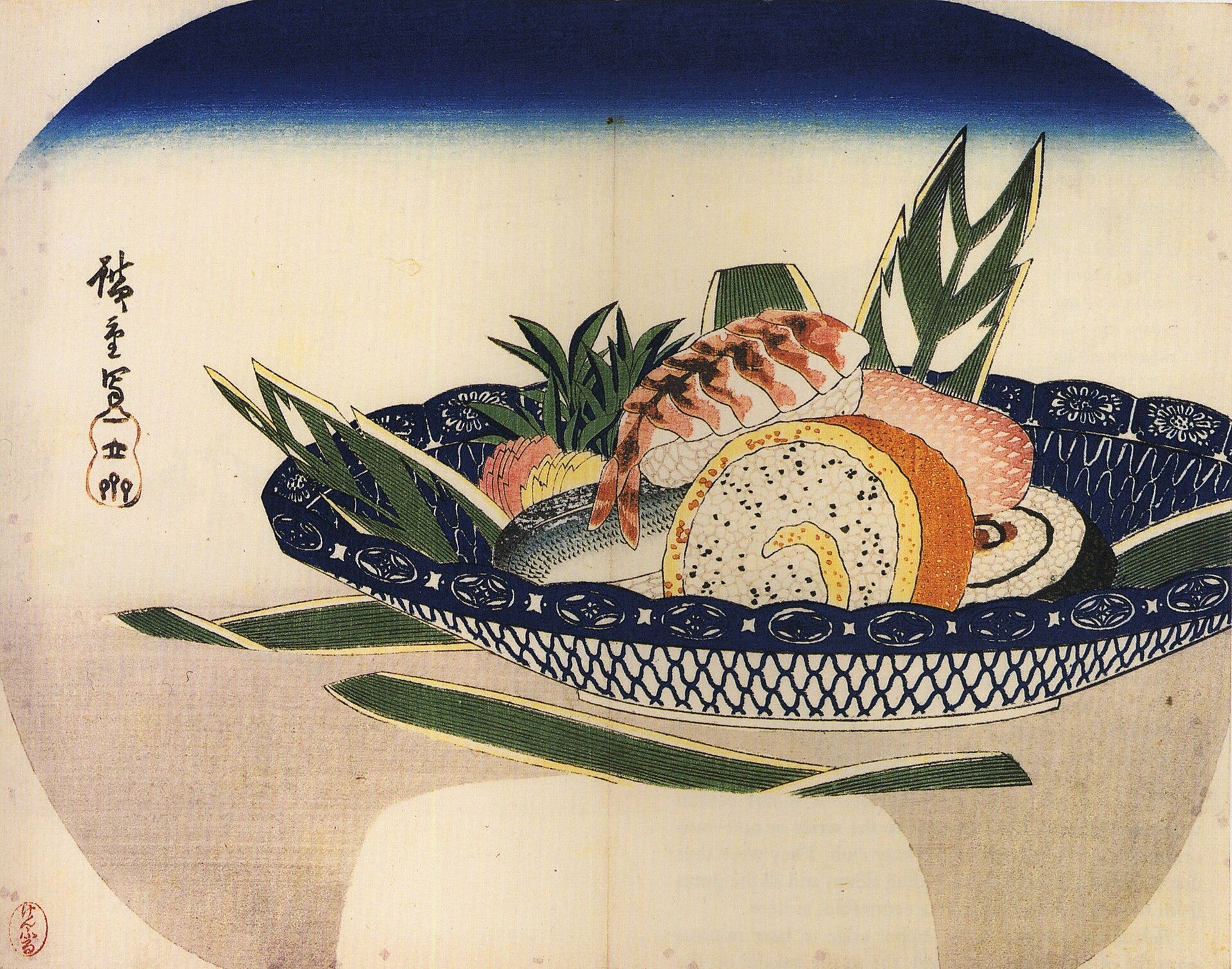
Damien: Before you tuck into your bacon and eggs. Given all the craft that goes into, though, maybe the best analogy is sushi. If you’ve ever seen Jiro Dreams of Sushi, you’ll know what I mean.
Michael: Exactly.
Damien: Whatever the metaphor, it’s not going to leave you feeling stuffed. Well, Michael, thanks so much for taking the time out of what we all now know to be your day. Really appreciate that, and all of the fantastic work. So, back to reading and researching and writing and pun-making and art-selecting.
Michael: Thank you. Good to chat.