

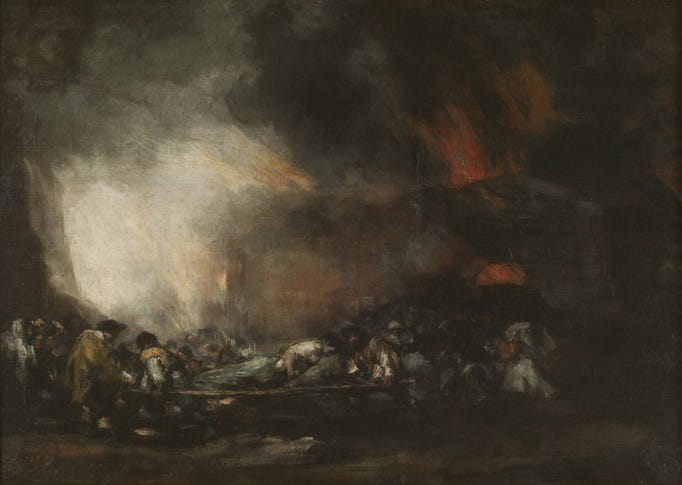
ISRAEL. PALESTINE. UNITED STATES. Into the fire.
Calls for diplomacy are rejected as the crisis deepens.
A blast killed at least 500 at a Gaza hospital on Tuesday, with Israel and Hamas blaming each other. The US embassy in Beirut was stormed. Amman cancelled a summit between Joe Biden and leaders from Jordan, Egypt and Palestine.
INTELLIGENCE. The Gaza hospital strike ignited protests across the region, including one that breached the US embassy in Lebanon and set fire to a UN office. Hamas blamed an Israeli air strike; Israel claims the hospital was hit by an errant rocket from a Palestinian group. And while key players cannot be seen publicly meeting the US at this point, intense talks between US officials and key actors are undoubtedly taking place behind the scenes.
FOR BUSINESS. Several media sources reported that Biden is considering a defence package of around $100 billion to support Israel, Ukraine and Taiwan. The large sum would reportedly cover a full year of funding. The true costs of these wars are only just starting to emerge. On Tuesday, the UN released a report showing that Russia's destruction of the Kakhovka dam had caused almost $14 billion in damage, with recovery and reconstruction likely until 2033.
Written by former diplomats and industry specialists, Geopolitical Dispatch gives you the global intelligence for business and investing you won’t find anywhere else.
CHINA. UNITED STATES. Chip on the shoulder.
Export controls on sensitive technologies are tightened.
Washington unveiled new measures on Tuesday to stop shipments to China of advanced AI chips that could have military applications. Another 21 countries will also face expanded licensing requirements for chipmaking tools.
INTELLIGENCE. The new measures take effect in 30 days and attempt to close loopholes in the chip and chipmaking regulations released in October 2022. The rules explicitly “restrict the PRC’s ability to both purchase and manufacture certain high-end chips critical for military advantage”. The US has been alarmed by the pace and development of Chinese chip-making technology, with workarounds proving an effective means of circumventing chip export bans.
FOR BUSINESS. There will be new limits on computing power for chips per unit size. Additionally, the rules will apply to exports to any firm, if their parent companies are headquartered in China or arms-embargoed nations. While the impacts will certainly be felt at large companies, such as Nvidia, which developed special chips for the Chinese market based on previous rules, smaller firms trying to get a foothold in the Chinese market will also be impacted.
With the brevity of a media digest, but the depth of an intelligence assessment, Daily Assessment goes beyond the news to outline the implications.
ARMENIA. AZERBAIJAN. A hand extended.
Yerevan sets out a timeline for peace.
Armenia’s prime minister told the EU on Tuesday he was willing to sign a treaty with Azerbaijan by the end of the year. Azerbaijan's president on Sunday raised the national flag in the former ethnic-Armenian region of Nagorno-Karabakh.
INTELLIGENCE. At the European Parliament, Prime Minister Nikol Pashinyan said Armenia and Azerbaijan must move towards peace and Armenia wanted a simultaneous withdrawal of troops back to the 1991 borders. But such sentiments aren’t new, and the border has never been formally demarcated, with ethnic enclaves still on either side. And while Armenia calls for a treaty based on 1991 borders, Azerbaijan now sees itself in an ascendant position.
FOR BUSINESS. The conflict between Israel and Hamas has diverted attention, and Azerbaijan will feel less pressure to cede ground. Nagorno-Karabakh is now fully under Baku’s control, most Armenians have fled, and the self-declared Karabakh Republic of Artsakh confirmed all institutions will be dissolved by 1 January. Turkey and even Russia appear to be firmly behind Azerbaijan too. Earlier this month, Russia's Lukoil lent Azerbaijan's state oil firm $1.5 billion.
INDONESIA. Land of the rising son.
A constitutional court ruling is heavily criticised.
Indonesia’s Constitutional Court on Monday made a last-minute change to presidential and vice-presidential candidate requirements, effectively allowing President Joko Widodo’s son Gibran to run in the 2024 presidential election.
INTELLIGENCE. Widodo is popular, but there has been a chorus of condemnation, including from Indonesia’s judicial elite. The decision allows people who have previously been elected to a regional post to run for the presidency, regardless of age, whereas the previous rule required all candidates to be at least 40 years old. In a country saddled with dynasties, calls of nepotism have rung out, particularly as the Court is chaired by Widodo’s brother-in-law.
FOR BUSINESS. The ruling came just before registration opens, on October 19, for candidates for the 2024 election. President Widodo is constitutionally barred from running for a third term, but his son could become the running-mate of lead candidate and defence minister Prabowo Subianto. Indonesia has seen a boom on the back of increased resource exports, relatively low inflation, and increased tourism, but corruption and cronyism remain endemic.
Emailed each weekday at 5am Eastern (9am GMT), Daily Assessment gives you the strategic framing and situational awareness to stay ahead in a changing world.
GUINEA-BISSAU. TURKEY. Power outrage.
An unpaid bill cuts off a capital city.
Power to Bissau, the capital of Guinea-Bissau, was cut off by Turkish firm Karpowership on Tuesday, on account of unpaid bills. Karpowership also briefly cut electricity to Freetown, Sierra Leone, in September, due to a $40 million debt.
INTELLIGENCE. There is a reported $15 million in unpaid electricity debts owing to the Turkish company. The power went off on Tuesday and has yet to be restored. The economy minister said arrangements were underway to pay the arrears within 15 days, but an entire city continues to go without electricity in the meantime. Guinea-Bissau has an exclusive power deal with Karpowership, which supplies 100% of the needs of the West African country of 2 million.
FOR BUSINESS. Guinea-Bissau is a strategic minnow with an economy almost entirely based on agriculture and minor gold exports. Per capita GDP is among the world’s lowest, and it continues to struggle with instability. There have been at least 10 coups or attempted coups since its 1974 independence from Portugal. Turkey has promoted its firms in Africa, supported by increased aid, presidential visits, and the partly state-owned Turkish Airlines.