

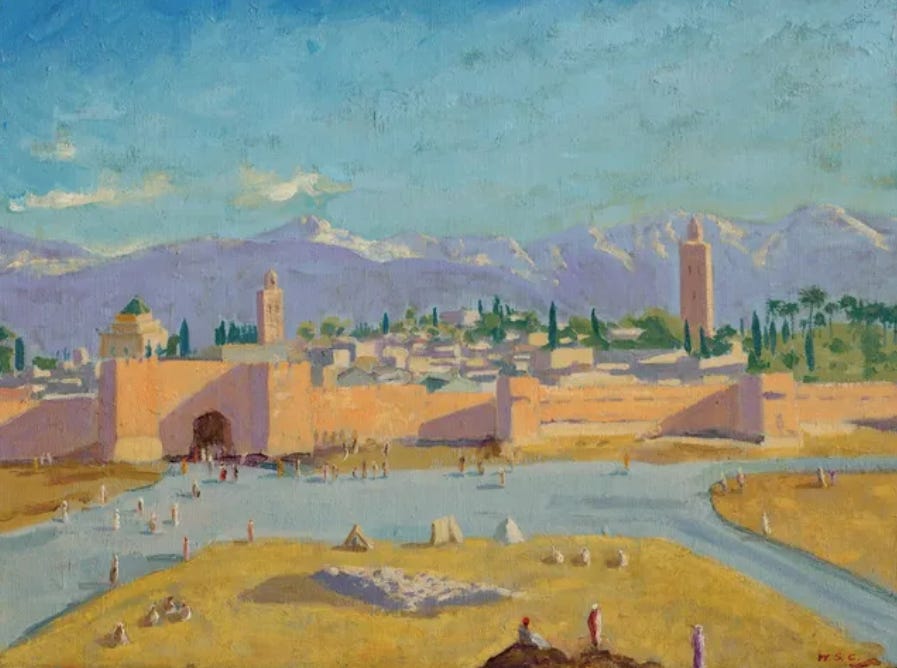
MOROCCO. ALGERIA. Seismic shift.
Hope comes amid tragedy.
Rescue efforts continued early on Monday after Friday night's earthquake near Marrakesh killed at least 2,100. Algeria offered aid to Morocco on Sunday, after opening its airspace on Saturday to humanitarian and medical flights.
INTELLIGENCE. Morocco and Algeria severed relations in 2021 over Rabat’s alleged support for Berber separatists and amid Algiers’ open support for Sahrawi separatists in Western Sahara. In March, Algiers said ties had reached “the point of no return”. This month, two Moroccan tourists were shot by Algerian border guards. But as was the case for Turkey and Syria in the wake of earthquakes in February, a natural disaster could yield a neighbourhood détente.
FOR BUSINESS. Better Moroccan-Algerian relations could reopen the Maghreb–Europe Gas Pipeline at a time when LNG prices are at recent highs thanks to Australian strikes.A Russia-pushed North African free trade area could also gain impetus if the region's second and third-biggest economies repair ties. Western Sahara remains an irritant, but a visit on Friday ahead of the quake by the UN’s regional envoy – his first since being appointed in 2021 – bodes well.
ISRAEL. SAUDI ARABIA. INDIA. Two belts, two roads.
A deal seems more silk purse than Silk Road.
Joe Biden joined leaders from India and Saudi Arabia in the margins of the G20 on Saturday to announce a new India-Middle East-Europe Economic Corridor. The project will link Piraeus in the west to Mumbai in the east via sea and rail.
INTELLIGENCE. While described by Biden as a “big deal”, it is hard to see how sending a container overland through Israel, Jordan, Saudi Arabia, and the UAE would be better than sending one via the Red Sea. The proposal is more a part of Washington’s efforts to normalise Israel-Saudi relations and integrate the Jewish state into Arab infrastructure – something that India also supports as a counter to China’s Belt and Road Initiative, which turns ten in October.
FOR BUSINESS. Trains from Israel to the Gulf could benefit local firms but will not displace international routes. Nor will the Corridor, if built, displace Chinese infrastructure. Riyadh, which has flagged compulsory Mandarin lessons in Saudi schools, has flirted with Chinese-built nuclear power if the US does not provide it as part of an Israel deal. Last week, the Bank of China opened its first branch in the Kingdom, where trade is increasingly being settled in yuan.
Written by former diplomats and industry specialists, Geopolitical Dispatch gives you the global intelligence for business and investing you won’t find anywhere else.
CHINA. UNITED STATES. Containment lines.
Biden gaffes his way out of diplomatic détente.
Joe Biden said on Sunday he didn't want to “contain” China and added he didn't think Beijing's economic slump would cause it to invade Taiwan. “As a matter of fact, the opposite, probably doesn't have the same capacity that it had before.”
INTELLIGENCE. Biden’s staff were visibly uncomfortable at his press conference in Hanoi. Beijing, which recently proposed criminalising statements that “hurt the feelings” of the Chinese people, may feign outrage, but will be less uncomfortable as incidents like these distract from resurfaced rumours that a brain aneurysm has forced Xi Jinping to avoid the G20. It may even give Xi an excuse to skip the APEC Leaders’ Meeting, which Biden hosts in November.
FOR BUSINESS. US and Chinese officials – including Janet Yellen and Gina Raimondo – have worked hard this year to stabilise Sino-US ties, but unless leaders can meet (Biden’s meeting with Li Qiang in Delhi doesn’t count) the risk of an accident looms large. The same goes for a lack of dialogue between the US and Chinese militaries. The two powers may be economically entwined, but they remain locked in strategic competition and thus prone to misstep.
VIETNAM. UNITED STATES. Partnering up.
US attention could shift to the Mekong.
The US and Vietnam signed a 'comprehensive strategic partnership' on Sunday during Joe Biden's visit to Hanoi. The Mekong River Commission released its annual report on Thursday, noting increased salinity and barriers to water flow.
INTELLIGENCE. Biden’s visit caps off a partnership that began under Clinton and accelerated as US-China ties broke down. The US has attempted to match burgeoning trade flows with deeper naval cooperation, but Vietnam has been more hesitant than the Philippines, a fellow South China Sea claimant, in challenging Beijing in the region. A more fertile area could be in the Mekong, which flows to southern Vietnam from tributaries that China has begun to dam.
FOR BUSINESS. The Laos-based Mekong River Commission was typically oblique in its comments, but all Mekong countries share concerns about the river, particularly as rice prices hit 15-year highs. Vietnam’s success as a rice exporter – and its broader economic stability – could be endangered by predicted droughts during the current El Nino weather pattern. Cambodia and Laos, close to China, may also be willing to support a greater US role if it can help.
With the brevity of a media digest, but the depth of an intelligence assessment, Daily Assessment goes beyond the news to outline the implications.
UKRAINE. RUSSIA. Papering over.
The G20 gets a joint statement, but at Kyiv’s expense.
The White House hailed a G20 statement on Ukraine as "consequential", despite it not mentioning Russia’s invasion. The Kremlin also welcomed the communique, to which Kyiv responded with sarcastic messages on social media.
INTELLIGENCE. For the officials who negotiated the year’s first G20 joint statement, this may look like a victory, but it fails to see the wood for the trees (or the paper). Despite the absence of Xi and Putin, the US failed to achieve a sterner rebuke to Moscow. Brazilian President Lula da Silva will host next year's summit. And as if to emphasise the point, he said Putin would be welcome, despite an outstanding arrest warrant from the International Criminal Court.
FOR BUSINESS. As the G20 fades into banal platitudes, the war in Ukraine grinds on. Despite immense Western aid and a huge cost to Ukrainian lives, the insipid message from the global community suggests a waning enthusiasm.The next test will be whether the EU extends a ban on Ukrainian grain on 15 September, to which Kyiv has threatened arbitration. Another will be whether North Korea can be prevented from supplying Russia with arms (and vice versa).
THE MALDIVES. Reef knot.
Another island state is tied between India and China.
A second-round presidential poll will be held on 30 September, the Maldives' Election Commission said on Sunday. Pro-China opposition candidate Mohamed Muizzu secured 46% of the first-round vote to 39% for incumbent Ibrahim Solih.
INTELLIGENCE. Muizzu, who is mayor of the capital Malé, is a UK-trained engineer and is known for his support for Chinese-backed megaprojects such as the Sinamalé Bridge and the artificial island of Hulhumalé. His Progressive Party under former president Abdulla Yameen – currently in prison – is also known for its 'India Out' campaign. Solih wants to keep Delhi close, notwithstanding allegations of its heavy-handed interference in internal Maldivian affairs.
FOR BUSINESS. Though famous for tourism, the Maldives also straddles a major shipping lane. Delhi wants to avoid ceding influence to Beijing, which gained a potential base in Sri Lanka next door before the latter’s government collapsed under Chinese-issued debt last year. Further to the south is the British Indian Ocean Territory, which hosts a US naval base. BIOT’s sovereignty is disputed by Mauritius, whose prime minister met Rishi Sunak on Saturday.
Emailed each weekday at 5am Eastern (9am GMT), Daily Assessment gives you the strategic framing and situational awareness to stay ahead in a changing world.