


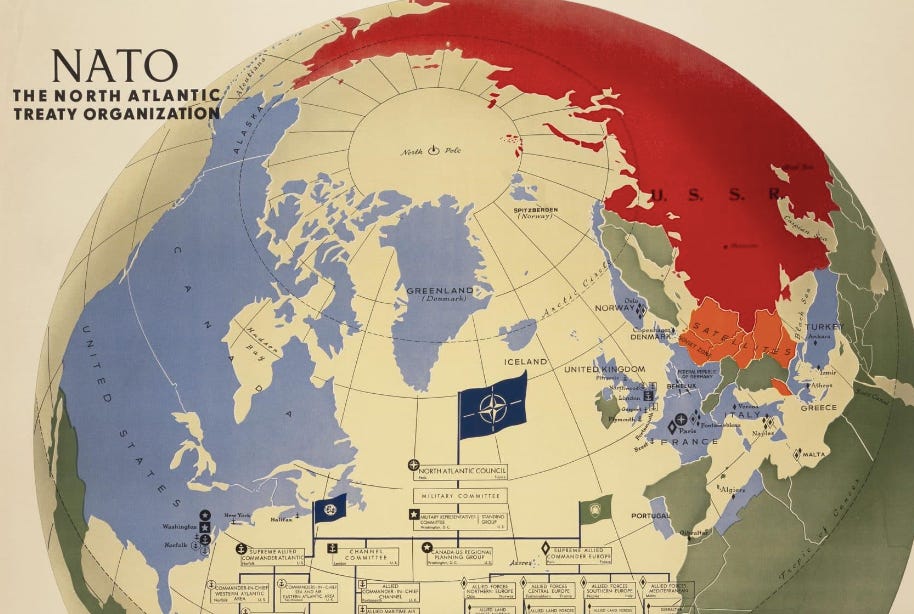
Welcome to this week’s Not in Dispatches where, on the two-year anniversary of Russia’s invasion of Ukraine, we are looking at the North Atlantic Treaty Organisation (NATO).
In the beginning
NATO was born in a different geopolitical era. In 1949, Europe remained devastated by World War II. Germany, the once aggressive imperial power, had been not only defeated but split in two. The Iron Curtain divided the continent. And a bipolar world order – and the Cold War – had begun to emerge.
At the time, the United States and its allies saw Soviet expansion as the most serious threat to peace and their own security. NATO was established primarily to secure Western Europe as part of the broader ‘Truman Doctrine’ strategy of containing the USSR by encircling it with collective security arrangements. NATO would protect Western Europe while the now-defunct Central Treaty Organisation (CENTO, 1955-1979) and the Southeast Asia Treaty Organisation (SEATO, 1954-1977) would prevent the dominos of communism falling on the other flanks.
The original rationale for NATO was succinctly encapsulated in its founding treaty, which articulated the principle of collective defence – most famously in Article 5, which states that an armed attack against one or more members is considered an attack against all. This principle was a radical departure from the pre-war notions of national military security, reflecting a commitment to a new order based on mutual defence and shared values of democracy, liberty and the rule of law. NATO, in this sense, represents not only a Western alliance but – to its members and detractors alike – a bedrock of the Western-led post-WW2 order.
NATO’s raison d'être has transformed through the decades. When birthed, NATO’s role in Europe’s security was clear – “to keep the Soviet Union out, the Americans in, and the Germans down”, in the words of Lord Ismay, NATO’s first Secretary General.
At the time, the Europeans wanted to keep America engaged in European affairs and seize a rare moment when it had departed from its traditional isolationist foreign policy. Both wanted to deter Soviet expansion and prevent the spread of communism. And both wanted to ensure Germany would not re-emerge as an aggressive imperial power: after all, it had effectively started three major wars in the past 75 years.
Mid-life crisis
But once the Berlin Wall fell, Germany reunified and the Soviet Union disintegrated, NATO’s role suddenly became less clear.
The early 1990s were characterised more by constructive engagement than containment. Indeed, by 1993, Boris Yeltsin was angling for Russia to join NATO. Liaisons were appointed and a NATO-Russia Founding Act and a NATO-Russia Council were established in 1997 and 2002 respectively. During this ‘unipolar moment’, cooperation made sense because, above all, Russia was weak and no longer had an ideological conflict with the West.
Over the next twenty years, NATO’s priorities shifted. After the terrorist attacks of September 11, NATO invoked Article 5 for the first and only time in its history. The group’s focus became combating terrorism and for nearly two decades NATO allies (and partner countries) had military forces deployed to Afghanistan. Russia, its traditional foe, was off NATO’s radar.
NATO, however, was not off Russia’s radar, especially once Vladimir Putin came to power.
From Moscow’s vantage point, despite NATO’s military efforts being focused on Afghanistan, its membership was steadily growing to include countries Russia considered as within its sphere of influence. And despite what NATO said about being a purely ‘defensive’ pact, Russia saw considered its expansion as aggressive and threatening.
Since the end of the Cold War, NATO expanded from 16 to 31 members.
Czechia, Hungary and Poland became the first former members of the Warsaw Pact to join in 1999. Seven countries (Bulgaria, Estonia, Latvia, Lithuania, Romania, Slovakia and Slovenia) acceded in a major wave in 2004 such that all former Warsaw Pact members were now allied with the United States. And these were followed by Albania and Croatia (2009), Montenegro (2017) and North Macedonia (2020).
Vladimir Putin saw NATO’s expansion as a betrayal of promises made by US Secretary of State James Baker to Mikhail Gorbachev on 9 February 1990 that NATO would not expand “one inch forward” if Russia accepted Germany’s reunification – promises soon repeated by Chancellor Helmut Kohl and the NATO Secretary General.
There remains some ambiguity about what was actually promised. Putin believed it was a broad promise not to allow countries in eastern Europe closer to Russia’s border to join the alliance. Although America, NATO, and even Gorbachev himself, have said that Baker was only promising not to deploy additional forces in the former GDR after reunification.
Either way, NATO’s expansion into Eastern Europe — always requested by new members and often out of a desire for protection from Russia — created a sense of betrayal, mistrust and fear in Moscow. While we may never know the extent to which NATO enlargement – and, specifically, dangling the possibility of Ukraine joining – contributed to Putin’s decision to invade Ukraine, it is clear this decision has reinvigorated NATO’s original purpose.
Geopolitical Strategy is the advisory firm behind Geopolitical Dispatch. Our partners are former diplomats with vast experience in international affairs, risk management, and public affairs. We help businesses and investors to understand geopolitical developments and their impacts with clarity and concision.
Blowback
Beyond reinvigoration, Russia’s invasion of Ukraine has directly led to a greater NATO presence in Eastern Europe.
Finland departed from its longstanding policy of military non-alignment to join NATO in 2023, doubling NATO’s land border with Russia. Sweden, equally famous for its neutrality, looks set to join following Hungary’s agreement. And many NATO members now talk much more confidently about Ukraine joining — once the war finishes.
NATO has also ramped up its drills and is presently undertaking its largest military exercise since the Cold War – “Steadfast Defender 2024”. Over 90,000 troops from all 31 NATO allies, plus Sweden, are wargaming for five months the deployment of American troops to and across Europe. NATO describes this as “a clear demonstration of our unity, strength and determination to protect each other, our values and the rules-based international order”. Russia describes it as a threat.
NATO countries have significantly increased their defence spending too. In 2024, 18 of the 31 members are expected to meet or exceed the 2% GDP defence spending requirement, up from ten countries in 2021 and only four countries in 2017. Defence spending has risen not only because of Donald Trump’s hectoring but also because many European governments see a genuine threat from Russia for the first time since the Cold War.
Since 2022, neighbouring countries Poland, Norway, Lithuania and Estonia have all significantly increased their defence budgets. Further south, Italy and Spain have renewed their commitment to reaching the 2% target. Germany has set up a €100 billion fund to increase defence funding (though critics have said that much of this has eroded due to inflation). And France has committed to doubling its defence budget from 2017 levels by 2030.
Emailed each weekday at 5am Eastern (9am GMT), Geopolitical Dispatch goes beyond the news to outline the implications. With the brevity of a media digest, but the depth of an intelligence assessment, Geopolitical Dispatch gives you the strategic framing and situational awareness to stay ahead in a changing world.
A troubled partnership
The biggest challenge to NATO may not come from without but from within.
Chief among these is a potential second Trump presidency. Donald Trump has, for many years, criticised NATO members for not paying their fair share. America’s defence budget (approximately $860 billion) is, after all, more than ten times that of its second-largest contributors (Germany spends $68 billion, the UK spends $65 billion and France spends $56 billion). On the campaign trail, Trump recently went further, saying he would encourage Russia to invade any NATO member that failed to reach its 2% defence spending target.
Trump’s rhetoric should not be taken literally. But his comments speak to his essentially isolationist approach to foreign policy – wanting to avoid costly and entangling alliances and instead focus primarily on domestic prosperity and security.
And so a priority for many European leaders today is, once again and just ahead of NATO’s 75th anniversary, to keep Russia out and America in.
We hope you are enjoying Geopolitical Dispatch, as well as these weekly essays. Please feel free to share with a friend or colleague, or leave a comment below.