


Hello,
In this week’s Irregular, we provide a briefing on Russian foreign policy through the lens of its unique history, geography, and culture.
It’s an addendum to a piece we wrote last year – Russian rules of thumb – and a bit of context following Russia’s (re-)invasion of Kharkiv Oblast, in Ukraine’s north, over the past 24 hours. It should also hopefully contextualise two of this week’s more symbolic but – to Russia – pertinent events: the inauguration of Vladimir Putin, on 7 May, and the snowy Victory D parade in Moscow on 9 May.
The very cranky bear
Russia is the world’s largest country and (still) the world’s preeminent land power.
From the Bering Sea, abutting Alaska, to its western enclave of Kaliningrad, Russia spans eleven time zones and half the lines of longitude of the world.
Russia shares land borders with 14 countries, from Poland to North Korea. It has two narrow maritime boundaries, with the United States and Japan. And its principal seacoast, in the Arctic north, is unusable for most of the year.
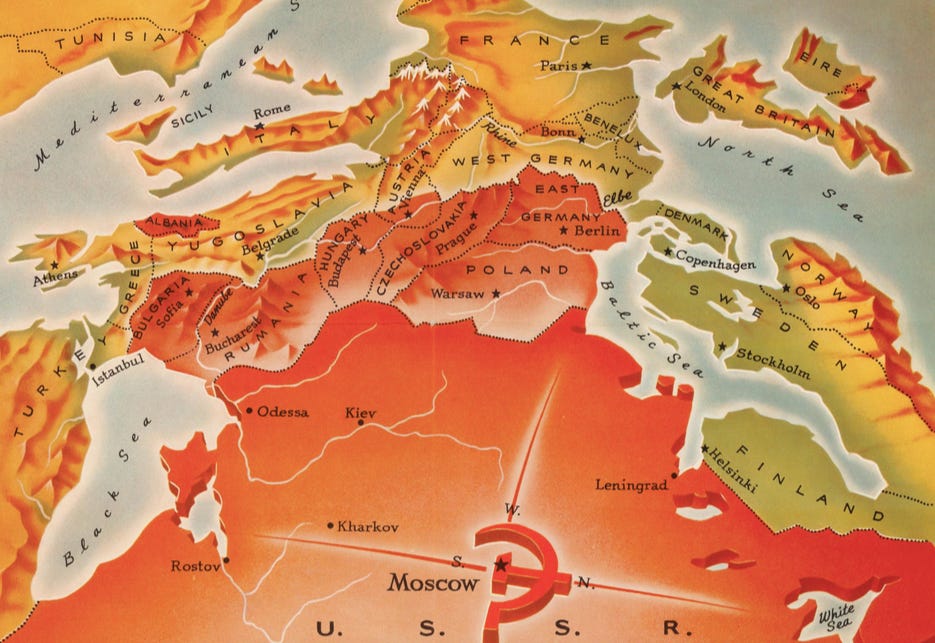
But for all of Russia’s many neighbours, Russia has very few natural borders.
It is open at most sides to invasion, especially across the flat western plains. As a land power, it lacks the protection of the oceans. And memories of invasions by the Swedes, the Poles, the French, the Germans, and the Lithuanians – not to mention the Mongols, the Vikings, and various Turkic tribes – have created an insecure, suspicious, and hard-headed national character.
Putin, looking out from the Kremlin – a fortress structure repeated across the Russian lands as an architectural tribute to this history – and seeing the same invasion routes as the tsars and communist rulers before him, draws the same conclusion: Russia needs buffer states.
Expand or risk being conquered instead.
And if direct territorial control is impossible, achieve indirect control by keeping neighbouring countries weak, and fighting wars abroad to keep hostile powers at bay.
Putin may base his justifications for invading Ukraine on history, but Russian strategy is rooted fundamentally in geography. Whether annexing Ukraine, invading Georgia, or expanding influence over its ‘near abroad’, Russia’s primary driver is almost always defending its territory and, simply, keeping the enormous country together.
As a consequence of geography, Russia’s default mode is expansion. Defence often means offense, and any threats to losing control of what it considers its buffer states will trigger a visceral response.
Horrible histories
Just as geography constrains Russia, so too does history.
Russia has a long, effectively uninterrupted, history of authoritarian rule.
Ever since the Mongol invasion of the 13th century, and its subsequent two centuries of subjugation, which introduced a harsh tribute system that necessitated efficient administration and ruthless leadership, Russia has had a system of centralised authoritarian control.
From tsarist days through to the Soviet Union, Russia has never known democracy, the rule of law (in Western terms) or government accountability, and instead always tended towards authoritarianism. And Putin’s Russia is no aberration but a mere continuation of this long trend.
Russian schoolchildren are typically taught that the only way to govern such a huge territory is through a strong ruler.
Federalism has never been tested. Nor really has democracy or accountability — anything that would challenge the ruler. Russian elections are shams, and the Russian populace knows this. But they also, for the most part, believe that having a strong leader is what matters most.
In this context, Putin’s rebuilding of a strong army — at least until it had been weakened in Ukraine — subordinating institutions to his will, and empowering the intelligence agencies as the most powerful and important instruments of state fits within a long historical tradition.
Sacralisation of the ruler notwithstanding, Putin does not control everything in Russia. Putin has never been omnipotent, ruling not by diktat but by arbitrating disputes among elites, allocating resources, and keeping everyone in balance. Over the past two decades, institutions have been hollowed out and serve as instruments of this highly personalised system of “manual control”.
Geopolitical Strategy is the advisory firm behind Geopolitical Dispatch. Our partners are former diplomats with vast experience in international affairs, risk management, and public affairs. We help businesses and investors to understand geopolitical developments and their impacts with clarity and concision.
Control panel
While Putin remains the most powerful political actor, his role is more that of arbiter among warring factions than a Stalin-like figure, with direct command and control.
In such a system, Putin remains the ‘godfather’ — the capo dei cappi — with Russian politics is best viewed as a brutal competition between feudal lords atop a technocratic bureaucracy. Some of these elites can be characterised as warlords; some are retail politicians; some are oligarchs; and then there are the siloviki, who run the security services. Russian policy positions, whether domestic or foreign, are often what is left after the battles between these elites have been won or settled.
And just like any mafia boss, Putin’s primary concern is survival. Russian leaders tend not to leave power voluntarily. For Putin, keeping the peace means keeping his head.
Priority number two is keeping the immense, diverse country together.
“Stability” is Putin’s watchword and has always been his main appeal. That means keeping elites in check so that no one can threaten his rule. But it also means avoiding anarchy in a country that suffered chaos after 1917 and 1991. For years, Putin’s legitimacy derived from the public’s assumption that only he could hold Russia together.
While many Western observers suggest that the Ukraine War and the Wagner mutiny have led elites and those in the general populace to question whether that remains true, Putin nevertheless remains broadly popular. He also remains — for elites and the populace alike — the only real option.
No one knows what would happen if Putin were to get hit by a bus (or, like his enemies, fall out a window), and few want to run the risk of anarchy breaking out as it did during the 1990s. And even if it didn’t, history suggests that the next Russian ruler would be equally authoritarian with a similar geopolitical outlook.
In Soviet Russia, economy sanction you
A corollary of Russian centralisation of power and lack of democratic institutions is that economic concerns are secondary.
Unlike in the West, Russian rulers, including Putin, do not prioritise growth and incrementally raising living standards. They favour economic security via autarky.
The state hoovers up resources (oil, gas and minerals) and allocates them to elites for patronage. Monetary policy is designed to weather shocks from external enemies. Trade relations are developed to reduce dependence on the West.
Russians are used to economising with money and choice. Where security and economics collide, security always trumps. Hence sanctions are not only tolerated but used to shift trade to Asia, reduce dependence on imports, develop local industries, and blame the West for the country’s woes.
The Russian system — irrespective of popular protests led by brave oppositionists like the late Alexei Navalny — also means that public opinion barely matters.
Russia may have the trappings of democracy, but a liberal democracy in the Western sense it is not. The tsar must still remain popular for legitimacy. But unlike Western leaders, Putin does not make decisions based on opinion polls.
Russians also tend to rally around the tsar. They are patriots, and can endure a lot of suffering in support of the state. Further, there is a political tendency to “blame the boyar, not the tsar”.
Emailed each weekday at 5am Eastern (9am GMT), Geopolitical Dispatch goes beyond the news to outline the implications. With the brevity of a media digest, but the depth of an intelligence assessment, Geopolitical Dispatch gives you the strategic framing and situational awareness to stay ahead in a changing world.
Fatalist attraction
As such, Russian political culture tends to be fatalistic and politically passive. Whatever gripes Russians have about Putin and the state, they will unlikely push for change.
Most people accept the system, do not believe it can change, and keep their heads down. They certainly do not want a revolution. And those who push for reform – the intelligentsia, the “cultural class”, journalists and civil society – have largely been suppressed or have emigrated.
Both Prigozhin’s and Navalny’s fate closed any remaining doubt.
Russian foreign policy will likely continue following the precepts it has followed for centuries — geographical expansion and centralising authoritarian rule, above all.
But making more specific predictions is challenging.
Kremlinology is a dark art. The main players keep their cards to their chest, and often even they cannot predict events.
The Kremlin constantly lies. Russian television is mostly propaganda. Independent media has been stifled. Foreign correspondents are, quite rightly, too scared to enter the country, especially after the arrest of the WSJ’s Evan Gershkovich — as clear a signal as any on the direction of the Russian state.
And so it makes sense to take any confident assertions about Russia with a grain of salt — and any specific predictions with a jar of dill pickles.
Best wishes
Damien
