

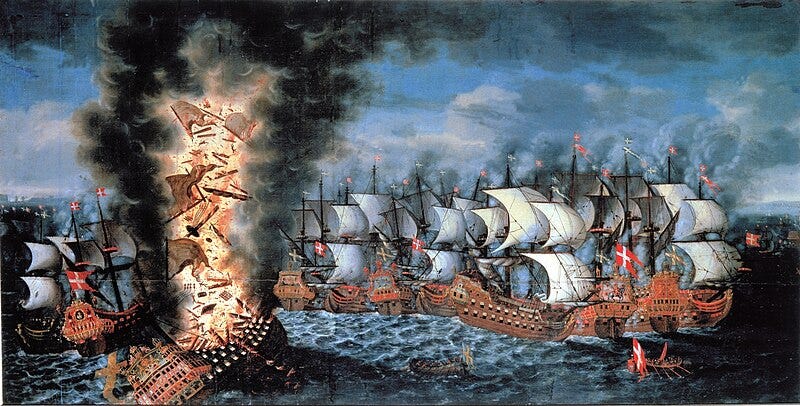

SWEDEN. Waterloo.
History is always repeating itself.
Turkish President Recep Tayyip Erdogan condemned Sweden on Thursday for permitting the burning of a Koran outside Stockholm’s largest mosque on Eid al-Adha. Dozens of protesters stormed Sweden's embassy in Baghdad.
INTELLIGENCE. Sweden’s freedom of expression is constitutionally enshrined, but the timing is bad as Stockholm awaits Ankara’s approval to join NATO. Despite Sweden acquiescing to his demands on Kurdish refugees, Erdogan will now want more concessions. His big ask is for the US to remove sanctions on Turkey’s purchase of Russian S-400 missile defence systems, putting Washington in a bind ahead of the NATO summit in Vilnius on 11 July.
FOR BUSINESS. Sweden’s NATO accession was already shaky. The bigger risk for Stockholm is its reputation in the Muslim world.When a Danish paper published cartoons of Muhammad in 2005, boycotts led to a 50% drop in exports to the Middle East. A Swedish cartoon in 2007 led to protests and terrorism. The incident also casts a spotlight on Sweden’s culture wars, refugee policies and right-wing extremism on the final day of Sweden’s EU Council presidency.
FRANCE. Battle of Paris.
A police killing is a gift for propagandists.
France saw a third night of riots on Thursday after the shooting of a teenager of Arab descent on Tuesday. More than 400 have been arrested and around 40,000 police officers have been deployed across the country.
INTELLIGENCE. France’s third fatal police shooting during a traffic stop this year, following 13 in 2022, the incident has unleashed a wave of pent-up anger and revived memories of the 2005 banlieue riots, which over three weeks led to a state of emergency and 2,888 arrests. Had Paris not already been convulsed by so many protests – from the gilets jaunes of 2018 to the pension reform riots earlier this year – the comparisons to George Floyd would be valid.
FOR BUSINESS. The glass will be swept away and La Défense’s dealmakers will continue trading, but the manifest dissatisfaction in Emmanuel Macron’s France is being reported with glee in Russia, Iran and China. In Africa, it is also being used to highlight perceptions of structural racism, which actors like Wagner, perhaps ironically, have exploited to disrupt Paris’s sway. Even the US, on the day its courts overturned university affirmative action, appears shocked.
Written by former diplomats and industry specialists, Geopolitical Dispatch gives you the global intelligence for business and investing you won’t find anywhere else.
UKRAINE. Hit and miss.
The costs of military support grow higher.
EU leaders said they would continue funding Kyiv through the European Peace Facility on Thursday but stopped short of a mutual defence pledge. The Pentagon on Thursday denied reports it would send Kyiv long-range ATACMS missiles.
INTELLIGENCE. The Army Tactical Missile System would give Ukraine a range of 300 kilometres, but the US has so far been unwilling to provide the capability due to escalation concerns and the fact that stocks for the discontinued missile system – which costs over $1 million per unit – are already depleted. What isn’t depleted is EU rhetoric, but only NATO can provide real deterrence, and the chances of Ukraine’s near-term membership are vanishingly low.
FOR BUSINESS. The US approved another $500 million in aid on Tuesday, adding to a $40 billion tally. Yet the high sums, and impressive kit, have so far failed to win back much territory since Ukraine’s counter-offensive began. Unless Russia collapses, or NATO provides guarantees (both unlikely), the war’s resolution will be through attrition or negotiated settlement. The failure to get US ATACMSs, or Swiss Leopard tanks, won’t make much difference.
BELARUS. RUSSIA. Apparition at Asipovichy.
A Wagner military base suddenly appears.
Satellite imagery released Thursday suggested the construction of a Wagner Group base 90 kilometres south of Minsk and 280 kilometres from Ukraine. Russian media said Wagner was using a vacant facility in the town of Asipovichy.
INTELLIGENCE. The swift building of an 8,000-person mercenary camp is not troubling for both Ukraine and NATO. Further, Asipovichy hosts the 465th Missile Brigade, Belarus’s only ballistic missile unit and – alongside the Lida Air Base near the Lithuanian border – the likely location of tactical nuclear weapons on loan from Russia. Nuclear fears have been rising in recent weeks, with Ukraine claiming Russia plans to sabotage the Zaporizhzhia nuclear plant.
FOR BUSINESS. The rapidity with which Wagner has apparently constructed the base either suggests exceptional logistics or prior preparation (i.e., before the mutiny on 23 June). Much is still unknown about the weekend’s events and the exact involvement of Belarusian President Alexander Lukashenko, who claims to have mediated a resolution between Vladimir Putin and Yevgeny Prigozhin. Asipovichy will stay one of many mysteries for some time.
With the brevity of a media digest, but the depth of an intelligence assessment, Daily Assessment goes beyond the news to outline the implications.
CHINA. UNITED STATES. Bursting balloons.
Beijing wasn’t spying but it was using US spyware.
The Pentagon said on Thursday a Chinese surveillance airship shot down over the Atlantic in February did not collect any intelligence over the US. The Wall Street Journal reported that the craft contained US-made sensor technology.
INTELLIGENCE. Though it was the chief cause of Secretary of State Antony Blinken postponing his visit to Beijing until this month, Washington is now downplaying the balloon’s risk to US security. Still, allegations that it was filled with US equipment will enliven parallel debates on commercial espionage, sanctions-busting and technological superiority. The BBC’s Panorama programme showed footage this week of similar balloons over Taiwan and Japan.
FOR BUSINESS. China doesn’t need balloons to surveil the US, but it does need cutting-edge technology to become the world’s leading economic and military power. The competition is severest in artificial intelligence and advanced semiconductors, where Washington and its allies currently have an edge. More US export restrictions are expected. Nvidia shares fell on Thursday when its CFO said the restrictions could lead to a loss of opportunity for US firms.
SOUTH AFRICA. Talking to a BRICS wall.
Pretoria doesn’t seem to mind Western criticism.
South Africa said on Thursday it would proceed with the Brazil-Russia-India-China-South Africa Summit in August, as planned, despite its International Criminal Court obligations to arrest Vladimir Putin, currently under an ICC warrant.
INTELLIGENCE. Should Putin attend, South Africa will likely use the fudge of diplomatic immunity to let him enjoy the facilities of the Sandton Convention Centre. When former Sudanese president Omar al-Bashir visited in 2015, Pretoria claimed it had no duty to arrest a serving head of state of a non-ICC party. Then, as now, South Africa threatened to leave the court, which it has also claimed is biased. Until 2019, all ICC investigations had been over African countries.
FOR BUSINESS. Though it side-stepped US claims it had sent Russia arms, South Africa won’t turn its back on BRICS, which it judges will give it trade and investment without the hypocrisy of the West, which, in its view, preaches on human rights and law, but enabled colonialism and Apartheid. Other developing countries are keen to get in. Ethiopia said on Thursday it had applied to join. Growing powers from Indonesia to Saudi Arabia have also expressed interest.
Emailed each weekday at 5am Eastern (9am GMT), Daily Assessment gives you the strategic framing and situational awareness to stay ahead in a changing world.