

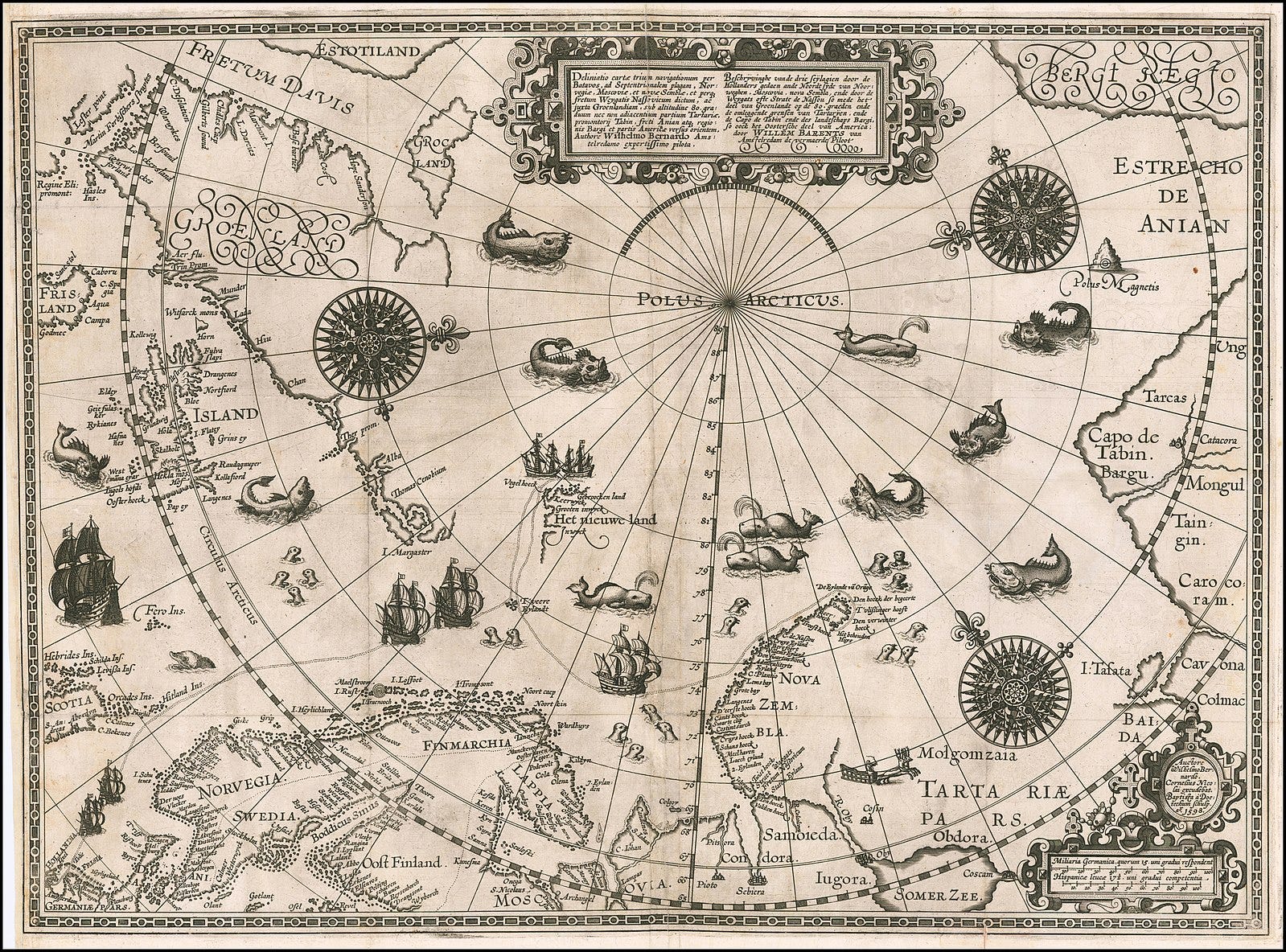
Welcome to the final Not in Dispatches for 2023 - a Christmas special on the geopolitics of Santa’s home: the Arctic.
Very Cold War.
Since the early days of the Cold War, the Arctic has been a geopolitical hotspot, temperatures notwithstanding.
For most of this time, the Arctic was a strategic frontier between the United States and the Soviet Union. The period saw a substantial military build-up, with both nations establishing military bases, conducting nuclear tests and patrolling Arctic waters, viewing it as a critical buffer zone and a potential launch site for nuclear missiles.
By the mid-1950s, the United States had become so concerned about Soviet military capabilities that it established the North American Aerospace Defense Command (NORAD). NORAD’s core mission was to provide early warning of possible air, missile or space attacks and defence against ballistic missiles. But since 1958 it has also tracked Santa’s flight path each Christmas Eve and claims to have intercepted his flight “many, many times” with its fighter jets.
The end of the Cold War brought a decrease in the region’s strategic significance and a shift towards cooperation among the eight Arctic nations (the US, Russia, Canada, Norway, Sweden, Finland, Iceland, and Denmark via Greenland). In 1996, the Arctic Council was established, seeking to promote collaboration, especially on environmental protection and sustainable development. And for a long time Arctic cooperation was one of the few areas of constructive engagement between the United States and Russia.
But climate change - and the war in Ukraine - has brought an end to all that.
Land ahoy.
In terms of climate change, the Arctic is being affected more than most places on earth. Changes in plant cover, shifting animal migration patterns, and the thawing of permafrost are making large parts of the Arctic unrecognisable compared to several decades ago.
Most significant in geopolitical terms, however, is the melting of summer Arctic ice, which according to NASA is shrinking at 12% per decade due to warmer temperatures. Melting ice is opening up new shipping lanes, reducing natural defences against invasion for the Arctic nations, and making accessible resources previously impossible to extract.
The increasing viability of the Northern Sea Route - a shipping route between Northeast Asia and Europe - will have major geopolitical implications. Currently operational for about 80 days a year, if the passage becomes ice-free the whole year round, it could potentially reduce transit time by at least 40 per cent compared to the route going via the Suez Canal.
Most experts reckon this could happen by 2050. Putin, speaking at the Belt and Road Forum in Beijing in October, said it would be next year.
Whenever it occurs, Europe-Asia trade will become cheaper, faster and safer, a boon for the global economy. Countries controlling maritime chokepoints (such as Egypt and Iran) or whose prosperity hinges on other sea lanes (like Singapore) will lose some influence in international affairs while Russia, which has sovereignty over 53% of the Arctic coastline, will gain a new and powerful tool in its diplomatic arsenal. And Russia-China trade will likely increase, further entwining the two nations challenging the West’s geopolitical supremacy.
Geopolitical Strategy is the advisory arm of Geopolitical Dispatch. With the same clarity of thought, but customised to your requirements, Geopolitical Strategy aims to ensure your business has the tools to manage geopolitical challenges.
Shippers would delight given real geopolitical risks from maritime chokepoints (which we covered earlier this month). Just this week, more than 100 container ships have been rerouted around southern Africa to avoid the Suez canal owing to the threat to vessels from Houthi rebels, adding three to four weeks to delivery times and jeopardising Christmas gifts (except those delivered by Santa who, of course, takes to the air). An alternative route free of pirates would no doubt be attractive.
But the biggest geopolitical winner might be China, which sees a “Polar Silk Road” as a component of its broader Belt and Road Initiative.
China is massively dependent on maritime shipping routes. Around 90% of Chinese products are transported by sea. China-Europe maritime trade is three times greater than air trade. And China’s geography makes it vulnerable to a naval blockade - what former President Hu Jintao used to call the “Malacca dilemma”.
Thawing Arctic ice would yield both economic and strategic benefits for China. Its businesses could ship more goods, more quickly and more safely to Europe. It would become less vulnerable to any potential blockade - for example, if the US were to impose one during a conflict over Taiwan. And it would have another option for importing strategic commodities like oil and natural gas, useful in times of both peace and war.
With the brevity of a media digest, but the depth of an intelligence assessment, Geopolitical Dispatch goes beyond the news to outline the implications.
Old game and the sea.
China - like other nations - is also increasingly interested in the Arctic because of the potential for new energy sources.
Beneath its thawing ice, the Arctic has major reserves of natural resources - primarily oil and gas, rare earths and fish - that are not only economically valuable but also strategically important.
Fossil fuel deposits are enormous, accounting for over 13% of the world’s undiscovered oil and 30% of its undiscovered gas. Russia and Norway have been actively exploring and exploiting these resources for years, while others - like the US and China - are poised to follow. A scramble for resources may be some time off since exploring, drilling and transportation will remain comparatively expensive and risky for many years. But in the long run, the region’s resources represent a potential economic boon for Arctic nations seeking growth, jobs and energy independence.
Of more immediate geopolitical significance is the Arctic’s large mineral deposits. The value of minerals in Arctic Russia alone is estimated at $1.5-2 trillion. Many of the rare earth metals (especially neodymium, praseodymium, terbium and dysprosium) that underpin advanced and renewable technologies are found in the Arctic. So too are the less “critical” but highly valuable minerals, such as lead, iron, nickel, zinc, gold and coal.
Written by former diplomats and industry specialists, Geopolitical Dispatch gives you the global intelligence for business and investing you won’t find anywhere else.
Arctic fish will also become more exploited. While a 2021 moratorium bans fishing in the Arctic high seas until 2037, once this lapses the Arctic will almost certainly become a major fishing spot. By then, Arctic fishing will not only be legal but more commercially lucrative given collapsing fish stocks worldwide, more navigable waters for trawlers and growing demand among a growing middle class.
With resource competition only likely to increase, so too will tensions over overlapping sovereign claims.
Russia, Canada, and Denmark (via Greenland), for instance, each claim the resource-rich Lomonosov Ridge seabed as their own territory. Russia’s claim extends even as far as the North Pole where in 2007 it planted an underwater (titanium) flag.
While so far territorial disputes have been peaceful (in February, the United Nations Commission on the Limits of the Continental Shelf found the vast majority of Russia’s claim to be valid), the past few years has also seen a military buildup in the region.
Father Christmas (and Ded Moroz, his Russian Orthodox counterpart) declined to comment.
We hope you enjoyed the last edition of Not in Dispatches for 2023. We’ll return to your inbox on 8 January and wish you a merry Christmas and a happy new year.
Best,
The Geopolitical Dispatch team.