

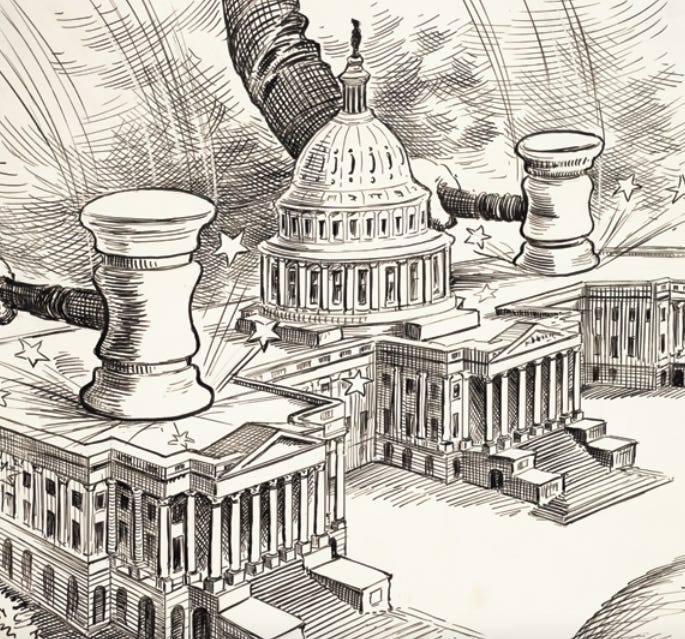
UNITED STATES. Aberration of powers.
Politics goes to the courts.
Hunter Biden was indicted on Thursday on three gun charges after an earlier plea deal collapsed. An impeachment into the president's alleged dealings with his son’s business was launched on Tuesday by House Speaker Kevin McCarthy.
INTELLIGENCE. The US separation of powers encourages division and debate. The partisanship of recent years, however, threatens to overrun these checks and balances, with Joe Biden possibly soon to join his predecessor in impeachment proceedings, and with trust in the courts hitting 50-year lows. So far, there has been no evidence to link Biden to his son’s dealings, but multiplying investigations will only muddy the record and distract from other issues.
FOR BUSINESS. As the US nears another debt ceiling limit, Congress is arguably wasting time with a long-shot inquiry, but ahead of next year’s elections, many Republicans want retribution for what they perceive as a string of politicised and bogus cases against Donald Trump and allies. Thursday's retail sales data was strong, and the dollar is at a six-month high, but political miscalculation could easily undo what has been an improbable economic recovery.
CHINA. General theories.
Speculation surrounds another missing minister.
China's defence minister General Li Shangfu was under house arrest, the US ambassador to Japan claimed on Friday. Li has not been seen for two weeks and has cancelled meetings with Vietnamese and Singaporean counterparts.
INTELLIGENCE. No official statement has been issued by Washington, let alone Beijing, but circumstances indicate the General is not just sick or on holiday. Foreign minister Qin Gang went missing in July, before being replaced by his predecessor. Two senior generals were sacked in August. Xi Jinping, who has been on an anti-corruption purge, has stayed home from several international summits (though this week made time to meet Venezuela’s dictator).
FOR BUSINESS. Unexplained personnel changes can spook investors but tend to be soon forgotten. The case of Li Shangfu could be different in that he is China’s senior-most minister and Beijing has been making increasingly belligerent moves on Taiwan. Taipei on Thursday reported an incursion of 40 Chinese aircraft in the island's air defence zone. Unannounced large-scale drills involving China’s Shandong aircraft carrier began earlier this week.
Written by former diplomats and industry specialists, Geopolitical Dispatch gives you the global intelligence for business and investing you won’t find anywhere else.
CUBA. Havana club.
The socialist republic’s diplomats get busy.
The UN's Secretary-General arrived in Cuba on Thursday to join 30 other leaders at the G77+China Summit in Havana. Cuba's vice foreign minister on Thursday said progress had been made in talks with the US, but obstacles remained.
INTELLIGENCE. Since the end of the Cold War, Cuba has largely been left to its own devices, but this does not negate its strategic location at the mouth of the Gulf of Mexico (and thus access to the Mississippi and 90% of US agricultural exports). While Xi Jinping will not attend today’s summit, Beijing is keen to maintain close links with Havana, as is Moscow, which has recruited Cuban fighters to Ukraine, much to the annoyance of some in Cuba’s government.
FOR BUSINESS. China is replacing Russia and Venezuela as Cuba’s chief patron, but so far trade has been limited, as has its alleged spy presence on the island. Yet it’s been enough to get Washington to reconsider its embargo on Havana. The US admitted to hosting rare talks with Cuban officials this week. While no breakthroughs have been reported, the Biden administration has quietly rolled back some restrictions, including on flights and family reunions.
NIGER. Near-death expedience.
The junta can’t dispense with the West, yet.
The US has resumed reconnaissance flights from Niger, the Pentagon announced on Thursday. A French consular official was released on Thursday, France's foreign ministry said, having been arrested on 8 September.
INTELLIGENCE. Nigerien authorities appear to have cooled on demands that Western forces leave the country. As France risked angry crowds outside its facilities, it is assumed US diplomats have brokered a solution where some activities – like counter-terrorist surveillance missions – can continue. Niger’s generals know that a power vacuum would be in nobody’s interest. Since UN troops stood down in neighbouring Mali, Islamic State has rebounded.
FOR BUSINESS. With Wagner decapitated and the Kremlin focussed on Ukraine, West African juntas must be realistic about who they can rely on to manage the region's insurgencies and extremist threats. Mistakes could still be made, but for now, pragmatism seems to have prevailed, with the US maintaining limited operations in Niger. This may however be of little comfort to the region's remaining foreign investors. Violence in the Sahel continues to skyrocket.
With the brevity of a media digest, but the depth of an intelligence assessment, Daily Assessment goes beyond the news to outline the implications.
SUDAN. Problem seeks solution.
General al-Burhan travels the region.
Sudan's army chief visited Turkey on Wednesday for his fifth foreign visit in recent weeks. The UN's envoy in Sudan stepped down on Wednesday, citing difficulties with the military authorities and their rivals, the Rapid Support Forces.
INTELLIGENCE. In a de facto civil war since the start of the year, and with an estimated five million now displaced, Sudan’s acting government, led by Abdel Fattah Al-Burhan, cannot defeat former allies the RSF without external support, but external support is unlikely to come without strings. Al-Burhan has left his new base in Port Sudan to visit Egypt, South Sudan, Qatar and Eritrea, but has returned empty-handed, other than restored flights from Cairo.
FOR BUSINESS. Foreign involvement in Sudan could bring peace, but could also bring further chaos, as previous interventions, from Syria to Yemen, have shown. Sudan has oil and gold, but external players may think it’s more trouble than it’s worth. Sudan agreed in February to a Russian port on the Red Sea, but even the Kremlin is said to be eyeing alternatives, such as in Eritrea. Libyan militias and the UAE are meanwhile giving alleged support to the RSF.
POLAND. Poles apart.
Polish politics becomes even more divisive.
Poland's president said on Thursday he was awaiting a probe into an alleged 'cash-for-visas' affair that the opposition leader described as “probably the biggest scandal in Poland in the 21st century.” Elections will be held on 15 October.
INTELLIGENCE. The anti-migrant Law and Justice party has governed Poland since 2015 and remains the leading contender, but the scandal could be a blow to its majority or even coalition hopes. A change in Warsaw would impact the fortunes of Europe’s other conservative governments as well as a resurgent populist right. It could also impact calculations on Ukraine. Under Law and Justice Poland has been one of NATO's biggest military spenders.
FOR BUSINESS. Law and Justice has also delivered strong growth, but persistent inflation and an allegedly politicised decision by the central bank to cut interest rates have put Warsaw’s economic credentials in question. The main opposition Civil Platform party is also business friendly and its leader, former prime minister Donald Tusk, has strong market credentials, but a slowdown in Germany and across the EU will drag down Poland no matter who is in power.
Emailed each weekday at 5am Eastern (9am GMT), Daily Assessment gives you the strategic framing and situational awareness to stay ahead in a changing world.