

UNITED STATES. Politics as usual.
A string of Democrat victories may ultimately prove pyrrhic.
Democrats held Virginia's senate on Tuesday and flipped the lower house. Kentucky re-elected its Democratic governor and abortion rights were endorsed in Ohio. Democrats also won Supreme Court votes in Pennsylvania and Wisconsin.
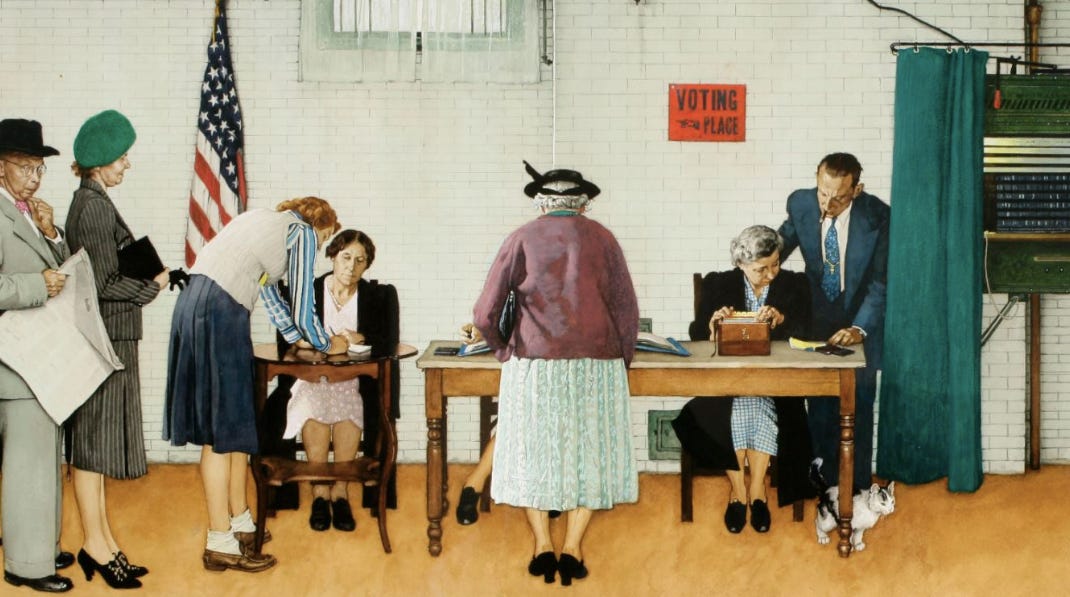
INTELLIGENCE. With polls suggesting Joe Biden will lose to Donald Trump, the results are a relief to the White House. But they could also worsen Democrat odds in 2024 if they lessen any push for an alternative candidate to an ageing Biden or lead to Trump move away from his party’s abortion policies. While Biden wasn’t on Tuesday’s ballots, reproductive rights were, which drives Democrats to the ballots and independent voters to shun the Republican Party.
FOR BUSINESS. Biden is unpopular and largely blamed for inflation, which the GOP could more readily exploit if it declared a truce on abortion. But this will be hard, even for Trump, with religious conservatives, including the new House Speaker, ascendant. Abortion arose as a key difference between second-place rivals Ron DeSantis and Nikki Haley during Wednesday’s Republican debate. Amid his legal troubles, Trump will need to take a firmer stance soon.
Written by former diplomats and industry specialists, Geopolitical Dispatch gives you the global intelligence for business and investing you won’t find anywhere else.
UKRAINE. RUSSIA. Zelensky’s winter.
Kyiv cancels elections as rivalries intensify.
Ukraine's president on Monday called off a vote expected in March, when his five-year term ends. An adviser to Ukraine's military chief was killed on Monday when a grenade ‘gift’ exploded. Kyiv sacked its special forces chief on Saturday.
INTELLIGENCE. Volodymyr Zelensky has asked repeatedly for further Western aid, as has his military chief Valery Zaluzhny, but questions over Ukraine’s democracy and leadership will only make the request harder, particularly as Washington faces a possible shutdown in eight days and Congress seeks measures to jettison. Russia has meanwhile intensified its missile attacks, hitting a civilian ship in Odesa and damaging energy infrastructure.
FOR BUSINESS.Zaluzhny is Zelensky’s chief rival and made waves last week with an unauthorised interview. The elimination of Zaluzhny’s two lieutenants invites speculation, which Moscow will amplify against the background of previous Kyiv putsches (such as the 2014 ousting of Viktor Yanukovych). This in turn could hurt Ukraine’s admittedly long-shot EU membership hopes, which were otherwise given a boost by the European Commission on Wednesday.
With the brevity of a media digest, but the depth of an intelligence assessment, Daily Assessment goes beyond the news to outline the implications.
SUDAN. The other war.
The Rapid Support Forces are poised to seize Darfur.
The UN on Wednesday reported serious human rights violations connected to the paramilitary Rapid Support Forces. Aid agencies on Tuesday said more refugees had fled to Chad in the first few days of November than in all of October.
INTELLIGENCE. The RSF, which grew out of the Janjaweed militias that terrorised Darfur in the 2000s, is now close to controlling the entire region, which is almost the size of Spain, and would link the militant group to its alleged Russian supporters operating from the Central African Republic in the south and eastern Libya in the north. This in turn could give the RSF momentum to seize the rest of Sudan, whose military leadership has fled to the Red Sea.
FOR BUSINESS. A series of Saudi-organised peace talks between the RSF and Sudan’s army have failed to broker a ceasefire. And with the claimed backing of Russia and the United Arab Emirates, the RSF have little reason to stop, particularly as a conclusive victory would confer some protection on international war crimes. The Sudanese authorities were once allied to the RSF. A new government dominated by the militants would destabilise the region.
OMAN. Oh buoy.
Allegations of a Chinese naval base on the Arabian Sea.
The White House has been briefed on China’s plans for a military presence in Oman, Bloomberg said on Wednesday. Secretary of State Antony Blinken spoke to his Omani counterpart on Wednesday, discussing Gaza and Yemen.
INTELLIGENCE. Beijing is an investor in Oman's Duqm special economic zone, which could in time become the region's biggest oil-storage facility. Duqm hosts a British logistics facility, which the US Navy has access to, and while technically neutral, Oman is a key Western defence partner. A Chinese naval presence would seemingly upend this. But with Beijing already accessing facilities in US-aligned Djibouti and the UAE, it may not be a long-term dealbreaker.
FOR BUSINESS. Strategically located countries are enjoying greater options as the major powers compete, and Ukraine and Israel keep capitals busy. A wildcard is India, which has long seen Oman as a security partner. Another is Iran, which supports the Houthis in next door Yemen. Yet another navy in Oman may balance the region’s non-state actors and help manage the universal problem of terrorism and piracy in one of the world’s busiest shipping zones.
Emailed each weekday at 5am Eastern (9am GMT), Daily Assessment gives you the strategic framing and situational awareness to stay ahead in a changing world.
SRI LANKA. Ports in a storm.
The US plays China at the infrastructure diplomacy game.
The US on Wednesday announced a $553 million loan to an Indian-led project at the Port of Colombo. A Chinese survey ship docked in Colombo last month, shortly after Xi Jinping said China would assist Sri Lanka "with no political strings".
INTELLIGENCE. Sri Lanka has seen an intensifying battle for influence between India and China, with occasional appearances from Pakistan, Japan and the US. Under the rule of the Rajapaksa family, much of that influence came in the form of loans and potential dual-use (military/civilian) projects, leading to an economic collapse last year that is still being worked out. The US’s loan is designed to help Sri Lanka’s recovery, but also forestall rival Chinese deals.
FOR BUSINESS. Beijing has been criticised for building white elephant infrastructure and loading Colombo with debt, but it isn’t the only one to practice coercive statecraft. For most of Sri Lanka’s independence, India has played such a role, partly explaining why the Rajapaksas were so open to China. The US Development Finance Corporation’s loan is to a consortium led by India’s Adani, a firm close to the Modi government and with a controversial financial record.