

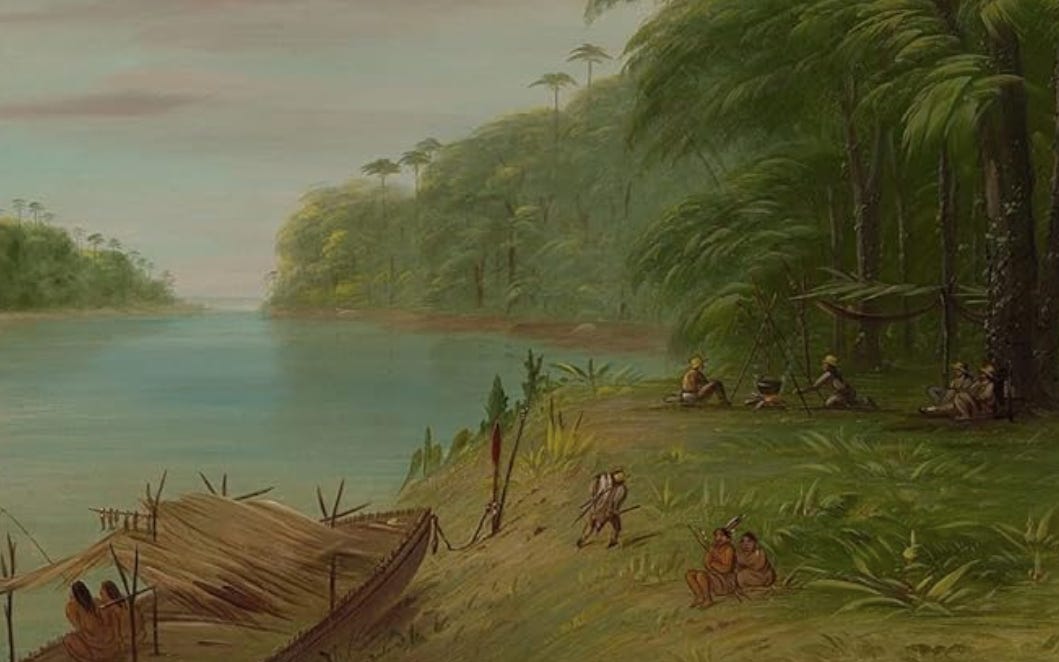
VENEZUELA. GUYANA. The goad to El Dorado.
Maduro locks himself into greater confrontation.
Venezuelans voted by 95% to reject the International Court of Justice's jurisdiction over Guyana’s disputed Essequibo region and four other motions, Caracas said Sunday. The ICJ on Friday barred Caracas from changing the status quo.
INTELLIGENCE. Essequibo has long promised riches, which is why Europeans, in search of El Dorado, first went there. A border dispute between ex-Spanish Venezuela and ex-British Guyana then festered until oil was discovered in 2015. Today, Guyana has as much oil as Kuwait and, like Kuwait in 1990, fears the interest of its diplomatically isolated and debt-ridden neighbour. And while Nicolas Maduro is no Saddam Hussein, he has now backed himself into a corner.
FOR BUSINESS. Washington threw Caracas a lifeline in October, offering to lift sanctions for fair elections and cooperation on refugees (Venezuela is now the largest source of irregular migration to the US). But fearing defeat, Maduro has not only turned his back on democracy but is gambling on Guyana to maintain legitimacy. Invasion is unlikely, but Sunday’s vote may not just justify blockades and coercion but politically demand them. It is a risky bluff.
Written by former diplomats and industry specialists, Geopolitical Dispatch gives you the global intelligence for business and investing you won’t find anywhere else.
YEMEN. Red Sea herrings.
Houthi attacks are less about Gaza than domestic objectives.
Yemen's Houthi militants claimed attacks on two Israeli-linked vessels in the Red Sea on Sunday, while the US said a third commercial ship was also attacked. The US Navy intercepted an Iranian drone in the Persian Gulf on Saturday.
INTELLIGENCE. The Houthis claimed the attacks were in response to events in Gaza, where bombing has escalated, but they also ratchet the group's negotiating position in stalled peace talks. The Houthis, backed by Iran, control around a third of Yemen's territory, but over two-thirds of its population. Almost ten years after seizing the capital Sanaa, they crave international recognition. The UN-recognised government is otherwise based in Saudi Arabia.
FOR BUSINESS. Yemen's civil war has displaced 4 million and killed almost 400,000. Its spill-over into shipping isn’t new – the security vacuum has long contributed to piracy in the Gulf of Aden – but recent attacks on Israel-linked vessels give the crisis a renewed salience. It also serves to embarrass not just Saudi Arabia, but the United Arab Emirates, which has unsuccessfully sought to crush the Houthis and has been victim of the occasional missile attack.
With the brevity of a media digest, but the depth of an intelligence assessment, Daily Assessment goes beyond the news to outline the implications.
SUDAN. Khartoum and gloom.
Catastrophe looms on the other side of the Red Sea.
The UN's political mission in Sudan ended on Sunday after the Security Council voted Friday to close it at Sudan’s request. A Sudanese general last week accused the UAE and others of funding the rebel Rapid Support Forces militia.
INTELLIGENCE. UN missions can only operate with the host’s agreement. Security Council members expressed disappointment, yet few will want their civilians in harm's way and Sudan barely has a host government. The civil war, which began in April, is starting to turn in favour of the RSF, which grew out of the genocidal Janjaweed paramilitary group in the early 2000s. The RSF controls most of Darfur and is edging close to encircling the capital Khartoum.
FOR BUSINESS. Accusation of the UAE's role serve to embarrass the Emiratis during COP28, but they're not the only ones backing the RSF. Besides Chad, Uganda and the Central African Republic – whom Sudan has also blamed – the RSF has likely received support from eastern Libya and Russia. Recent footage of Ukrainian commandos fighting in Sudan add credence to the latter. RSF control of Sudan could give Moscow a long-sought naval base on the Red Sea.
UKRAINE. RUSSIA. Master vs commander.
Zelensky faces new enemies within.
A US journalist claimed Friday Ukraine's military chief was in secret dialogue with his Russian counterpart. Kyiv barred former president Petro Poroshenko from leaving on Saturday. Kyiv's mayor said Zelensky had become “authoritarian”.
INTELLIGENCE. Even during war, it would not be strange for Ukraine’s Valery Zaluzhny to have some contact with Moscow. But that this is being leaked to Pulitzer-winning Seymour Hersh suggests a signal is being sent to the West. Zaluzhny, who ironically is said to not be speaking with Zelensky, sent a similar signal with a frank interview with The Economist last month. The magazine for the first time on Saturday described Vladimir Putin as “winning”.
FOR BUSINESS. Zaluzhny is outpolling Zelensky as preferred leader, despite not being on the ballot and Zelensky postponing elections. Rumours are spreading that Kyiv insiders, including ex-president Poroshenko, are working to dislodge Zelensky, who could be exiled to the US. Budget wrangling in Washington and Brussels are depriving Zelensky of a lifeline. Headline-grabbing wins, such as a derailment in Siberia, are failing to have a strategic effect.
Emailed each weekday at 5am Eastern (9am GMT), Daily Assessment gives you the strategic framing and situational awareness to stay ahead in a changing world.
INDIA. Momentum Modi.
The ruling Bharatiya Janata Party sweeps state elections but still faces risks.
The BJP was declared winner on Sunday in three state polls – Madhya Pradesh, Chhattisgarh, and Rajasthan – with the last two flipping from the opposition Congress party. Congress won in Telangana against a regional incumbent party.
INTELLIGENCE. The results are a relief for Narendra Modi but belie a more worrying arithmetic should the Congress-led ‘INDIA’ coalition of opposition parties hold until national elections next year. As recent events in Taiwan show, opposition unity can quicky break down when political rivalries get in the way, but a united front is probably the only way to stem Modi’s dominance, let alone defeat the BJP. His national popularity is at its highest point since 2014.
FOR BUSINESS. Congress did not compete in the polls under the ‘INDIA’ umbrella, but if it had it may have picked up additional votes. The BJP otherwise appears unassailable in India’s northern Hindi belt, with Congress and others stronger in the richer but less populous south. And as long as Modi, aged 73, can hold it together, it will probably govern for at least another term. A first-round vote has meanwhile kicked out the ruling party in neighbouring Bhutan.