


Hello,
In this week’s edition of Week Signals:
IN REVIEW. Disenchantment and misenchantment, religion and geopolitics, bargaining and belief, understanding and incarnation.
UP AHEAD. Kosovo votes, Myanmar pretends to vote, and Benin kind of votes. Netanyahu goes to Washington again. Bulgaria gets the euro.
This is the last Week Signals for the year. Next week, we’ll publish our Year in Review, followed by our Year Ahead on the Saturday after. We’ll also be publishing several special features over the Christmas and New Year break before returning to our regular cadence on Monday, 19 January. Wishing you the best for the season.
Week Signals is the Saturday note for clients of Geopolitical Strategy, also available to GD Professional subscribers on Geopolitical Dispatch.
The Week in Review: Heaven and hell on earth
The week began with a terror attack on Bondi Beach. It ended with the release of reams of redacted documents by the US Department of Justice, in an almost offensively begrudging response to a near-unanimous Congressional demand for transparency on the Jeffrey Epstein files.
December is often seen as a time of enchantment. Whether it’s Christmas or Hanukkah, as was being celebrated by hundreds on a balmy Sunday in Sydney, it’s a time for family, friends, and community. This year, however, it’s been another month of disenchantment.
German sociologist Max Weber described “disenchantment“ (Entzauberung) as the shift from a magical worldview to a rationalist understanding. The originator of so much of how we think about government, science, and political economy, Weber didn’t see disenchantment as positive or negative, but as an inevitable feature of capitalism and modernity. What worried him, however, was the gap that would need to be filled. Humans need the magical, the sacred and the mythical. For in the gap left by traditional religion, it’s not just ersatz spirituality that will take its place (Santa Claus, elves, Die Hard), but something more insidious: mis-enchantment.
Misenchantment can be seen like misinformation. It can be harmless (urban myths, Jesus in a piece of toast, aliens off the coast of California). But it can also be dangerous (QAnon, neo-Nazism, Islamic State). And the answer isn’t simply more education, more proof, more rationalism (i.e., more disenchantment). There must be re-enchantment, and if not a return to the old gods, so to speak, then to a more holistic, humane, and compassionate understanding of our fellow creatures and the world in which we live.
Perhaps the most disenchanted people on the planet, it’s not for us – former bureaucrats – to give spiritual counsel, but understanding the profane cannot be complete without understanding the sacred. As above, so below.
Geopolitics has always been intertwined with the divine. Would Israel be so fought over if not for the Abrahamic faiths? Would Vladimir Putin have invaded Ukraine if not for an idea about a holy Russia? Would the Cold War have been what it became without the deeper ontology of a Moscow and Washington competing as Christendom’s Third Rome? Would the recent National Security Strategy’s claim of Europe’s “civilisational erasure” have cut so deep if not for the West’s ancient hang-ups over the division of the Roman Empire, or the schism of 1054? And why does the US Secretary of War wear a tattoo of “Deus Vult”? Why indeed?
A contemporary of Weber was the US Navy strategist Alfred Thayer Mahan. While Weber was writing his Protestant Ethic and the Spirit of Capitalism, Mahan was applying his theories of sea power to the First World War. Yet Mahan, besides his contributions to geopolitics, was also an Episcopalian theologian. His discussions on the holy spirit have, unlike his theories on naval blockades and maritime chokepoints, faded with the years, but it is perhaps not unsurprising that a mind so consumed with the geographic, would cast itself to heaven as well.
The other main geopoliticians of the last two centuries have also had a more than passing interest in religion.
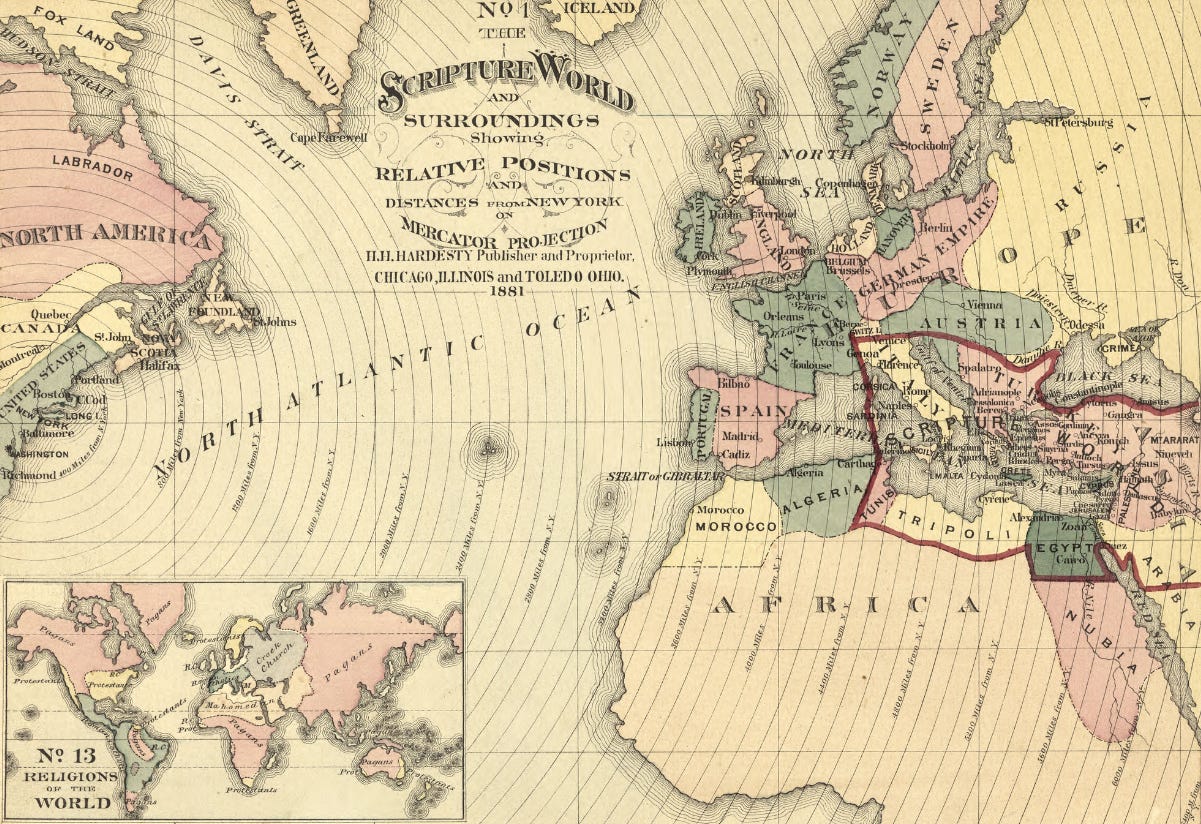
Halford Mackinder, whose ideas on land were as profound as Mahan’s on sea, centred his heartland theory on not just space, but the idea that Eurasia’s “marginal crescent”, or rimland, coincided with areas of four great religions: Christianity, Islam, Hinduism and Buddhism.
Zbigniew Brzezinski, besides being the intellectual heir to Mackinder and Carter’s National Security Adviser, was one of Pope John Paul II’s chief interlocutors, so much so that the KGB believed Zbig actually selected him.
Henry Kissinger may have been ambivalent about his Judaism, but it undoubtedly informed present-day US policy toward Israel.
The alarm in George Kennan’s containment theory, the most vivid rendering of the Truman Doctrine, was not only informed by Russian expansion but by Soviet atheism.
Samuel Huntington, a direct report to Brzezinski, and later the grand theorist of the post-Cold War order, codified it directly in his Clash of Civilizations thesis, directly joining the geographic with the religious.
Geopolitical forecasting and analysis often have the flavour of eschatology, no less in times when war, technology, disruption, and dislocation seem to be spiralling ever deeper into a Dantean void. Dealing with life and death at scale, it perhaps comes closest to the Book of Revelation than any of the social sciences (sorry, economists). But there are lessons in the sacred that can and should be applied to understanding the political, or rendered unto Caesar if you will. Whatever your personal beliefs or position along the scale of disenchantment, what can the timeless wisdom of the enchanted teach us about this year and the next?