


Hello,
In this edition of Week Signals:
IN REVIEW. Lessons from 1956, hubris and humiliation, a return to Eurasia, and the hope of repair.
UP AHEAD. Tokayev’s constitution, North American trade, Lehman broligarchs, Cuba, and Takaichi.
And don’t forget to connect with me on LinkedIn.
The Week in Review: Eden revisited
The week began with attacks on Tehran that caused acid rain. It ended with the flattening of Kharg Island. Entering its third week, based on the scale of destruction alone, you would think that Donald Trump was having a good war, as he presumably does, too. Yet, based on those very same metrics, and with US munition stocks dropping as quickly as its oil reserves, the war has been a calamity.
Last week, we presented a worst-case scenario for how the war may continue, as a rejoinder to a more optimistic outlook the week before. This week, with a clearer sense of the conflict’s parameters, we can see another possible outcome crystallising, though for US power at least, it’s probably worse than the worst case.
If a bad scenario for our waning Pax Americana is another Iraq, Afghanistan or Vietnam, then a catastrophic one would be another Suez Crisis.
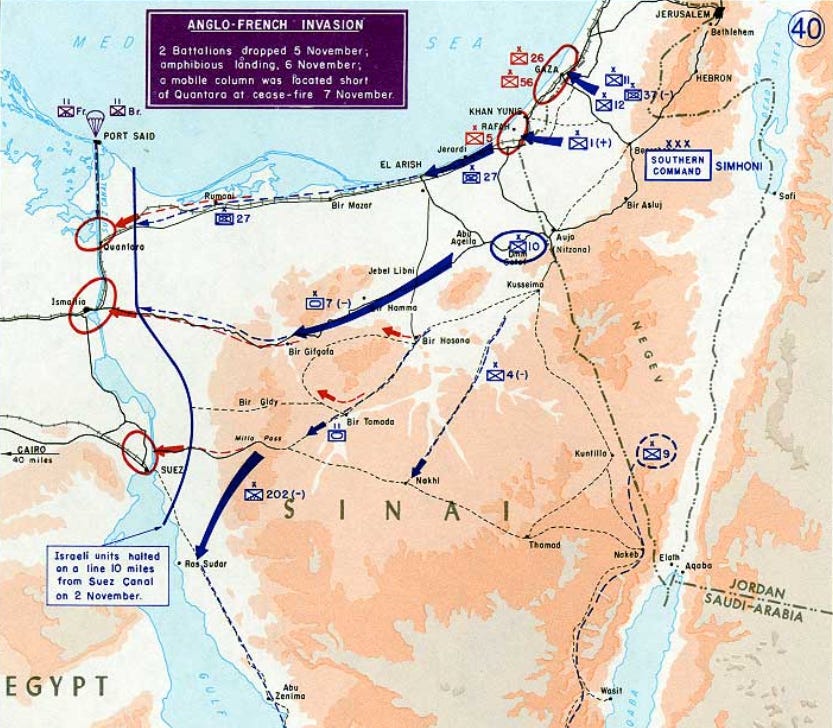
Unlike the US’s wars of the 60s, 70s, and 2000s, the Suez Crisis – of one week and two days – was remarkably short. Yet in late 1956, merely a decade after the end of the Second World War, it was the nail in the coffin for the British and French empires. While, together with Israel, they hit Nasser’s Egypt hard – invading the Sinai Peninsula to retake the nationalised Suez Canal, they did so at incredible cost to diplomatic prestige and strategic standing. Once the dog caught the car, as it were, the owner (Dwight Eisenhower) said no more. The political and economic pressure was too great. Nasser got his canal back (though Israel kept the Sinai for another year, and would retake it a decade later). He would become a hero of the postcolonial world. Egypt would later be courted by the Soviet Union and the United States, paving the way for it to become a de facto leader of the Arab world. Only OPEC’s actions much later in 1973 would pass this crown to Saudi Arabia.
Today, there’s no Eisenhower to write Anthony Eden a stern letter. In military terms, the US is today preeminent, and China does not come close. But by jamming shut another maritime chokepoint, Trump has posed a graver risk to world markets and US creditors than Eden, France’s René Coty, and Israel’s David Ben-Gurion ever did to Red Sea shipping or their own bond markets.
Sanae Takaichi, who represents the country with the largest US bond portfolio, is unlikely to admonish Trump when the two meet on Thursday (see the Week Ahead, below). But when Trump goes to Xi Jinping, MAGA cap in hand, at the end of this month, will he be triumphant, proving what happens to those who FAFO, or will he TACO, needing another power to re-open Hormuz and provide an offramp that the US and Israel cannot negotiate with a millenarist regime with its back against the wall?
A Chinese solution to the conflict would be logical for the Middle East. Beijing brokered an earlier détente between Riyadh and Tehran. Iran, this week, has cryptically suggested that cargoes may be available to those who purchase crude in Chinese yuan. China, alongside other Asian buyers, has a vastly greater interest in Gulf oil and gas than distant America. There may be an APEC, but there is no AIPAC in Beijing to muddy the debate. Multi-member groups like BRICS and the Shanghai Cooperation Organisation are surely built for this kind of contingency. Let the Board of Peace focus on Gaza instead.
China has been relatively silent on Iran, though its oil tankers have been present throughout. One could assume its interests are purely economic, but with more leverage and room to manoeuvre around Taiwan, it hardly lacks a strategic cudgel. And coupled with oil-rich Moscow, which continues to benefit from Washington’s attrition of its own Patriot missile stocks (per Volodymyr Zelensky, more were used against Iran in three days than in the entirety of the Ukraine war), Beijing can speak in the language of peace-through-strength that Trump surely understands.
Suez, as much as the events of 1945, defined the end of the last multipolar era. Hormuz, as much as the events of the 2008 financial crisis or the 2021 retreat from Kabul, could come to mark the beginning of the next. And beyond the symmetries of chokepoints and Israel, the role of debt (owed to America in the wake of Lend-Lease; owed to everyone in the wake of quantitative easing) looms large.
So, how likely is this scenario? Are the lessons of 70 years ago relevant today? Surely, just as Keir Starmer is “no Churchill”, Trump is no Eden. But are there some meaningful similarities between the two leaders beyond their alleged poor health and desire to outshine their predecessors?