


Hello,
In this week’s edition of Week Signals:
IN REVIEW. A discordant Concert of Great Powers, the ‘Donroe Doctrine’, Greater Russia, and a Sinicised East Asia.
UP AHEAD. Chile’s election, Witkoff goes to Berlin, monetary divergence, the Epstein files, and the trade deal of tomorrow.
And don’t forget to connect with me on LinkedIn.
Week Signals is the Saturday note for clients of Geopolitical Strategy, also available to GD Professional subscribers on Geopolitical Dispatch.
The Week in Review: Dividing the spoils
Co-authored with Oscar Martin.
The week began with the fallout over Donald Trump’s public-facing National Security Strategy and the breakdown of Trump’s ceasefire between Cambodia and Thailand. It ended with an even bigger fallout over alleged contents of the classified NSS, and Cambodia and Thailand ignoring Trump’s entreaty to stop the fighting. In between, a tanker was seized off Venezuela, Maria Machado escaped to get her Nobel Prize, and Honduras remained in constitutional limbo.
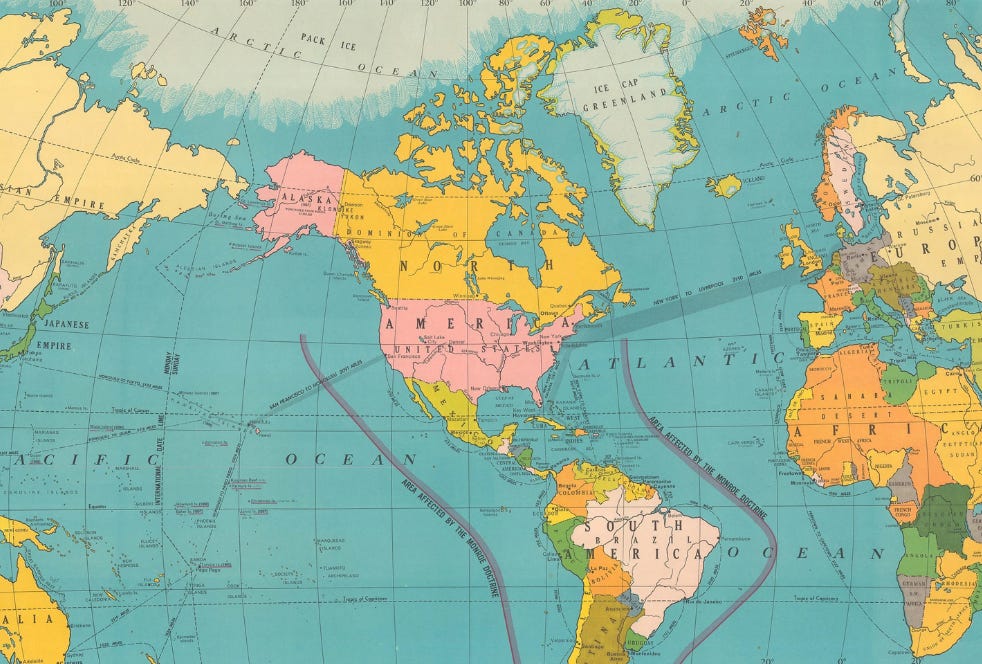
The unifying theme of resistance to the NSS in Europe, muscle-flexing in the Americas, and shoulder-shrugging in East Asia is the NSS’s key acknowledgment (wise or unwise): the emergence of a multipolar world, and a world of spheres of influence. Europe shudders to think it’ll become a toss-up between Russia and the US (especially with allegations that the classified NSS makes it policy to drag Italy, Poland, Hungary and Austria out of the EU – unlikely but provocative). Venezuela and its neighbours are worried that Teddy Roosevelt is back with a Diet Coke addiction. And Asia doesn’t care. It has bigger powers (China and the triads) to worry about.
Friedrich Merz said the West no longer exists. The Pope criticised a US bid to “break apart” the transatlantic alliance. Tucker Carlson said Russia would be the “best ally” for the US.
Welcome to the new Concert of Great Powers, where a “C5” is set (apparently) to replace the G7 (which perhaps explains Emmanuel Macron’s eagerness to invite Xi Jinping). And welcome to a new isolationist period in US foreign policy, when it returns to an offshore balancing role (with or without Trump in our view). For while Trump’s divorce with Europe may be annulled when a new president takes over (and at this point that president is likely to be a Democrat), the trust, if not the love, has been irreparably broken. A values-based partnership with the EU (when those values were at least shared) has been replaced by the girl-next-door of Western Hemisphere hegemony. If things gets seized or blown up in the Caribbean, that’s America’s business (though it perhaps doesn’t explain the alleged raiding of an Iranian ship in the Indian Ocean last month).
There is a lot to unpack here. If a sphere-of-influence world truly does emerge – and we think, on the balance of probabilities it will – then business needs to prepare. Our Paris-based analyst Oscar Martin takes a look at how those spheres may form, where they may form, and what to do about it.