



Hello,
In this edition of Week Signals:
IN REVIEW. The United States at 250; democratic foundations; trust and technology; power and liberty.
UP AHEAD. Meetings in Turkey, verdicts in Paris, minutes in Washington, and elections in Johor.
Try the full Geopolitical Dispatch — free for a month
Throughout July, free subscribers can activate a full 30-day trial of Geopolitical Dispatch, including the complete Daily Dispatch, Week Signals, our Private Monthly Roundtables and Quarterly Outlook Briefing.
The Week in Review: Technocracy in America
The week began with firefights in the Persian Gulf. It will soon end with fireworks over the Potomac. What will next week bring?
There is a lot being written today on the 250th anniversary of the Declaration of Independence. Some of it is hagiographic. Much of it is obituarial. If you asked an LLM to summarise it all into short sentences (we haven’t), I imagine it’d be along the lines of: Mostly good. Has inequality. Trump is an aberration. Nothing that’s wrong can’t be fixed with what’s right.
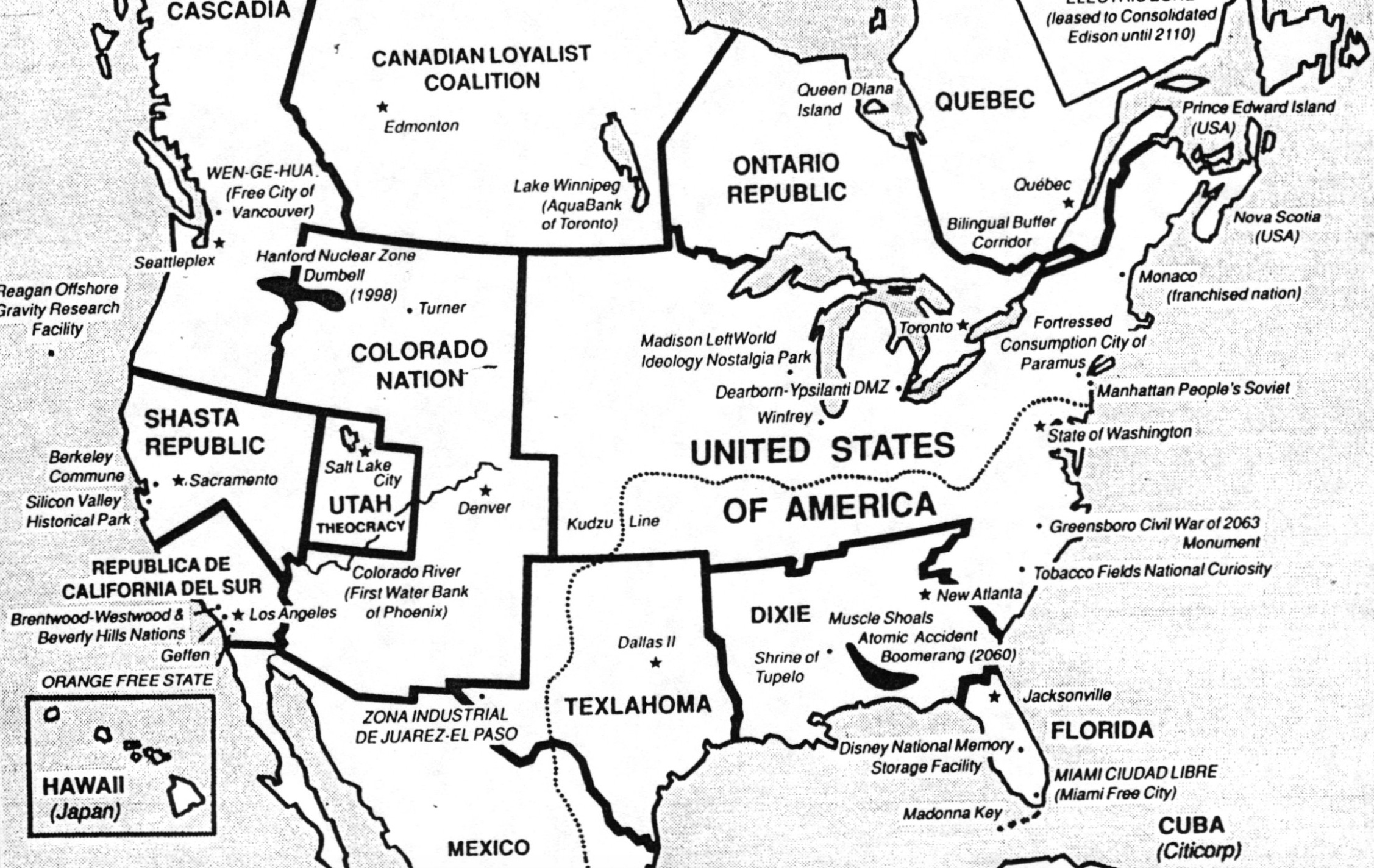
All well and good, but not particularly illuminating, or likely to be remembered after the hot dogs are digested. The more useful exercise then might be not an analysis of where America has come from, or where it is going (most long-range forecasts say more about the author than the topic, such as Douglas Coupland’s 1992 op-ed, the subject of this week’s map), but rather where America is today, and what might challenge its ongoing success or survival.
This is what Alexis de Tocqueville did so vividly in the 1830s and why his Democracy in America remains studied to this day. We don’t know any young French aristocrats to commission such a work today, but we do have a young South Australian living in Paris, which is almost the same thing. And like Tocqueville, Oscar Martin’s essay is well worth your time:
Alexis de Tocqueville arrived in America in 1831 as a young French aristocrat from a country still living with the aftershocks of revolution. He was officially there to study prisons, but his real subject became the democratic age.
In the United States, he saw a society that had escaped much of Europe’s old aristocratic architecture: fewer inherited ranks, more mobility, more religious energy, and more ordinary citizens convinced that they had the right to judge public affairs for themselves. He called this equality of conditions, and it was, for him, the central organising principle of American life.
Tocqueville’s argument was that democracy was more than a form of government. It was a social condition, a way of organising ambition, status, and daily life. Elections were foundational, but so were the informal institutions that sat between the citizen and the state: religious organisations, town meetings, newspapers and voluntary associations.
These institutions trained Americans to govern themselves before they asked the state to do it for them. The frontier gave restlessness a direction, though at immense cost to indigenous peoples, while slavery made the American language of liberty morally unstable from the beginning.
Tocqueville later described democracy as “the waters of the Deluge.” Democracy was not a policy that could be reversed, or an institutional fashion that could be contained by nostalgia. It was a social force advancing across old hierarchies with slow and irresistible effort. The choice was no longer between democracy and aristocracy. The waters were already rising.
Tocqueville’s admiration was never complete. Equality could produce energy, invention and practical intelligence. It could also produce conformity, envy, loneliness and impatience with limits. Majority opinion could become coercive. Citizens absorbed in private comfort could lose the habit of public responsibility. A central power could grow by promising to manage the anxieties of democratic life. Tocqueville saw the risk of soft despotism: rule through administration, dependence and comfort rather than open terror.
Tocqueville understood a young America as a system of habits before he understood it as a set of institutions. As America reaches its 250th anniversary, the nation has changed drastically. The US is now a continental power, a global military system, the centre of the dollar economy, the home of the largest technology platforms, the world’s most important capital market, and the leading theatre of the artificial intelligence boom. Its citizens distrust many of the institutions that govern them, its politics has moved upward into the presidency and the courts, and its old continental instincts are returning after decades of global management. The question, then, is what Tocqueville would see if he arrived in the US in 2026, as both its habits and institutions undergo significant upheaval.
The presidency has become the main theatre of national politics. Congress remains noisy, but it rarely feels like the place where the country decides its direction. The courts have become arenas of political settlement. The Supreme Court’s decision in Trump v. Slaughter, which upheld Trump’s removal of a federal trade commissioner, Rebecca Slaughter, and struck down the FTC’s for-cause removal protections, pulled independent regulatory agencies closer to direct presidential control. Other rulings have checked executive ambition, including the court’s rejection of Trump’s attempt to restrict birthright citizenship. More of American democracy now flows through presidential action, plus the judicial review of those actions.
For Tocqueville, this would be a sign of a strong legal institution but waning democratic habits. The American legal system still successfully restrains executive power. However, a democratic society that constantly asks judges to settle political questions may also be confessing something about its own civic weakness.
The deeper problem is trust, and the weakening of the institutions that turn democratic opinion into civic action.