



Hello,
In this edition of Week Signals:
IN REVIEW. Political upheaval; from process to protest; scenarios for public disorder.
UP AHEAD. Reckonings for Washington and Wellington; summits for empires past; questions for Iran and Ukraine.
The Week in Review: The pursuit of unhappiness
The week began with shock elections in Brazil and Serbia. It ended with questions about whether a similar shock will be in store for the United States.
For political news junkies, it may feel like Christmas has come early, with not just these big upsets, but a tied election in Israel, the stirrings of a renewed opposition movement in Venezuela, and, of course, the ongoing uncertainty in oil markets and the Middle East. For the rest of us, however, it’s like Halloween has come early. The question then for today, its official date, is how much scarier it’s going to get.
We’ll be unpacking all that in our monthly webinar for paid subscribers next week, rescheduled by a few days to allow us to digest the implications of the midterms. In the meantime, beyond the previews on how we see things unfolding in the Week Ahead section below, there’s probably not much more to say that hasn’t already been covered voluminously elsewhere.
Yet what may be more useful than prematurely predicting the midterms’ strategic lessons is some reflection on how businesses should think about a combustible political environment more broadly, regardless of the results. And while this isn’t a prediction of political violence in the US, it’s a reflection of how politics is happening beyond the ballot box and the parliamentary chamber.
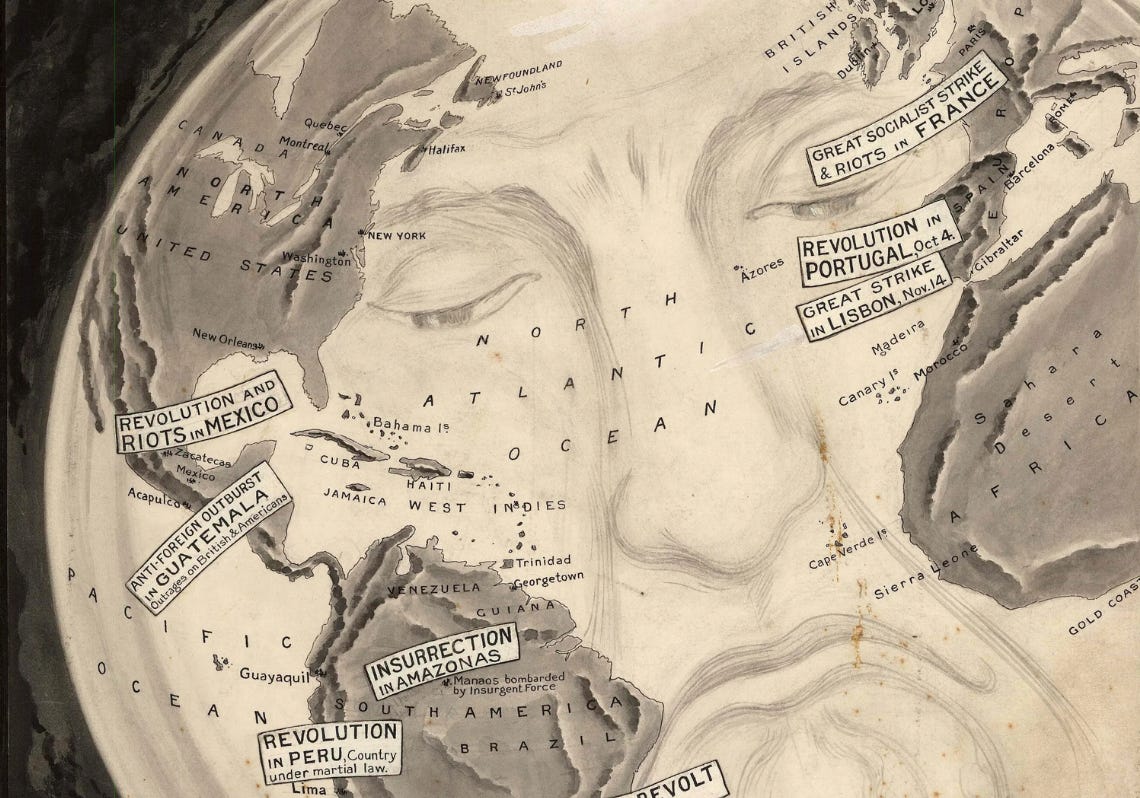
Few know this better than our analyst Oscar Martin, who, based in Paris, has been seeing it daily on his walks to work. With more big protests expected today, events in France show how, like water finding its level, views will be expressed through arson and looting if there’s no better channel.
France’s Emmanuel Macron is the type of leader any geopolitical analyst likes. He’s intelligent, educated, technocratic, serious, and diligent. His ideas and policies are grounded in evidence and fact.
But this all makes him a terrible politician. People are often irrational and emotional, and the job of a political leader is to channel that irrationality and emotion, not ignore or belittle it. And while, at the opposite end of the spectrum, it shouldn’t be the job of a leader to exacerbate these traits – the habit of populists from Mussolini to Trump – if there’s no safety valve for their expression, the gasket will blow.
That’s of course a gross simplification. There are many other non-leadership reasons why France is so convulsive. Including, even more simply, that it’s France. But lest you think that the world’s problems could be solved by removing the demagogues from the scene, keep reading below.
Oscar begins:
As someone who’s been living in Paris for the last two years, I’ve seen my fair share of protests. However, the recent protests, which began with teachers, students and parents at a school in Créteil who blockaded their school due to declining standards in education, have by far and away been the most intense yet.
The largest day of protest on October 17 drew 550,000 according to the government, while organisers put the figure at 800,000. This marked an escalation from high school students to a nationwide demonstration. The protests have been largely peaceful, but have also seen riots, looting and violence between protesters and police.
The police response has arguably been one of the driving factors behind the escalation of protest activity across France. Reports of injured teenagers have brought parents and other adults into a movement initially organised around education. Earlier in the movement, a 15-year-old in Lens lost a hand to a police grenade and another minor was blinded in one eye, reportedly by a rubber bullet. Personally, I’ve been lucky not to have been tear-gassed just walking around central Paris, whereas friends of mine have had their eyes hurt while simply waiting in line at a ramen shop.
Despite the coverage of seemingly massive disruptions, the French have an attitude towards these events that contrasts with much of the rest of the world, particularly in English-speaking countries. The attitude is one of vast engagement with politics and protest, but also a calmness in the chaos that surrounds it. I’ve seen riot police charge at protesters with batons, with groups of locals calmly drinking wine at a café on the sidelines. In France, there is a distinct attitude that has acclimated to forms of protest, but also to political violence.