

Since we began writing Geopolitical Dispatch almost one year ago, the world has felt in a permanent state of crisis. And while it’s generally accepted the world always feels to be in a state of crisis, organisations like the International Institute for Security Studies have quantified that we are indeed in a time of elevated risk.
And this past week, of all the weeks we’ve written about, feels especially febrile. With Iran’s strike on Israel on the 13th and Israel’s retaliation on the 19th, now is perhaps a good time to step back and consider some of the frameworks through which we can interpret and predict such events.
In this week’s Not in Dispatches, we look at several concepts in international relations theory that can help us think through how countries can end up – deliberately or inadvertently – at war. With apologies to Dr Strangelove, the Doomsday machine is terrifying and simple to understand...
Game theory
Few concepts in international relations are as fascinating and terrifying as escalation – the process by which conflicts intensify and spread, often beyond the original intentions of the participants. With very real fears that the war in Ukraine could escalate into a direct military conflict between Russia and NATO and, most recently, that the proxy war between Israel and Iran could morph into a broader Middle East conflict, it is also one of the most important.
Escalation is, of course, a fundamental and perennial dynamic in international affairs. But it was a major preoccupation for military strategists during the Cold War. The advent of nuclear weapons in the United States and their subsequent acquisition by the Soviet Union dramatically raised the stakes in managing tensions between the superpowers, each hoping to prevail in the strategic contest without coming to blows that could, quite literally, destroy the world.
‘Game theory’ – the study of mathematical models of strategic interactions between rational agents – became a central way for American defence strategists to develop a nuclear strategy. And several ‘games’ from the field have particular relevance today.
Cops and robbers
The most famous model is the ‘Prisoner’s Dilemma,’ a thought experiment that demonstrates how two parties, acting in what they consider to be their own best interests, can easily end up in a worse situation than if they had cooperated.
In this model, two criminals are arrested and held in separate interrogation rooms. The police do not have enough evidence to charge them both with a principal offence and intend to charge them for a lesser crime punishable by one year. They offer each prisoner a Faustian pact: if one testifies against his partner, he will go free, and his partner will get three years. But if both testify against the other, they will each get a two-year sentence.
In this game, the ‘dominant strategy’ (that is, the superior tactic, regardless of what the opponent chooses) is to testify against the other criminal, even though this will never lead to the ‘optimal outcome’ (in this case, both staying silent would lead to the shortest sentences). Both criminals have an incentive to dob in their accomplice, even though it risks landing them each in prison for longer.
The Prisoner's Dilemma shows how challenging it is to make good decisions in situations of uncertainty.
Welcome to the real world
In international affairs, the Prisoner’s Dilemma often leads to an arms race or a series of retaliatory actions that raise tensions or even lead to war.
During the Cold War, this was much more than a game: Two superpowers, driven by fear of being at a strategic disadvantage, engaged in a continuous escalation of nuclear arsenals despite knowing that such an accumulation of weapons could lead only to ‘mutually assured destruction’ – a stark and sobering equilibrium point.
Today, an iterative version of the ‘Prisoner’s Dilemma’ can help think through the Iran-Israel conflict.
The two regional powers with conflicting strategic objectives have long engaged in a covert proxy war, of which the war in Gaza is arguably (among other things) the latest manifestation.
Each nation’s actions – whether Israel bombing an Iranian consulate, Iran attacking Israel with hundreds of drones, or Israel returning fire on Iranian military facilities – have been taken to send signals that they will not back down, create deterrence against further attacks, and assert dominance in the larger strategic game.
But when one or the other pursues the dominant strategy, the conflict between the two risks escalation – whether that is geographically (the conflict spreading to new theatres) or in the nature of war (proxy, conventional, chemical, biological, tactical nuclear, etc) – because each act of aggression may invite retaliation and further countermeasures.
One of game theory’s insights is that it is often rational for countries to escalate to advance their self-interest, even if it risks conflict spreading or becoming more intense and dangerous.
Geopolitical Strategy is the advisory firm behind Geopolitical Dispatch. Our partners are former diplomats with vast experience in international affairs, risk management, and public affairs. We help businesses and investors to understand geopolitical developments and their impacts with clarity and concision.
The best defence is offence
Another concept in game theory – the ‘Security Dilemma’ – vividly captures the predicament faced by Israel and Iran: as each state increases its security measures, it inadvertently threatens the other, potentially leading to a spiralling escalation that neither originally sought nor desired.
Israel and Iran getting to their current point is in no small part thanks to them both taking actions each considers ‘defensive’. Over the years, Israel has received advanced weaponry from its Western allies, assassinated Iranian officials, and attacked Iranian nuclear facilities. And today, whatever the world thinks, Israel considers its actions in Gaza a form of defence. Tehran, however, views all these increasing security measures as threats to Iran’s interests.
Similarly, Iran’s build-up of alliances, funding and arming of proxy groups and development of nuclear weapons capabilities are, in its view, purely defensive measures. As we explained in a recent backgrounder, Iran may employ aggressive and millennial rhetoric, but its strategic actions are, to its mind, defensive, not offensive in nature. Viewed from Tel Aviv, however, such actions are easily interpreted as aggressive threats to Israel’s security.
As with the ‘Prisoner’s Dilemma’, the ‘Security Dilemma’ has an inherently grim logic. When one country sees another taking defensive measures, often it will decide to take more defensive measures itself. And so on. And as the cycle continues, this can lead to a situation where, perversely, the more defensive actions a country takes, the more it jeopardises its own security.
On the brink
The logic of escalation – whether understood through these models or others – can also lead states to engage in ‘brinkmanship’: pushing a situation to the brink of disaster to compel the adversary to back down.
Thomas Schelling, the eminent economist and military strategist, provocatively likened this to bargaining over the custody of a child by threatening to kill it. Or, in the case of the Cuban Missile Crisis of 1962, bargaining over custody by threatening to kill the whole family.
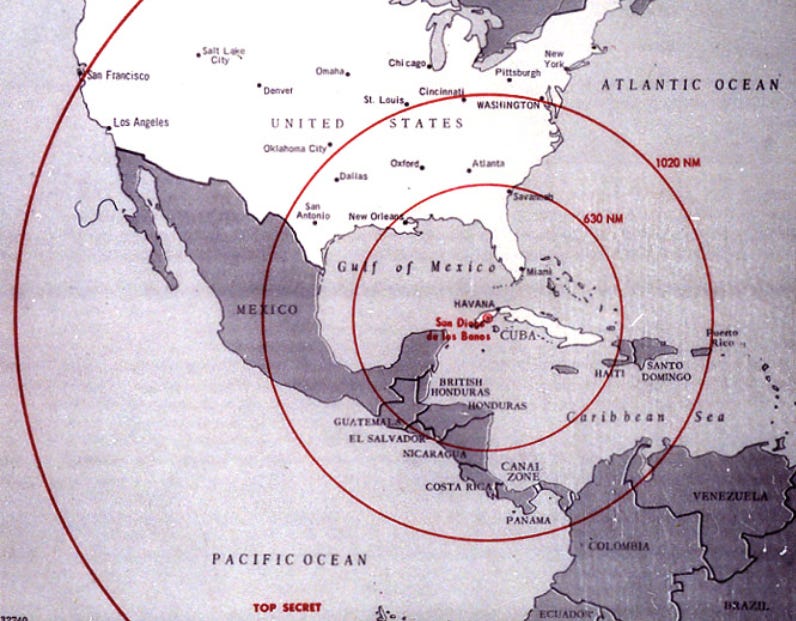
Back then, the world came eerily close to nuclear war. Kennedy and Khrushchev, by escalating their strategic deployments of nuclear weapons, very nearly initiated a nuclear apocalypse. But it also led to the mutual recognition of the possibility of assured destruction, which ultimately led to a de-escalation (and Khrushchev’s fall from power two years later and the Soviet Union’s determination to achieve nuclear parity with the United States).
The Americans and the Soviets pushing each other to the brink may have averted war in Cuba. But brinkmanship is, naturally, a high-risk strategy. Each escalatory action taken increases the stakes, potentially leading to a situation where backing down becomes too costly, thereby making escalation to outright conflict more likely. The ‘tipping point’ in such scenarios is often unpredictable, making these engagements extremely risky.
Brinkmanship may have led to an ‘optimal outcome’ in the case of the Cuban Missile Crisis. But it could easily have spelled disaster. It only would have taken a minor misjudgement, miscommunication or misunderstanding for the superpowers to have been lobbing nukes at each other.
Equally, Iran and Israel’s increasingly hostile tit-for-tat responses could end up resembling a game of chicken. And while the stakes may not be as high compared to the height of the Cold War, they are very serious: a direct, sustained war between Iran and Israel would, at the very least, roil oil markets, cause devastation in both countries, and risk external powers being drawn in. Playing ‘chicken’ may appeal to leaders wishing to demonstrate bravado, but proving one’s mettle is hardly ever worth driving a car over a cliff.
The fog of war
Uncertainty complicates how states signal their intentions and how they are received.
In the ‘fog of war’, uncertainty about an adversary’s intentions, capabilities and positions, ambiguity in intelligence and communications, and fluidity in circumstances make smart decision-making even more difficult.
And the fog of proxy war may have already descended over the Middle East.
Whereas most observers read Iran’s most recent strike on Israel as clearly demonstrating that it did not wish to escalate the scenario, Israel responded with a further military escalation. One reason may have been uncertainty: Israel could not be certain that the strikes, despite what Iran’s leaders said, would be the last or the smallest. Another — that we come to later — may have been ‘strategic ambiguity’.
After all, whether an action deters or provokes escalation all depends on how each side interprets the other’s intentions and capabilities, which in turn comes down to essentially human judgments about human judgments.
An additional challenge in using game theory to predict the outcomes of bilateral political dynamics is that nations may not necessarily make decisions ‘rationally’.
Carl von Clausewitz, the Prussian military theorist, spoke of (an unholy) ‘trinity’ of forces that collectively and interactively drive the events of war in the real world – “primordial violence, hatred and enmity”, “the play of chance and probability” and “rational calculation”.
With historical enmity and emotions in both Iran and Israel running high, for the situation to de-escalate, cooler heads will have to prevail.
Mad Men
Another concept in international relations relevant to understanding escalation is the so-called ‘Madman Theory’ of international relations – made famous by Richard Nixon in the Vietnam War and reprised, with a degree of success, by Donald Trump in his negotiations with Xi Jinping. This theory posits that if a leader can make opponents believe he or she is capable of irrational and extreme actions, those opponents might be more inclined to avoid provoking or escalating a conflict, hoping to prevent an unpredictable and possibly extreme response.
Iran and Israel have both, at times, cultivated an image of unpredictability to enhance their deterrence capabilities — and they will likely continue to do so while tensions remain high.
For Israel, its alleged readiness to conduct strikes deep within enemy territory or engage in sudden large-scale military operations (including in Gaza) might serve as a deterrent against Iranian escalation. Iran’s use of proxy forces, its involvement in various regional conflicts and intimations that it could strangle oil supplies, are part of a strategy to not only project power but to create uncertainty about its actual intentions and capabilities.
Both countries also embrace ‘strategic ambiguity’. Israel’s policy of nuclear ambiguity – neither confirming nor denying it possesses nuclear weapons – is Madman Theory par excellence. Similarly, Iran’s ambiguous rhetoric, religious exaultations, and provocative actions concerning its nuclear program contribute to a perception of irrationality or extreme risk-taking.
Sometimes the best form of defence is offence. Sometimes it is to make your adversary think you’re a raging lunatic. The truly mad thing, however, is that it is sometimes rational to act mad.
Emailed each weekday at 5am Eastern (9am GMT), Geopolitical Dispatch goes beyond the news to outline the implications. With the brevity of a media digest, but the depth of an intelligence assessment, Geopolitical Dispatch gives you the strategic framing and situational awareness to stay ahead in a changing world.
Escalator to nowhere
Game theory does not necessarily mean that tensions will always escalate or that there is no way to reduce tensions.
The literature suggests that one way to help countries step down the slippery escalation ladder is to create ‘focal points’ – mutually recognised solutions that both parties could agree upon without explicit or direct communication.
This might be a third-party diplomatic mediator who can help define limits, red lines, and rules that two adversaries could tacitly understand and respect. The theory, at least, is that this could move the situation from an ‘unstable equilibrium’, where each action heightens the risk of war, to a more stable one, where mutual deterrence is maintained through understood and respected boundaries.
In the complex, high-stakes and emotionally driven situation between Israel and Iran, third-party diplomacy will be crucial to avoiding conflict. Creating the rules, finding the mediator and convincing Iranian and Israeli leaders to cool off, will not be easy — and few could play that role — but with the stakes so high it’s well worth trying.
The map was cropped. I could tell because the "Top Secret" on the bottom of the map should have been centered and there also should have been a "Top Secret" at the center of the top.
Of course, it should have had the "Top Secret" crossed off and "Secret" markings when it was downgraded after the required number of years. Likewise, the "Secret" markings should have been crossed off when it downgraded to "Confidential", which should also have been crossed off when it was declassified a few decades ago.
Which raises the issue of why the map was even classified in the first place?
Surely, the Soviets and the Cubans knew the ranges of the missiles they were installing!
Was the map classified, because we didn't know that the Communist knew that we knew the ranges of their missiles?
Some argue for classification to prevent Americans from panicking. This is silly. In Third Grade in Chicago, I remember thinking that the only difference between an Air Raid Drill and a Tornado Drill was the pattern of the blasts from the warning horn. I doubt my concern would have been much different if I had known that only one of the 3 types of missiles being set up in Cuba could reach Chicago. Of course, at the time, I did not know that the B-58s that flew over Chicago often were practicing attacking a Communist City next to a large body of water, like maybe Havana.
Now that I liven in Florida, I am more concerned about hurricane than missiles from Cuba. My house will handle a Cat 4 very well. If a Cat 5 comes, I will take the insurance check and move in with my daughter in Pennsylvania or one of my brothers in Nevada.
As Alfred E. Neuman said, "What me worry?" Actually, I have a more spiritual approach than the Mad Magazine character. "When the worst that could happen is dying and going to heaven, there isn't much to worry about!"