


Hello,
In this edition of Week Signals:
IN REVIEW. Epistemological rupturing; a White House built on silicon dioxide; coming down to earth.
UP AHEAD. Elections in Peru, Kosovo, and Armenia; a summit in Estonia; and the World Cup starts in Mexico.
Geopolitical Dispatch is the daily client brief of Geopolitical Strategy - a specialist advisory firm helping leaders understand the geopolitical forces reshaping business and world affairs. Our work includes strategic forecasting, scenario planning and geopolitical risk workshops, crisis simulations, and GD Corporate Memberships. Learn more or upgrade for the full edition below
The Week in Review: In for a paradigm, out for a dollar
The week began with multiple ceasefire violations in the Gulf and Lebanon as negotiations went around in circles. It ended in much the same way. Unlike previous such weeks, however, the US stock market didn’t end at record highs, with the S&P 500 falling by 2.6% and the Nasdaq by 4.2%. Ahead of SpaceX’s IPO next Friday, the largest in history, the omens aren’t good.
Share market routs happen for all sorts of reasons. This time, it was blamed on US job numbers being “too strong”, erasing hopes of an interest rate cut. But anyone who still predicted a cut wasn’t following the data. And anyone undeterred by the frothy valuations wasn’t understanding the data.
With the macroeconomic and geopolitical picture only as dire as any other day, perhaps the better explanation was that this was what the kids call a vibe shift, and the olds call a paradigm shift (or, more floridly, an epistemological rupture). These can happen for all sorts of reasons, or none at all. Either way, we have a growing sense that David Solomon’s remark this week about there being “more greed than fear” may have been one of those top-of-the-market moments.
This is not a financial brief, and we don’t provide investment advice, but if you could come up with an explanation, it’d likely be found in Hans Christian Andersen’s story of the emperor with no clothes. As you may remember, a king is hoodwinked by two tailors who convince him they can make a suit so fancy that it’s only visible to those who are very clever. Of course, the suit doesn’t exist, but convinced of his genius, or needing to prove it, the king proceeds to parade it in public, with all the other geniuses gushing in admiration. It takes a small boy – who has obviously never traded bitcoin – to point out that the emperor is naked. No clothes, and no point in pretending otherwise.
This is the common knowledge game, and once you understand it, you see it everywhere, from fairy tales to Jeffrey Epstein. If everyone is incentivised to pretend, then it takes a brave, foolhardy, or ignorant person to point out the truth. From investment fads, to political order, to Joe Biden’s health, occasionally the sign will be removed from the window, in the words of Mark Carney, channelling Vaclav Havel, and everyone will drop the pretence.
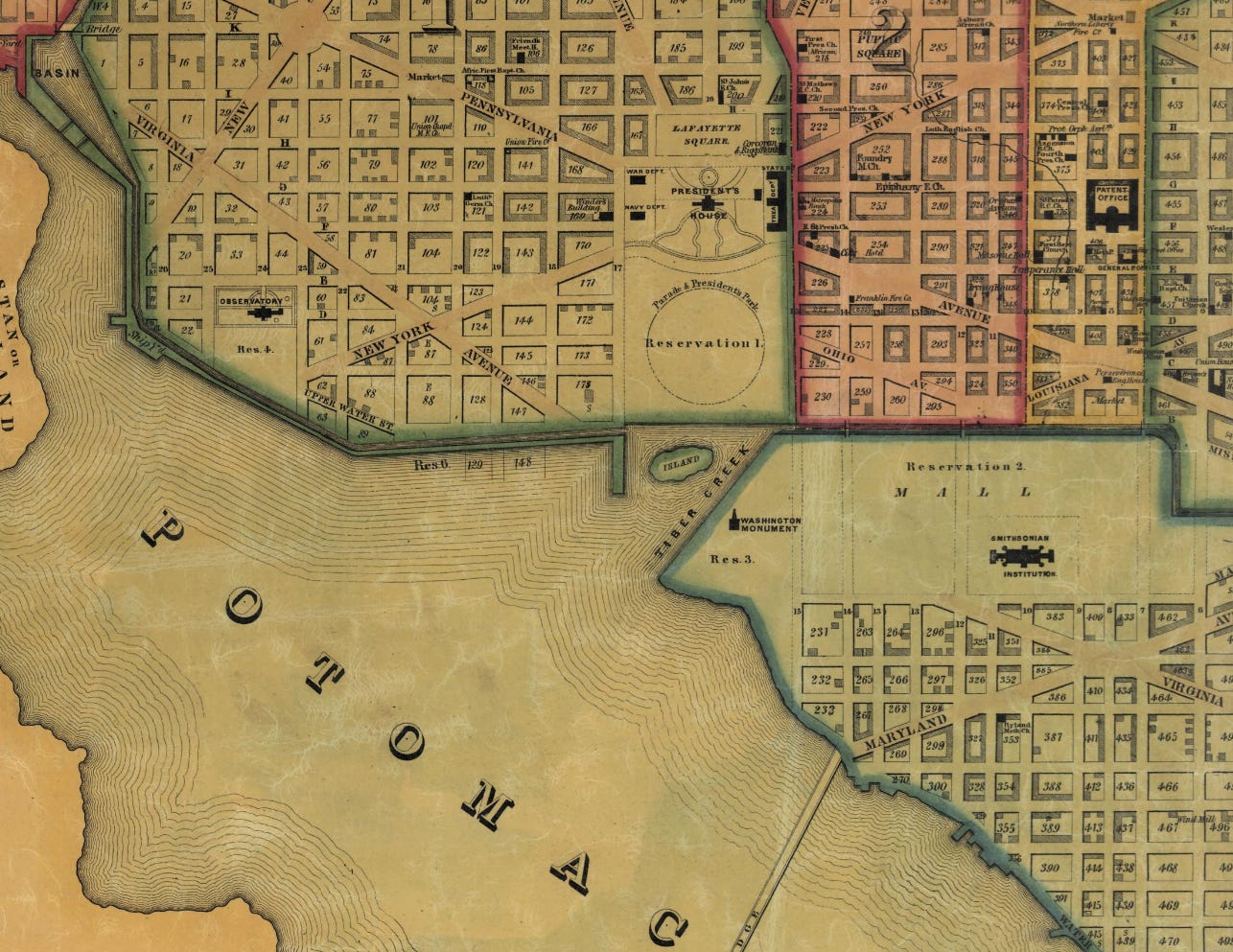
A similar metaphor could be seen this week in Washington. Beyond fulminating about the market and his perceived enemies, Donald Trump has been talking a lot this week about his “American-flag-blue” renovation to the cracks in the Lincoln Memorial Reflecting Pool, which was built in the 1920s over what was once part of the Potomac River.
Alongside his ballroom, and the Center formerly known as the Trump-Kennedy Center, it’s fair to say the president has been obsessed with this renovation. While he couldn’t quite drain the swamp, he could drain a pool “bigger than skyscrapers” and then resurface it with waterproof coating. And gazing at its shiny waters, a glorious past and future could be reflected back to him.
Yet whether the surface is grey or blue, a reflection is only an imitation of reality. And whether it’s a clear day or cloudy, a mirror can lie.
Certainly, the markets, whether in oil futures or stock indices, are only simulacra of the real economy. And to summarise financial commentator Nathan Tankus, markets reflect the consensus view, not the consolidated view. In his own words, they process conventional wisdom, not the sum of all wisdom, or, in the terms of John Maynard Keynes, “we devote our intelligences to anticipating what average opinion expects the average opinion to be.”
Expected average opinion in Friday’s market has obviously shifted, but why? Again, I expect it has something to do with Trump, and an emperor, gazing lovingly at his own reflection, without clothes. I also suspect it has something to do with another naked emperor: artificial intelligence.