


In this week’s Not in Dispatches, I wanted to examine an aspect of US power that’s generally seen as an advantage but should also be seen as a risk.
Friends in low places
One of Joe Biden’s achievements, which even his detractors acknowledge, is his administration’s restoration of the primacy of NATO and other alliances to US foreign policy.
Celebrating NATO’s 75th anniversary in April, pundits and politicians seemed optimistic that the Atlanticist president’s bearhug of Europe and Ukraine would soon lead to Russia’s defeat and another American century. As long as Donald Trump – who once called the bloc ‘delinquent’ – didn’t interrupt proceedings, Pax Americana and the rules-based order would live to fight another day.
A month or so later, things look different.
If anything, Trump is riding higher in the polls, and Russia has regained the initiative in its war on Ukraine. Those ‘delinquent’ allies continue to be behind on spending, recruitment, and rearmament. And a populist wave of pro-Trump fellow travellers looks set to take up a record number of seats in the European Parliament on 9 June.
So far, so normal, international relations scholars would argue. Governments come and go, but interests remain the same. Alliances endure. Grand strategy rumbles on.
If only that were true.
Alliances are fickle. Few tend to last, which is why NATO’s anniversary was perhaps so remarkable. As 19th-century British Prime Minister Lord Palmerston is attributed to have said (as have Henry Kissinger and Winston Churchill): “There are no perpetual allies, or eternal enemies, only permanent interests.”
Friends are great. They make you feel good. They go to your meetings. You can do business with them. But more intimate friendships – whether in marriages or alliances – are difficult to maintain on a pluralistic basis.
America, that most polyamorous of nations, is finding this out the hard way.
Though the US gained experience at balancing rival friendships during the Cold War (from Egypt and Israel, to Japan and South Korea) its 21st-century model of network diplomacy – where alliances are treated like miniature blocs, and neat little dialogues proliferate (the ‘Quad’ involving India, Australia and Japan; the ‘Squad’ involving the Philippines; ‘I2U2’ with Israel, the UAE and India, and so forth) – is becoming as unwieldy as an episode of Love Island.
Alliances were once managed according to a “hub and spoke” model. Each relationship was managed individually, even if Washington treated them as pieces of a broader strategy. And if one didn’t like the other, it was a matter the Pentagon or State could deal with like a parent with squabbling children.
Yet today, the US treats its allies with more deference, like adults at the big people’s table. And perhaps reflecting its relative diminishment in the economic and political league tables, or perhaps thanks to the rise of emerging markets, that table is getting as long as the one Vladimir Putin once used to meet the president of France.
This modern alliance model has increasingly left the US as much beholden to its partners as they are to it. Rather than dispensing its global security goods as the world’s policeman, it is increasingly seeking to trade such goods reciprocally with sovereign states that otherwise have the choice to partner with China, Russia, or Iran.
This episode of US geopolitics is thus more complicated than it was in the 1990s. But rather than returning to serial monogamy, the US feels it must continue to expand its menage, lest its many friends drift to the other side.
Moving away from hub-and-spoke relationships to relationships of equality also seems fair, of course. And it situates itself within the current administration's liberal worldview. Yet, like much of the liberal world order, this model of diplomacy masks a series of contradictions, and may contain the seeds of its own destruction.
Mutually assured defence
The most concerning contradiction sits within the concept of mutual defence. And where mutual defence is most immediately concerning is in NATO – the world’s most prominent mutual defence treaty.
The NATO of 2024 is very different from the NATO of 1949. It was already large by contemporary standards, containing 11 members in addition to the US. Several more joined in the years ahead. In 1952, it was Greece and Turkey. In 1955, West Germany. And in 1982, a post-Francoist Spain joined the fold.
But in the decade from 1999, 12 new members joined, all from the former Warsaw Pact. More recently, in 2017 and 2020, Montenegro and North Macedonia came on board. And this year and last, Finland and Sweden did the same.
Individual Partnership Action Plans have separately been agreed with Georgia, Azerbaijan, Armenia, Kazakhstan, Moldova, Bosnia, and Serbia. A special Action Plan has been adopted with Ukraine (which many have interpreted as an almost guaranteed path to membership). Dialogue partnerships have elsewhere been established with US-friendly powers across the Pacific, like Australia and Japan.
All well and good if your intention is to deny comfort to the enemy – whether Russia or Derek Zoolander – but what happens when your web of alliances contains enemies within?
For years, NATO was preoccupied with containing the rivalry of Greece and Turkey. Occasionally this would explode into near-conflict – particularly when other fair-weather frenemies like Italy and France would take opposite sides in the Aegean dispute. But the hub-and-spoke model gave the US leverage to calm things down.
Article V of the North Atlantic Treaty meant on paper that Turkey and Greece were obligated to each other to provide mutual defence, but in reality – and throughout the Cold War context in which it was drafted – the real obligation was to the US. To allow it to position its troops (or its nuclear weapons in the build-up to the Cuba Missile Crisis). And to allow it to deny the Soviet Union yet another bridgehead on an ever-redder Eurasian landmass.
Today, NATO is crowded with even more contradictions.
Like the European Union, to which it is often compared, its members range from the militaristic (Poland now spends 3.9% of GDP on defence), to the passive (Luxembourg spends 0.7%). On policy, they range from Atlanticist Estonia and Lithuania to Russia-friendly Hungary and Slovakia. In terms of capacity, they range from the US, with a presence on every continent, to Iceland, which only has a coast guard.
And should any of its action plan partners join, it could potentially contain states not only at war with external foes, but that could potentially be at war with internal ones too. This will not just be a challenge for admitting Ukraine or Moldova, in the case of Russia, but Armenia and Azerbaijan, or Serbia and Bosnia, which still have historic disagreements.
Geopolitical Strategy is the advisory firm behind Geopolitical Dispatch. Our partners are former diplomats with vast experience in international affairs, risk management, and public affairs. We help businesses and investors to understand geopolitical developments and their impacts with clarity and concision.
A tangled web
The challenge is even greater in Asia and the Pacific.
The US has treaties with Japan, South Korea, and the Philippines. Further south, there’s one with Australia and New Zealand (though the latter, on account of its nuclear policies, is in a bit of a grey zone). Thailand also enjoys status as a US MNNA (major non-NATO ally), a status shared (ominously) by Pakistan – despite the latter’s advanced friendship with China. There is a similar arrangement with Taiwan, while Singapore is understood to have a secret version.
In the case of Japan and South Korea, which have a legacy of historical mistrust, it’s complicated enough to knit these separate alliances together, but that is what the US is now attempting to do to better deter China on Taiwan and ease its overall share of the burden.
In the case of the Philippines, where the focus is more on the South China Sea, attempts to knit this alliance into others have proven more challenging, though multilateral naval exercises have been held in lieu of any mutual obligation network so far.
Indeed, the last time the US established a credible Southeast Asian bloc was in the 1950s, until just after the Vietnam War. As it happened, Pakistan was part of this alliance – the Southeast Asia Treaty Organization – as well as the separate pro-US Central Treaty Organization with the UK, Iraq, Iran and Turkey. But that one didn't last long either.
Across the other side of the Pacific, there was (and is) the Inter-American Treaty of Reciprocal Assistance. This alliance, sometimes known as the Rio Pact, has proven more durable, but has been even less coherent.
As a visible testament to the Monroe doctrine, and predating NATO by several years, it has suffered through near wars between its members and a difficult choice when one – Argentina – invaded the territory of a NATO ally – the UK. Thanks in no small part to the friendship between Ronald Reagan and Margaret Thatcher, the US chose the UK and the Rio Treaty has never been the same since. Indeed, citing the Falklands, Mexico decided to leave in 2002. Bolivia, Ecuador, Nicaragua and Venezuela left a decade later.
Stuck in the middle
But perhaps the US’s biggest challenge has been in alliance management in the Middle East.
So far, alliances have remained separate and with plenty of wriggle room around mutual obligation. Saudi Arabia, Bahrain and the UAE could thus blockade Qatar between 2017 and 2021, without the US needing to take a side (it has major facilities in each of these countries).
Enmity, at least on paper, could be maintained between the Gulf and Israel. And, as in the Cold War – where the US armed both Israel and its Arab neighbours despite several land wars (ostensibly to keep out the Soviets) – the US has enjoyed the exorbitant privilege of supporting several rival sides in Iraq, Syria, and Turkey, without causing a complete collapse in the region’s security architecture. A similar tactic, one might argue, to Britain’s divide-and-rule strategies in the 19th century.
Yet recent talks between Washington, Riyadh and Israel around a grand bargain peace agreement, which could involve mutual defence obligations – at least between the US and Saudi Arabia – could enmesh the US in a security dilemma of a whole other scale to that faced between Britain and Argentina in 1982.
Further, with the US voter so much more engaged in debates on the Middle East than the South Atlantic, any security interests would need to match domestic political interests, which are even more impermanent than alliances.
Bringing this up to the current week, we can see how US interests are complicated when friends and allies act in their own interests, whether because they have to, or whether because they choose (the two, in practice, are hard to disentangle).
The week began with Ukraine sending a drone to attack a Russian early-warning radar station. On paper, such an attack should enliven Russia’s nuclear doctrine, considering the radar is a core part of Russia’s strategic defence. Luckily, so far, no such doctrine has been enacted.
And the week has concluded with Israel sending tanks into central Rafah, ostensibly crossing a US red line about ground invasions. It begs the question: what would this kind of action mean if Israel were part of a wider security network? Would Saudi Arabia be culpable? Would (is?) the US?
Emailed each weekday at 5am Eastern (9am GMT), Geopolitical Dispatch goes beyond the news to outline the implications. With the brevity of a media digest, but the depth of an intelligence assessment, Geopolitical Dispatch gives you the strategic framing and situational awareness to stay ahead in a changing world.
The amnesia of amity
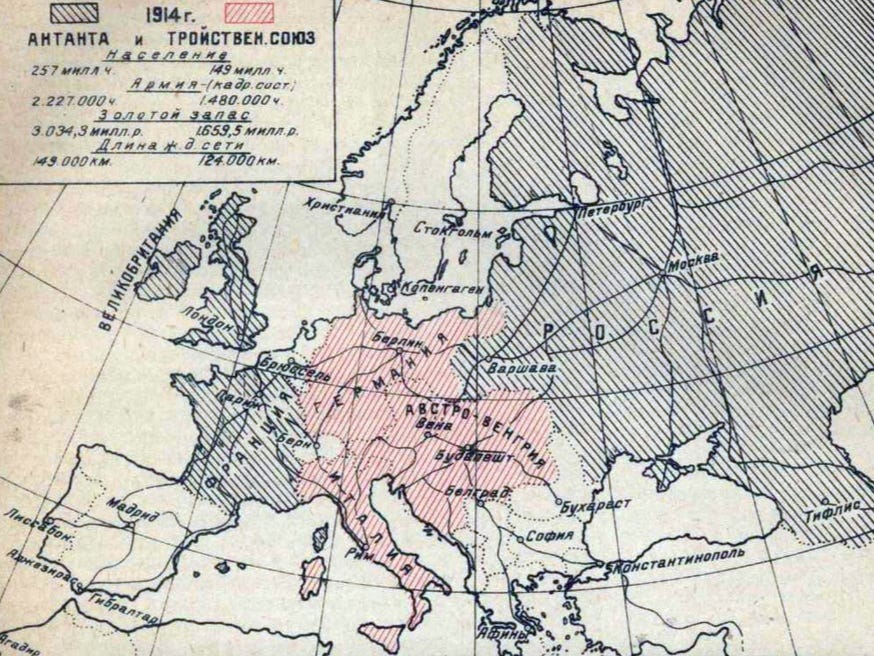
The last time these issues were most seriously considered was during World War I. As historian Christopher Clark wrote in his 2012 book Sleepwalkers, Europe ended up at war not because it wanted to, but because its web of diplomatic and military alliances forced it to.
As the map at the start of this article shows, Europe was locked into two competing blocs: the Triple Alliance of Germany, Austria-Hungary, and Italy (not to be confused with the Axis of World War II); and the Triple Entente of the Russian Empire (which did not survive the war), the Third French Republic, and the British Empire.
There were plenty of nuances to these arrangements. And war was by no means inevitable when a Serbian assassin shot an Austrian archduke – bringing to bear the force of Vienna, and subsequently Berlin, against a Belgrade quasi-aligned with Moscow. But the logic of deterrence and escalation ultimately meant that none of the powers could back down before it was too late.
We are still dealing with the consequences of World War I, not to mention the wars that followed. The lessons of history are often ignored. And when they’re not, they’re selectively remembered.
We are now at a moment in history where the selective lessons of the Cold War and the alliance building that contributed to Western hegemony are being remembered, but the lessons of a far greater calamity have moved into the background.
This is a dangerous moment. More dangerous indeed than anything seen on Love Island.