



Hello,
In this edition of Week Signals:
IN REVIEW. From Hormuz to Islamabad, Zugzwang to rope-a-dope; political theory for the mean streets; rumbles in the law of the jungle.
UP AHEAD. Elections in Bulgaria and India; parliamentary brawls in Romania and New Zealand; redistricting in Virginia.
Geopolitical Dispatch is the daily client brief of Geopolitical Strategy, an advisory firm helping businesses and investors to get ahead of the world. Connect with me on LinkedIn to learn more. If you’re not receiving the full edition, you can upgrade below.
The Week in Review: Everyone has a plan until they get punched in the face
The week began with ceasefire talks in Islamabad. It may end with those as well. Donald Trump has gone on a customary victory lap following yesterday’s announcement by Iran’s foreign minister that, thanks to the truce in Lebanon, Tehran will reopen the Strait of Hormuz. Crude futures fell 10% Friday, and the president has suggested that he, too, may end his own comprehensive but still porous blockade once “our transaction with Iran is 100% complete”.
But look beyond the headlines and tweets, and Iran has merely reiterated that its own “designated route” near Larak Island and close to the IRGC’s boats and drones, is “open”. Moreover, Iran has since added that it will end if the US blockade doesn’t. There are also few details on whether this involves tolls. The commercially accepted Traffic Separation Scheme route, established in the 1960s, remains off-limits for now. Many ships trying to use it have turned back. To some, it might all seem a trading set-up, or a cover for another 30-day Russian sanctions waiver.
The International Maritime Organisation and most commercial shippers remain cautious. They’re waiting for others to run this new gauntlet first. And while paper oil has fallen, physical prices remain high, at twice futures prices (the gap between the two is also at a record). We may be at a fork in the road, but we may simply be on the roundabout again.
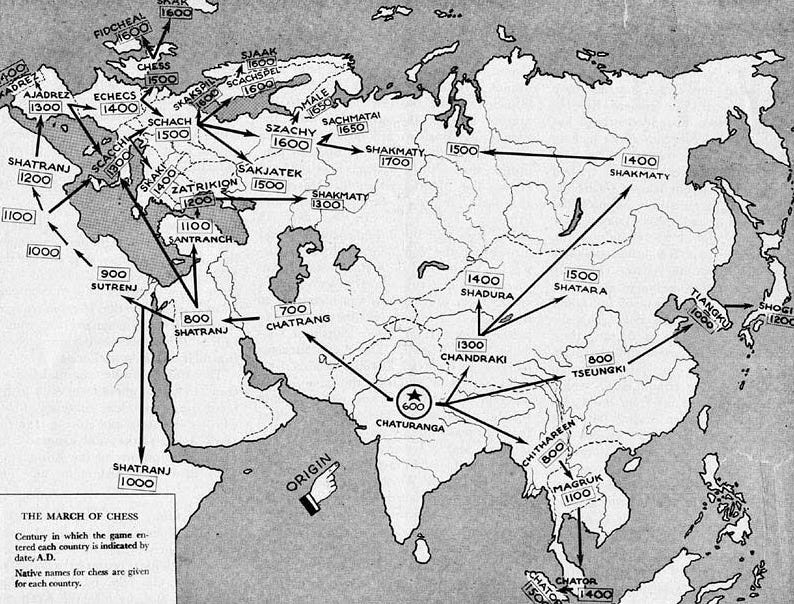
As we’ve said before, the alternative acronym for TACO is “Tehran Always Calculates Outcome“. Iranian civilisation, whose death has been greatly exaggerated, perfected the game of chess. The term checkmate is from the Persian “Shāh Māt” (شاه مات), or “the King is helpless.” Tehran is unlikely to have offered its latest concession without calculating that it will get something in return. It’s less likely a response to Trump’s blockade – though this certainly risks becoming a problem in the long term – than an assessment that amid Trump’s potentially premature self-adulation, it may get what it wants on enriched uranium (aka “nuclear dust”), regional proxies, and the presence of US troops, allowing it to maintain, or even improve, its strategic deterrence. We may only truly know if and when Trump sends his fall-guy, JD Vance, back to the negotiating table in Pakistan.
It’s a different assessment from the popular MAGA claims that Trump plays 3D chess, or variants thereof, while the rest of us play checkers. So, what then is Trump playing at? For a different assessment yet again, my colleague Damien Bruckard this week holds the pen:
Why do international relations feel so discombobulating? Not merely confusing in the ordinary sense – policy is always confusing, the world is always complex, and history is full of drama and spectacle – but vertiginous, like waking up and discovering that gravity itself has become optional. Many feel the world is topsy-turvy. What the hell is actually going on?
There are, of course, answers. Earnest and serious answers delivered in the soothing, antiseptic tones of Davos Man, as if geopolitics were a regrettable but ultimately manageable plumbing issue. Mark Carney gave one such answer recently: the United States has abandoned the rules-based order, jettisoned the catechism of free trade, stopped pretending that international law is binding rather than decorative, blurred (if not erased) the distinction between allies and adversaries, and replaced multilateralism-as-virtue with leverage-as-method. On this account, the US has gone from guarantor to vandal, from system architect to rogue state. Might makes right. Power politics is back. Great power competition, etc. It’s not wrong. But it’s also not particularly illuminating. It’s like explaining a car crash by reminding everyone about the rules of physics.
Because to all but Blind Freddy, speaking at Davos in sunglasses, this has been obvious for years. Has the rules-based order been under strain? For sure. Has the world become more uncertain? Of course.
If we want to understand why the moment feels so deranged – and why leaders sound unhinged, alliances feel provisional, threats oscillate between operatic and absurd, and Iran appears like Schrödinger’s cat – we need a better metaphor. Not a more academic one, but a more accurate one.
As Michael intimates above, the study of international relations is traditionally described as a game of chess. States are rational actors. Leaders peer into the future, anticipate moves, calculate costs, sacrifice pawns, and protect kings. The world is a chessboard – or even The Grand Chessboard, as Zbigniew Brzezinski put it. Strategy is patient, foresighted, and fundamentally cerebral. The great statesmen, and even the lesser ones, are those who play a rational game with a view to the long term.
When things get complicated, we upgrade the metaphor to “three-dimensional chess,” as if adding spatial axes somehow captures emotional volatility, domestic politics, or raw violence. This has always been a lie we tell ourselves because it flatters the people telling it.
The truth is uglier, more physical, and much less dignified.
Diplomacy, war, peace – international politics in its lived reality, is not chess. It is chess boxing.