


Hello,
In this edition of Week Signals:
IN REVIEW. Multipolarity and multi-partisanism; getting to Denmark; democracy in an atomised age.
UP AHEAD. Midterm primaries; Peru’s second round; Cuban anniversaries; Russian visits; NATO talks.
Geopolitical Dispatch is the daily client brief of Geopolitical Strategy, an advisory firm helping businesses and investors to get ahead of the world. Connect with me on LinkedIn to learn more. If you’re not receiving the full edition, you can upgrade below.
The Week in Review: Late to the party
The week began with an “unacceptable“ response from Iran on Hormuz and its nuclear program. It ended with Donald Trump saying a 20-year enrichment suspension would be “enough”, after suggesting to Fox News that the war was only “to help Israel”. So much for 3D chess.
In between, Trump visited Beijing, where he may have achieved “constructive strategic stability” with China, but, it would seem, only on Xi Jinping’s terms. Elsewhere, Keir Starmer’s government faced near-certain collapse, with the resignation of Wes Streeting and the entry of Andy Burnham into the leadership race. A government also fell in Latvia, coalition talks collapsed in Denmark, Germany’s chancellor was jeered at consecutive public rallies, and even Benjamin Netanyahu, at one point, seemed to have lost control of his coalition.
As China hosted a grand spectacle and Iran retained control of Hormuz, it would seem to be a bad week for democracies. And that’s without mentioning Trump’s flubbing on Taiwan or a decision to pause the rotation of US troops into Poland (more on that below).
And while Xi’s mention of the “Thucydides trap” – amplified by Trump as a criticism of Joe Biden (but then why mention it at all?) – was read as a warning about declining powers going into defensive wars with rising ones (the interpretation popularised by Harvard’s Graham Allison), there’s another message that perhaps Xi wasn’t referring to but should be seen as an overlooked subtext.
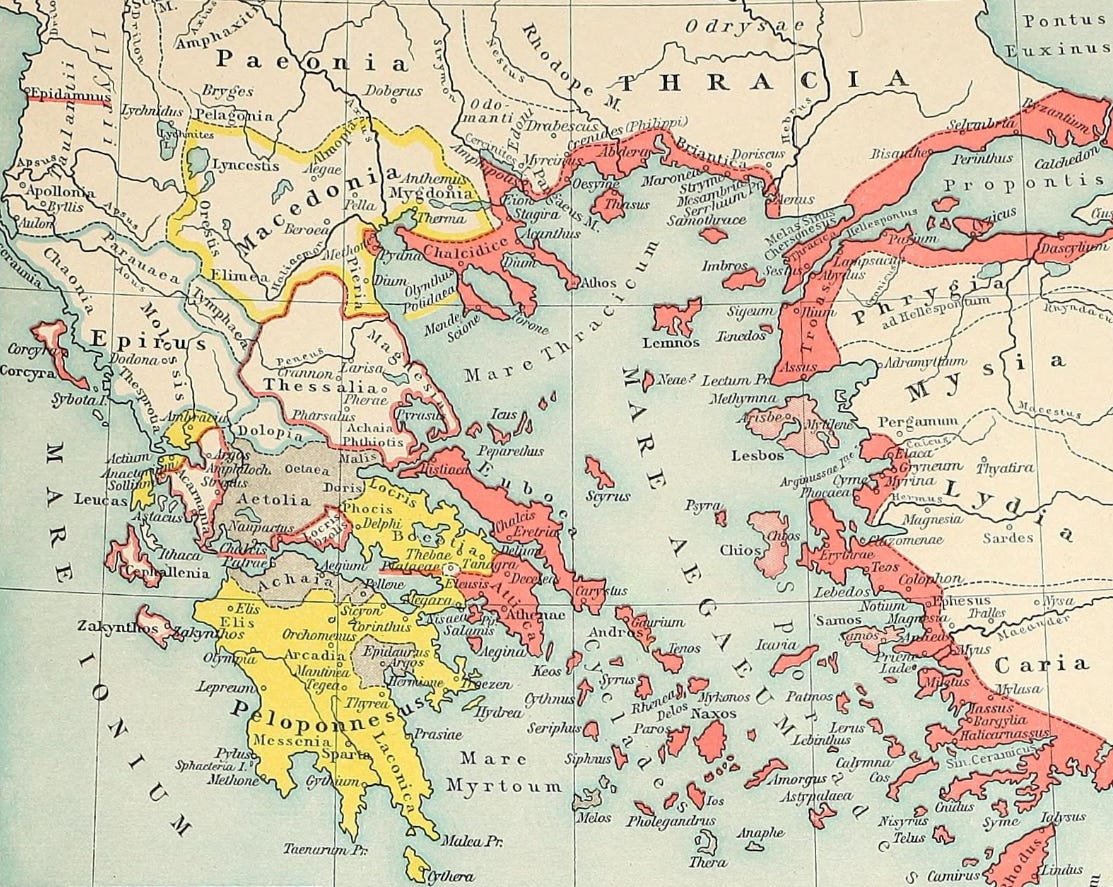
When Athenian general Thucydides wrote the History of the Peloponnesian War in the late 5th century BC – perhaps the first serious work of history in, well, history – he laid out not only a detailed account of the war between Sparta and Athens, but a theory of international relations and realpolitik that’s still in use today. Like all philosophy being a footnote to Plato, all geopolitical analysis might be a footnote to the Melian Dialogue and Pericles’s Funeral Oration.
Here, per Xi and Allison, there is an irresistible tension between rising and declining powers. Sparta, the superpower of the day, feared the seafaring Athenians. What would later become encoded in the escalatory game theory of the Cold War was already seen in the Bronze Age. Better to find accommodation and a balance of power before risking, as for the Greeks, the near collapse of a civilisation.
But Thucydides, via Pericles, also made some pointed observations about the nature of the regimes that would come into conflict. Athens, of course, was a democracy (though not in the form we’d recognise or welcome today). Sparta was a hybrid regime, but closer to what might be described as an oligarchy run by old people, a gerontocracy.
And while today’s China is the rising power, run by old men, and the United States is the hegemon – also run by old men, but still elected by the young – Thucydides would recognise not just the tensions in power between the two, but the tensions in philosophy, not to mention the anxieties, expressed by Plato, that democracies too easily turn to tyranny or ocholocracy (mob rule). And, indeed, from redistricting in the US to Starmageddon in the UK, it’s often hard to distinguish the two.
Yet just as wise statecraft may prevent a strategic Thucydides trap, might the very dynamic at play in the feralisation of today’s democracies provide a solution to a philosophical Thucydides trap – a war between systems of governance that was not only the Cold War’s leitmotif, but that of our present civilisational clash?
Like multipolarity – the world order to which we are potentially moving – the global drift of parliamentary democracy from bipartisanship to multi-partisanship might look destabilising, like the geopolitical interregnum we’re currently in, but ultimately it could be stabilising, like the multipolar Concert of Europe that underwrote the long 19th century, proving much more enduring than the bipolar order of the short US-Soviet 20th century.
Right now, a leader like Xi will look at the noise and chaos of Western democracies – whether Britain’s, dissolving from a two-party system into five or seven, or America’s, with the two parties staying in charge on the surface but fracturing within – and feel confident that his own uni-party system is the stronger, the stabler, and the better for the common wealth.
Yet, like multipolar geopolitics, multi-partisan politics can be strong, stable, and good for the average voter, not to mention the average business or investor, as well. Just look at Northern Europe, where it’s the rule, not the exception. Denmark might be in the midst of a messy multi-partisan government formation crisis right now, but such crises are routine in the centuries-old tradition of Nordic democracies.
Compromise is forced into a system where voters can pick from many flavours of government, rather than being forced to choose between two unappetising alternatives. Further, multi-party systems are more resilient to the polarisation endemic to two-party democracy. If a voter is unsatisfied with how the ultras can hijack the entire party (such as in the US primary contest system – see the Week Ahead section, below), they can always vote for someone else and still have a chance at being represented.
And while there are counterfactuals – Israel’s coalition of radicals has usurped a normally centre-right Likud-led government; Peru is a hot mess (also see below) – from the Netherlands to New Zealand, multi-party systems may look messy and incoherent, but the countries that employ them tend to be the most effectively governed as measured by economic or social performance.
And with even systems like Britain and Australia, notionally designed for two parties and first-past-the-post elections, moving to a multi-party reality, might the same soon happen for the US, particularly once Trump goes and the Republican Party faces its next existential crisis? And might it, in turn, lead to a more enduring understanding and accord with the rising Thucydidean powers of the multipolar order to which the world is now returning?